 Add to Chrome
 Add to Firefox
 Add to Edge
ShopSimulator: Evaluating and Exploring RL-Driven LLM Agent for Shopping Assistants
Jan 26, 2026
Large language model (LLM)-based agents are increasingly deployed in e-commerce shopping. To perform thorough, user-tailored product searches, agents should interpret personal preferences, engage in multi-turn dialogues, and ultimately retrieve and discriminate among highly similar products. However, existing research has yet to provide a unified simulation environment that consistently captures all of these aspects, and always focuses solely on evaluation benchmarks without training support. In this paper, we introduce ShopSimulator, a large-scale and challenging Chinese shopping environment. Leveraging ShopSimulator, we evaluate LLMs across diverse scenarios, finding that even the best-performing models achieve less than 40% full-success rate. Error analysis reveals that agents struggle with deep search and product selection in long trajectories, fail to balance the use of personalization cues, and to effectively engage with users. Further training exploration provides practical guidance for overcoming these weaknesses, with the combination of supervised fine-tuning (SFT) and reinforcement learning (RL) yielding significant performance improvements. Code and data will be released at https://github.com/ShopAgent-Team/ShopSimulator.

AMAP Agentic Planning Technical Report
Dec 31, 2025We present STAgent, an agentic large language model tailored for spatio-temporal understanding, designed to solve complex tasks such as constrained point-of-interest discovery and itinerary planning. STAgent is a specialized model capable of interacting with ten distinct tools within spatio-temporal scenarios, enabling it to explore, verify, and refine intermediate steps during complex reasoning. Notably, STAgent effectively preserves its general capabilities. We empower STAgent with these capabilities through three key contributions: (1) a stable tool environment that supports over ten domain-specific tools, enabling asynchronous rollout and training; (2) a hierarchical data curation framework that identifies high-quality data like a needle in a haystack, curating high-quality queries with a filter ratio of 1:10,000, emphasizing both diversity and difficulty; and (3) a cascaded training recipe that starts with a seed SFT stage acting as a guardian to measure query difficulty, followed by a second SFT stage fine-tuned on queries with high certainty, and an ultimate RL stage that leverages data of low certainty. Initialized with Qwen3-30B-A3B to establish a strong SFT foundation and leverage insights into sample difficulty, STAgent yields promising performance on TravelBench while maintaining its general capabilities across a wide range of general benchmarks, thereby demonstrating the effectiveness of our proposed agentic model.
Let It Flow: Agentic Crafting on Rock and Roll, Building the ROME Model within an Open Agentic Learning Ecosystem
Dec 31, 2025Agentic crafting requires LLMs to operate in real-world environments over multiple turns by taking actions, observing outcomes, and iteratively refining artifacts. Despite its importance, the open-source community lacks a principled, end-to-end ecosystem to streamline agent development. We introduce the Agentic Learning Ecosystem (ALE), a foundational infrastructure that optimizes the production pipeline for agent LLMs. ALE consists of three components: ROLL, a post-training framework for weight optimization; ROCK, a sandbox environment manager for trajectory generation; and iFlow CLI, an agent framework for efficient context engineering. We release ROME (ROME is Obviously an Agentic Model), an open-source agent grounded by ALE and trained on over one million trajectories. Our approach includes data composition protocols for synthesizing complex behaviors and a novel policy optimization algorithm, Interaction-based Policy Alignment (IPA), which assigns credit over semantic interaction chunks rather than individual tokens to improve long-horizon training stability. Empirically, we evaluate ROME within a structured setting and introduce Terminal Bench Pro, a benchmark with improved scale and contamination control. ROME demonstrates strong performance across benchmarks like SWE-bench Verified and Terminal Bench, proving the effectiveness of the ALE infrastructure.
RollArt: Scaling Agentic RL Training via Disaggregated Infrastructure
Dec 27, 2025Agentic Reinforcement Learning (RL) enables Large Language Models (LLMs) to perform autonomous decision-making and long-term planning. Unlike standard LLM post-training, agentic RL workloads are highly heterogeneous, combining compute-intensive prefill phases, bandwidth-bound decoding, and stateful, CPU-heavy environment simulations. We argue that efficient agentic RL training requires disaggregated infrastructure to leverage specialized, best-fit hardware. However, naive disaggregation introduces substantial synchronization overhead and resource underutilization due to the complex dependencies between stages. We present RollArc, a distributed system designed to maximize throughput for multi-task agentic RL on disaggregated infrastructure. RollArc is built on three core principles: (1) hardware-affinity workload mapping, which routes compute-bound and bandwidth-bound tasks to bestfit GPU devices, (2) fine-grained asynchrony, which manages execution at the trajectory level to mitigate resource bubbles, and (3) statefulness-aware computation, which offloads stateless components (e.g., reward models) to serverless infrastructure for elastic scaling. Our results demonstrate that RollArc effectively improves training throughput and achieves 1.35-2.05\(\times\) end-to-end training time reduction compared to monolithic and synchronous baselines. We also evaluate RollArc by training a hundreds-of-billions-parameter MoE model for Qoder product on an Alibaba cluster with more than 3,000 GPUs, further demonstrating RollArc scalability and robustness. The code is available at https://github.com/alibaba/ROLL.
LiveThinking: Enabling Real-Time Efficient Reasoning for AI-Powered Livestreaming via Reinforcement Learning
Oct 09, 2025
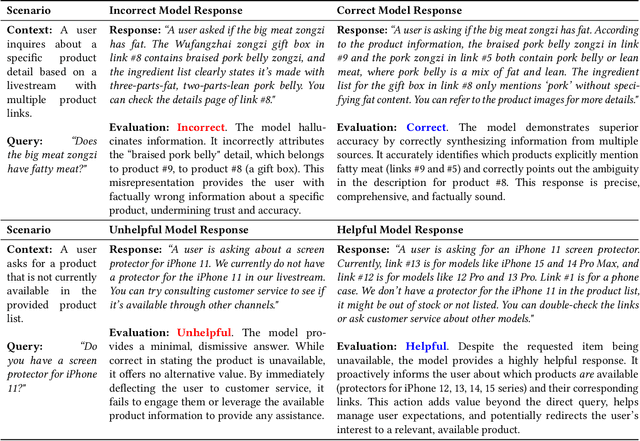
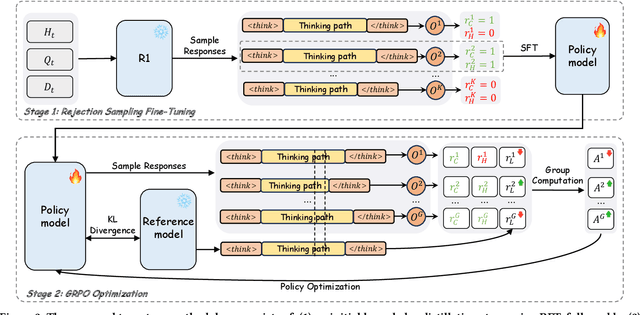
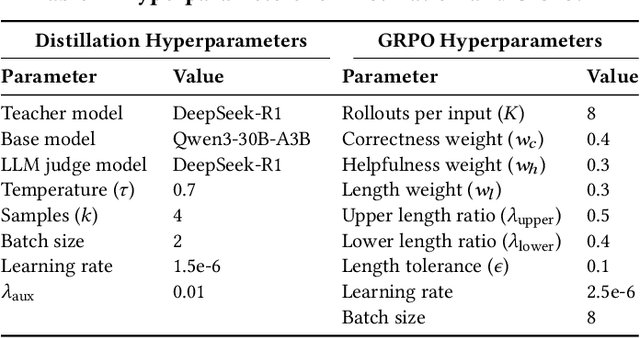
In AI-powered e-commerce livestreaming, digital avatars require real-time responses to drive engagement, a task for which high-latency Large Reasoning Models (LRMs) are ill-suited. We introduce LiveThinking, a practical two-stage optimization framework to bridge this gap. First, we address computational cost by distilling a 670B teacher LRM into a lightweight 30B Mixture-of-Experts (MoE) model (3B active) using Rejection Sampling Fine-Tuning (RFT). This reduces deployment overhead but preserves the teacher's verbose reasoning, causing latency. To solve this, our second stage employs reinforcement learning with Group Relative Policy Optimization (GRPO) to compress the model's reasoning path, guided by a multi-objective reward function balancing correctness, helpfulness, and brevity. LiveThinking achieves a 30-fold reduction in computational cost, enabling sub-second latency. In real-world application on Taobao Live, it improved response correctness by 3.3% and helpfulness by 21.8%. Tested by hundreds of thousands of viewers, our system led to a statistically significant increase in Gross Merchandise Volume (GMV), demonstrating its effectiveness in enhancing user experience and commercial performance in live, interactive settings.
Part I: Tricks or Traps? A Deep Dive into RL for LLM Reasoning
Aug 11, 2025Reinforcement learning for LLM reasoning has rapidly emerged as a prominent research area, marked by a significant surge in related studies on both algorithmic innovations and practical applications. Despite this progress, several critical challenges remain, including the absence of standardized guidelines for employing RL techniques and a fragmented understanding of their underlying mechanisms. Additionally, inconsistent experimental settings, variations in training data, and differences in model initialization have led to conflicting conclusions, obscuring the key characteristics of these techniques and creating confusion among practitioners when selecting appropriate techniques. This paper systematically reviews widely adopted RL techniques through rigorous reproductions and isolated evaluations within a unified open-source framework. We analyze the internal mechanisms, applicable scenarios, and core principles of each technique through fine-grained experiments, including datasets of varying difficulty, model sizes, and architectures. Based on these insights, we present clear guidelines for selecting RL techniques tailored to specific setups, and provide a reliable roadmap for practitioners navigating the RL for the LLM domain. Finally, we reveal that a minimalist combination of two techniques can unlock the learning capability of critic-free policies using vanilla PPO loss. The results demonstrate that our simple combination consistently improves performance, surpassing strategies like GRPO and DAPO.
Reinforcement Learning Optimization for Large-Scale Learning: An Efficient and User-Friendly Scaling Library
Jun 06, 2025We introduce ROLL, an efficient, scalable, and user-friendly library designed for Reinforcement Learning Optimization for Large-scale Learning. ROLL caters to three primary user groups: tech pioneers aiming for cost-effective, fault-tolerant large-scale training, developers requiring flexible control over training workflows, and researchers seeking agile experimentation. ROLL is built upon several key modules to serve these user groups effectively. First, a single-controller architecture combined with an abstraction of the parallel worker simplifies the development of the training pipeline. Second, the parallel strategy and data transfer modules enable efficient and scalable training. Third, the rollout scheduler offers fine-grained management of each sample's lifecycle during the rollout stage. Fourth, the environment worker and reward worker support rapid and flexible experimentation with agentic RL algorithms and reward designs. Finally, AutoDeviceMapping allows users to assign resources to different models flexibly across various stages.
Adaptive Dense Reward: Understanding the Gap Between Action and Reward Space in Alignment
Oct 23, 2024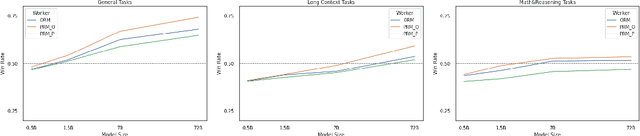
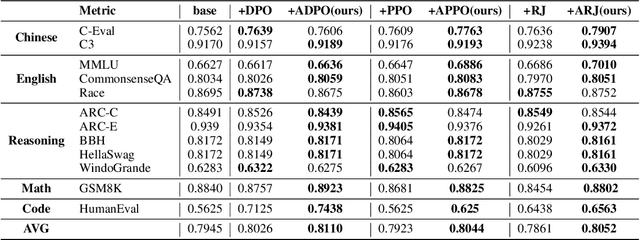
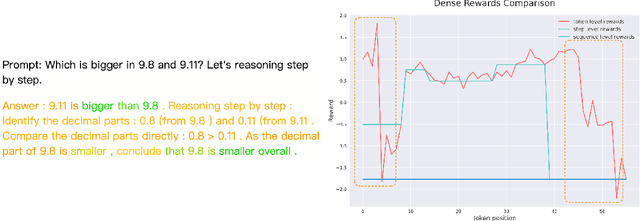
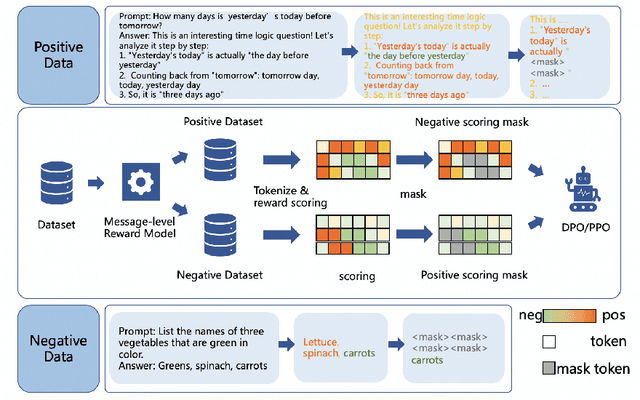
Reinforcement Learning from Human Feedback (RLHF) has proven highly effective in aligning Large Language Models (LLMs) with human preferences. However, the original RLHF typically optimizes under an overall reward, which can lead to a suboptimal learning process. This limitation stems from RLHF's lack of awareness regarding which specific tokens should be reinforced or suppressed. Moreover, conflicts in supervision can arise, for instance, when a chosen response includes erroneous tokens, while a rejected response contains accurate elements. To rectify these shortcomings, increasing dense reward methods, such as step-wise and token-wise RLHF, have been proposed. However, these existing methods are limited to specific tasks (like mathematics). In this paper, we propose the ``Adaptive Message-wise RLHF'' method, which robustly applies to various tasks. By defining pivot tokens as key indicators, our approach adaptively identifies essential information and converts sample-level supervision into fine-grained, subsequence-level supervision. This aligns the density of rewards and action spaces more closely with the information density of the input. Experiments demonstrate that our method can be integrated into various training methods, significantly mitigating hallucinations and catastrophic forgetting problems while outperforming other methods on multiple evaluation metrics. Our method improves the success rate on adversarial samples by 10\% compared to the sample-wise approach and achieves a 1.3\% improvement on evaluation benchmarks such as MMLU, GSM8K, and HumanEval et al.