 Add to Chrome
 Add to Firefox
 Add to Edge
State Rank Dynamics in Linear Attention LLMs
Feb 02, 2026
Linear Attention Large Language Models (LLMs) offer a compelling recurrent formulation that compresses context into a fixed-size state matrix, enabling constant-time inference. However, the internal dynamics of this compressed state remain largely opaque. In this work, we present a comprehensive study on the runtime state dynamics of state-of-the-art Linear Attention models. We uncover a fundamental phenomenon termed State Rank Stratification, characterized by a distinct spectral bifurcation among linear attention heads: while one group maintains an effective rank oscillating near zero, the other exhibits rapid growth that converges to an upper bound. Extensive experiments across diverse inference contexts reveal that these dynamics remain strikingly consistent, indicating that the identity of a head,whether low-rank or high-rank,is an intrinsic structural property acquired during pre-training, rather than a transient state dependent on the input data. Furthermore, our diagnostic probes reveal a surprising functional divergence: low-rank heads are indispensable for model reasoning, whereas high-rank heads exhibit significant redundancy. Leveraging this insight, we propose Joint Rank-Norm Pruning, a zero-shot strategy that achieves a 38.9\% reduction in KV-cache overhead while largely maintaining model accuracy.

From Absolute to Relative: Rethinking Reward Shaping in Group-Based Reinforcement Learning
Jan 30, 2026Reinforcement learning has become a cornerstone for enhancing the reasoning capabilities of Large Language Models, where group-based approaches such as GRPO have emerged as efficient paradigms that optimize policies by leveraging intra-group performance differences. However, these methods typically rely on absolute numerical rewards, introducing intrinsic limitations. In verifiable tasks, identical group evaluations often result in sparse supervision, while in open-ended scenarios, the score range instability of reward models undermines advantage estimation based on group means. To address these limitations, we propose Reinforcement Learning with Relative Rewards (RLRR), a framework that shifts reward shaping from absolute scoring to relative ranking. Complementing this framework, we introduce the Ranking Reward Model, a listwise preference model tailored for group-based optimization to directly generate relative rankings. By transforming raw evaluations into robust relative signals, RLRR effectively mitigates signal sparsity and reward instability. Experimental results demonstrate that RLRR yields consistent performance improvements over standard group-based baselines across reasoning benchmarks and open-ended generation tasks.
LTS-VoiceAgent: A Listen-Think-Speak Framework for Efficient Streaming Voice Interaction via Semantic Triggering and Incremental Reasoning
Jan 26, 2026Real-time voice agents face a dilemma: end-to-end models often lack deep reasoning, while cascaded pipelines incur high latency by executing ASR, LLM reasoning, and TTS strictly in sequence, unlike human conversation where listeners often start thinking before the speaker finishes. Since cascaded architectures remain the dominant choice for complex tasks, existing cascaded streaming strategies attempt to reduce this latency via mechanical segmentation (e.g., fixed chunks, VAD-based splitting) or speculative generation, but they frequently either break semantic units or waste computation on predictions that must be rolled back. To address these challenges, we propose LTS-VoiceAgent, a Listen-Think-Speak framework that explicitly separates when to think from how to reason incrementally. It features a Dynamic Semantic Trigger to detect meaningful prefixes, and a Dual-Role Stream Orchestrator that coordinates a background Thinker (for state maintenance) and a foreground Speaker (for speculative solving). This parallel design enables "thinking while speaking" without blocking responses. We also introduce a Pause-and-Repair benchmark containing natural disfluencies to stress-test streaming robustness. Experiments across VERA, Spoken-MQA, BigBenchAudio, and our benchmark show that LTS-VoiceAgent achieves a stronger accuracy-latency-efficiency trade-off than serial cascaded baselines and existing streaming strategies.
Efficient Paths and Dense Rewards: Probabilistic Flow Reasoning for Large Language Models
Jan 14, 2026High-quality chain-of-thought has demonstrated strong potential for unlocking the reasoning capabilities of large language models. However, current paradigms typically treat the reasoning process as an indivisible sequence, lacking an intrinsic mechanism to quantify step-wise information gain. This granularity gap manifests in two limitations: inference inefficiency from redundant exploration without explicit guidance, and optimization difficulty due to sparse outcome supervision or costly external verifiers. In this work, we propose CoT-Flow, a framework that reconceptualizes discrete reasoning steps as a continuous probabilistic flow, quantifying the contribution of each step toward the ground-truth answer. Built on this formulation, CoT-Flow enables two complementary methodologies: flow-guided decoding, which employs a greedy flow-based decoding strategy to extract information-efficient reasoning paths, and flow-based reinforcement learning, which constructs a verifier-free dense reward function. Experiments on challenging benchmarks demonstrate that CoT-Flow achieves a superior balance between inference efficiency and reasoning performance.
UserLM-R1: Modeling Human Reasoning in User Language Models with Multi-Reward Reinforcement Learning
Jan 14, 2026User simulators serve as the critical interactive environment for agent post-training, and an ideal user simulator generalizes across domains and proactively engages in negotiation by challenging or bargaining. However, current methods exhibit two issues. They rely on static and context-unaware profiles, necessitating extensive manual redesign for new scenarios, thus limiting generalizability. Moreover, they neglect human strategic thinking, leading to vulnerability to agent manipulation. To address these issues, we propose UserLM-R1, a novel user language model with reasoning capability. Specifically, we first construct comprehensive user profiles with both static roles and dynamic scenario-specific goals for adaptation to diverse scenarios. Then, we propose a goal-driven decision-making policy to generate high-quality rationales before producing responses, and further refine the reasoning and improve strategic capabilities with supervised fine-tuning and multi-reward reinforcement learning. Extensive experimental results demonstrate that UserLM-R1 outperforms competitive baselines, particularly on the more challenging adversarial set.
Long-term Task-oriented Agent: Proactive Long-term Intent Maintenance in Dynamic Environments
Jan 14, 2026Current large language model agents predominantly operate under a reactive paradigm, responding only to immediate user queries within short-term sessions. This limitation hinders their ability to maintain long-term user's intents and dynamically adapt to evolving external environments. In this paper, we propose a novel interaction paradigm for proactive Task-oriented Agents capable of bridging the gap between relatively static user's needs and a dynamic environment. We formalize proactivity through two key capabilities, (i) Intent-Conditioned Monitoring: The agent autonomously formulates trigger conditions based on dialog history; (ii) Event-Triggered Follow-up: The agent actively engages the user upon detecting useful environmental updates. We introduce a high-quality data synthesis pipeline to construct complex, multi-turn dialog data in a dynamic environment. Furthermore, we attempt to address the lack of evaluation criteria of task-oriented interaction in a dynamic environment by proposing a new benchmark, namely ChronosBench. We evaluated some leading close-source and open-source models at present and revealed their flaws in long-term task-oriented interaction. Furthermore, our fine-tuned model trained using synthetic data for supervised learning achieves a task completion rate of 85.19% for complex tasks including shifts in user intent, outperforming other models under test. And the result validated the effectiveness of our data-driven strategy.
GeoRA: Geometry-Aware Low-Rank Adaptation for RLVR
Jan 14, 2026Reinforcement Learning with Verifiable Rewards (RLVR) is crucial for advancing large-scale reasoning models. However, existing parameter-efficient methods, such as PiSSA and MiLoRA, are designed for Supervised Fine-Tuning (SFT) and do not account for the distinct optimization dynamics and geometric structures of RLVR. Applying these methods directly leads to spectral collapse and optimization instability, which severely limit model performance. Meanwhile, alternative approaches that leverage update sparsity encounter significant efficiency bottlenecks on modern hardware due to unstructured computations. To address these challenges, we propose GeoRA (Geometry-Aware Low-Rank Adaptation), which exploits the anisotropic and compressible nature of RL update subspaces. GeoRA initializes adapters by extracting principal directions via Singular Value Decomposition (SVD) within a geometrically constrained subspace while freezing the residual components. This method preserves the pre-trained geometric structure and enables efficient GPU computation through dense operators. Experiments on Qwen and Llama demonstrate that GeoRA mitigates optimization bottlenecks caused by geometric misalignment. It consistently outperforms established low-rank baselines on key mathematical benchmarks, achieving state-of-the-art (SOTA) results. Moreover, GeoRA shows superior generalization and resilience to catastrophic forgetting in out-of-domain tasks.
Fine-Mem: Fine-Grained Feedback Alignment for Long-Horizon Memory Management
Jan 13, 2026Effective memory management is essential for large language model agents to navigate long-horizon tasks. Recent research has explored using Reinforcement Learning to develop specialized memory manager agents. However, existing approaches rely on final task performance as the primary reward, which results in severe reward sparsity and ineffective credit assignment, providing insufficient guidance for individual memory operations. To this end, we propose Fine-Mem, a unified framework designed for fine-grained feedback alignment. First, we introduce a Chunk-level Step Reward to provide immediate step-level supervision via auxiliary chunk-specific question answering tasks. Second, we devise Evidence-Anchored Reward Attribution to redistribute global rewards by anchoring credit to key memory operations, based on the specific memory items utilized as evidence in reasoning. Together, these components enable stable policy optimization and align local memory operations with the long-term utility of memory. Experiments on Memalpha and MemoryAgentBench demonstrate that Fine-Mem consistently outperforms strong baselines, achieving superior success rates across various sub-tasks. Further analysis reveals its adaptability and strong generalization capabilities across diverse model configurations and backbones.
Silence the Judge: Reinforcement Learning with Self-Verifier via Latent Geometric Clustering
Jan 13, 2026Group Relative Policy Optimization (GRPO) significantly enhances the reasoning performance of Large Language Models (LLMs). However, this success heavily relies on expensive external verifiers or human rules. Such dependency not only leads to significant computational costs and training latency, but also yields sparse rewards that hinder optimization efficiency. To address these challenges, we propose Latent-GRPO, a framework that derives intrinsic rewards directly from latent space geometry. Crucially, our empirical analysis reveals a compelling geometric property: terminal token representations of correct reasoning trajectories form dense clusters with high intra-class similarity, whereas incorrect trajectories remain scattered as outliers. In light of this discovery, we introduce the Iterative Robust Centroid Estimation (IRCE) algorithm, which generates dense, continuous rewards by mitigating magnitude fluctuations via spherical projection and estimating a robust ``truth centroid'' through iterative aggregation. Experimental results on multiple datasets show that our method maintains model performance while achieving a training speedup of over 2x compared to baselines. Furthermore, extensive results demonstrate strong generalization ability and robustness. The code will be released soon.
Harvesting Efficient On-Demand Order Pooling from Skilled Couriers: Enhancing Graph Representation Learning for Refining Real-time Many-to-One Assignments
Jun 20, 2024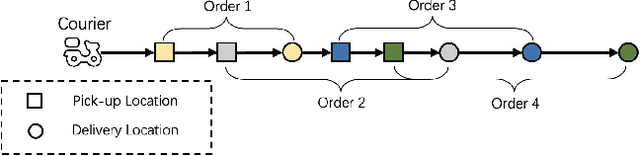
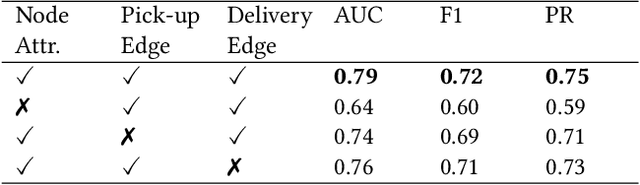
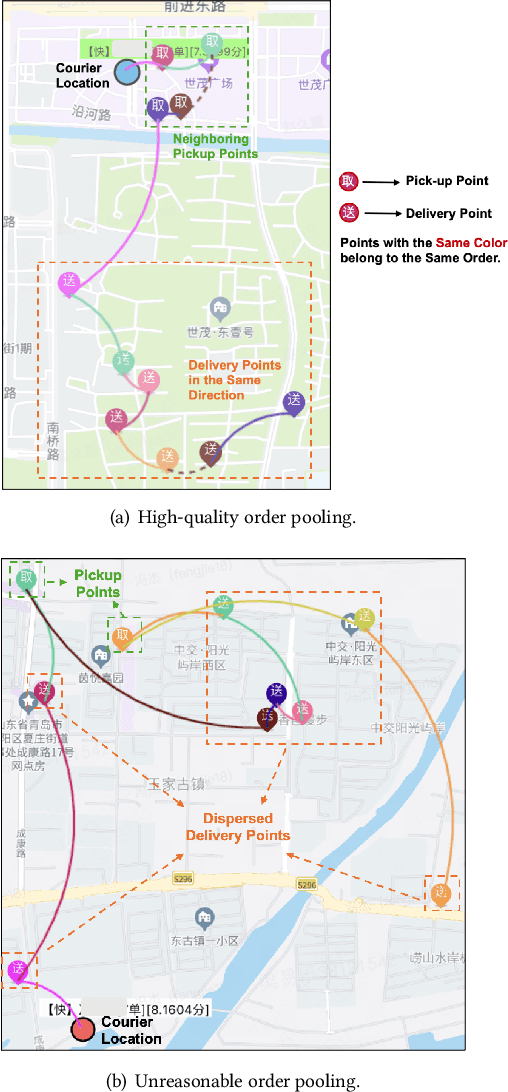
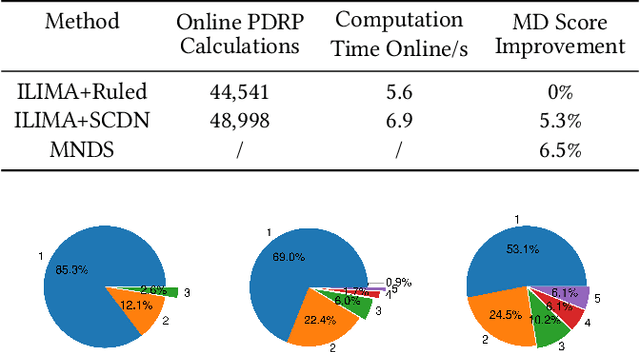
The recent past has witnessed a notable surge in on-demand food delivery (OFD) services, offering delivery fulfillment within dozens of minutes after an order is placed. In OFD, pooling multiple orders for simultaneous delivery in real-time order assignment is a pivotal efficiency source, which may in turn extend delivery time. Constructing high-quality order pooling to harmonize platform efficiency with the experiences of consumers and couriers, is crucial to OFD platforms. However, the complexity and real-time nature of order assignment, making extensive calculations impractical, significantly limit the potential for order consolidation. Moreover, offline environment is frequently riddled with unknown factors, posing challenges for the platform's perceptibility and pooling decisions. Nevertheless, delivery behaviors of skilled couriers (SCs) who know the environment well, can improve system awareness and effectively inform decisions. Hence a SC delivery network (SCDN) is constructed, based on an enhanced attributed heterogeneous network embedding approach tailored for OFD. It aims to extract features from rich temporal and spatial information, and uncover the latent potential for order combinations embedded within SC trajectories. Accordingly, the vast search space of order assignment can be effectively pruned through scalable similarity calculations of low-dimensional vectors, making comprehensive and high-quality pooling outcomes more easily identified in real time. SCDN has now been deployed in Meituan dispatch system. Online tests reveal that with SCDN, the pooling quality and extent have been greatly improved. And our system can boost couriers'efficiency by 45-55% during noon peak hours, while upholding the timely delivery commitment.