 Add to Chrome
 Add to Firefox
 Add to Edge
From Absolute to Relative: Rethinking Reward Shaping in Group-Based Reinforcement Learning
Jan 30, 2026
Reinforcement learning has become a cornerstone for enhancing the reasoning capabilities of Large Language Models, where group-based approaches such as GRPO have emerged as efficient paradigms that optimize policies by leveraging intra-group performance differences. However, these methods typically rely on absolute numerical rewards, introducing intrinsic limitations. In verifiable tasks, identical group evaluations often result in sparse supervision, while in open-ended scenarios, the score range instability of reward models undermines advantage estimation based on group means. To address these limitations, we propose Reinforcement Learning with Relative Rewards (RLRR), a framework that shifts reward shaping from absolute scoring to relative ranking. Complementing this framework, we introduce the Ranking Reward Model, a listwise preference model tailored for group-based optimization to directly generate relative rankings. By transforming raw evaluations into robust relative signals, RLRR effectively mitigates signal sparsity and reward instability. Experimental results demonstrate that RLRR yields consistent performance improvements over standard group-based baselines across reasoning benchmarks and open-ended generation tasks.

Mini-Ensemble Low-Rank Adapters for Parameter-Efficient Fine-Tuning
Feb 27, 2024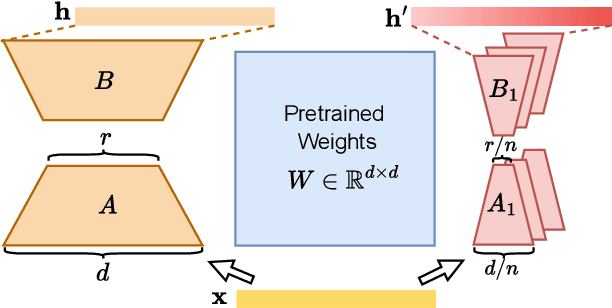
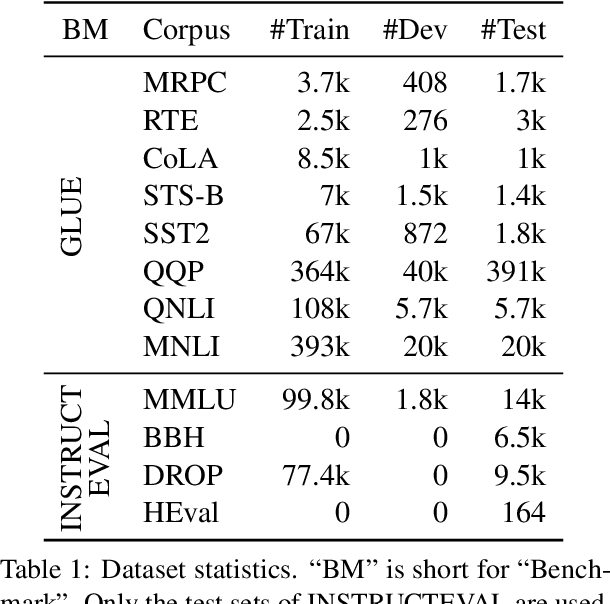
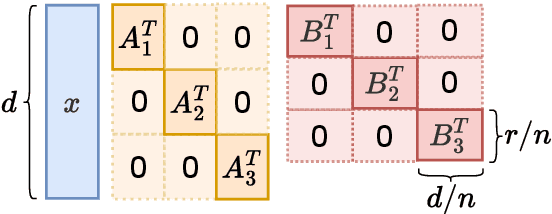
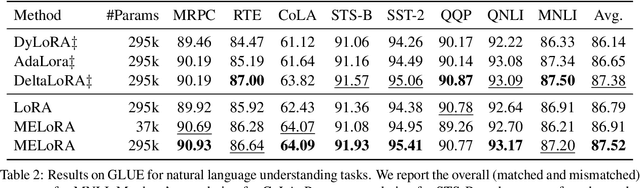
Parameter-efficient fine-tuning (PEFT) is a popular method for tailoring pre-trained large language models (LLMs), especially as the models' scale and the diversity of tasks increase. Low-rank adaptation (LoRA) is based on the idea that the adaptation process is intrinsically low-dimensional, i.e., significant model changes can be represented with relatively few parameters. However, decreasing the rank encounters challenges with generalization errors for specific tasks when compared to full-parameter fine-tuning. We present MELoRA, a mini-ensemble low-rank adapters that uses fewer trainable parameters while maintaining a higher rank, thereby offering improved performance potential. The core idea is to freeze original pretrained weights and train a group of mini LoRAs with only a small number of parameters. This can capture a significant degree of diversity among mini LoRAs, thus promoting better generalization ability. We conduct a theoretical analysis and empirical studies on various NLP tasks. Our experimental results show that, compared to LoRA, MELoRA achieves better performance with 8 times fewer trainable parameters on natural language understanding tasks and 36 times fewer trainable parameters on instruction following tasks, which demonstrates the effectiveness of MELoRA.