 Add to Chrome
 Add to Firefox
 Add to Edge
From Absolute to Relative: Rethinking Reward Shaping in Group-Based Reinforcement Learning
Jan 30, 2026
Reinforcement learning has become a cornerstone for enhancing the reasoning capabilities of Large Language Models, where group-based approaches such as GRPO have emerged as efficient paradigms that optimize policies by leveraging intra-group performance differences. However, these methods typically rely on absolute numerical rewards, introducing intrinsic limitations. In verifiable tasks, identical group evaluations often result in sparse supervision, while in open-ended scenarios, the score range instability of reward models undermines advantage estimation based on group means. To address these limitations, we propose Reinforcement Learning with Relative Rewards (RLRR), a framework that shifts reward shaping from absolute scoring to relative ranking. Complementing this framework, we introduce the Ranking Reward Model, a listwise preference model tailored for group-based optimization to directly generate relative rankings. By transforming raw evaluations into robust relative signals, RLRR effectively mitigates signal sparsity and reward instability. Experimental results demonstrate that RLRR yields consistent performance improvements over standard group-based baselines across reasoning benchmarks and open-ended generation tasks.

Dynamic Collaboration of Multi-Language Models based on Minimal Complete Semantic Units
Aug 26, 2025This paper investigates the enhancement of reasoning capabilities in language models through token-level multi-model collaboration. Our approach selects the optimal tokens from the next token distributions provided by multiple models to perform autoregressive reasoning. Contrary to the assumption that more models yield better results, we introduce a distribution distance-based dynamic selection strategy (DDS) to optimize the multi-model collaboration process. To address the critical challenge of vocabulary misalignment in multi-model collaboration, we propose the concept of minimal complete semantic units (MCSU), which is simple yet enables multiple language models to achieve natural alignment within the linguistic space. Experimental results across various benchmarks demonstrate the superiority of our method. The code will be available at https://github.com/Fanye12/DDS.
Adapting LLMs to Time Series Forecasting via Temporal Heterogeneity Modeling and Semantic Alignment
Aug 10, 2025Large Language Models (LLMs) have recently demonstrated impressive capabilities in natural language processing due to their strong generalization and sequence modeling capabilities. However, their direct application to time series forecasting remains challenging due to two fundamental issues: the inherent heterogeneity of temporal patterns and the modality gap between continuous numerical signals and discrete language representations. In this work, we propose TALON, a unified framework that enhances LLM-based forecasting by modeling temporal heterogeneity and enforcing semantic alignment. Specifically, we design a Heterogeneous Temporal Encoder that partitions multivariate time series into structurally coherent segments, enabling localized expert modeling across diverse temporal patterns. To bridge the modality gap, we introduce a Semantic Alignment Module that aligns temporal features with LLM-compatible representations, enabling effective integration of time series into language-based models while eliminating the need for handcrafted prompts during inference. Extensive experiments on seven real-world benchmarks demonstrate that TALON achieves superior performance across all datasets, with average MSE improvements of up to 11\% over recent state-of-the-art methods. These results underscore the effectiveness of incorporating both pattern-aware and semantic-aware designs when adapting LLMs for time series forecasting. The code is available at: https://github.com/syrGitHub/TALON.
LangTime: A Language-Guided Unified Model for Time Series Forecasting with Proximal Policy Optimization
Mar 11, 2025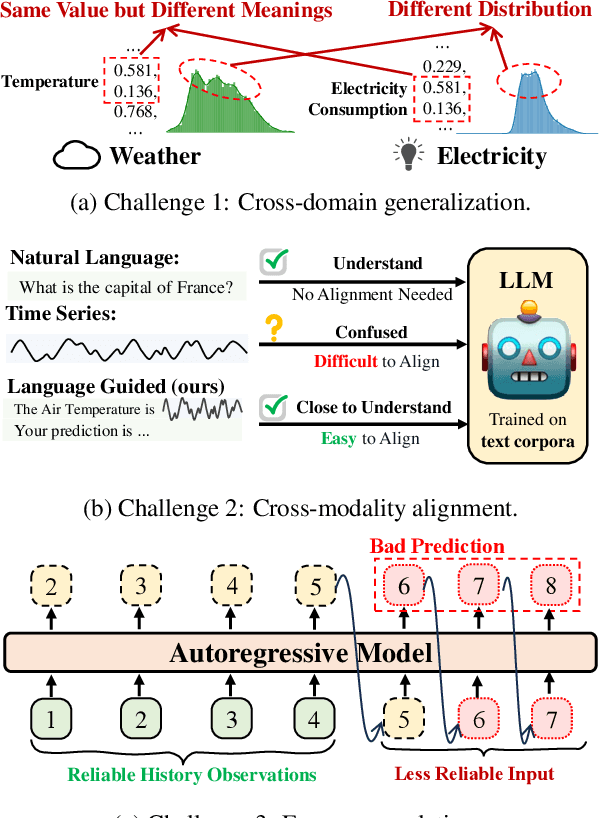
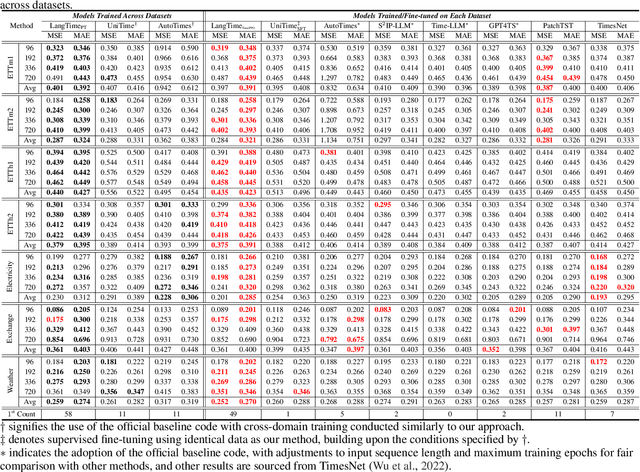
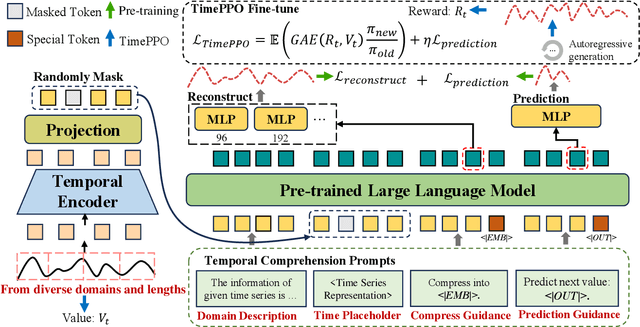
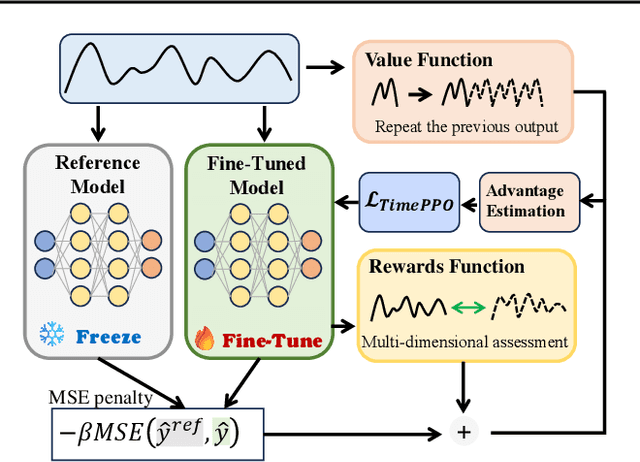
Recent research has shown an increasing interest in utilizing pre-trained large language models (LLMs) for a variety of time series applications. However, there are three main challenges when using LLMs as foundational models for time series forecasting: (1) Cross-domain generalization. (2) Cross-modality alignment. (3) Error accumulation in autoregressive frameworks. To address these challenges, we proposed LangTime, a language-guided unified model for time series forecasting that incorporates cross-domain pre-training with reinforcement learning-based fine-tuning. Specifically, LangTime constructs Temporal Comprehension Prompts (TCPs), which include dataset-wise and channel-wise instructions, to facilitate domain adaptation and condense time series into a single token, enabling LLMs to understand better and align temporal data. To improve autoregressive forecasting, we introduce TimePPO, a reinforcement learning-based fine-tuning algorithm. TimePPO mitigates error accumulation by leveraging a multidimensional rewards function tailored for time series and a repeat-based value estimation strategy. Extensive experiments demonstrate that LangTime achieves state-of-the-art cross-domain forecasting performance, while TimePPO fine-tuning effectively enhances the stability and accuracy of autoregressive forecasting.