 Add to Chrome
 Add to Firefox
 Add to Edge
Silence the Judge: Reinforcement Learning with Self-Verifier via Latent Geometric Clustering
Jan 13, 2026
Group Relative Policy Optimization (GRPO) significantly enhances the reasoning performance of Large Language Models (LLMs). However, this success heavily relies on expensive external verifiers or human rules. Such dependency not only leads to significant computational costs and training latency, but also yields sparse rewards that hinder optimization efficiency. To address these challenges, we propose Latent-GRPO, a framework that derives intrinsic rewards directly from latent space geometry. Crucially, our empirical analysis reveals a compelling geometric property: terminal token representations of correct reasoning trajectories form dense clusters with high intra-class similarity, whereas incorrect trajectories remain scattered as outliers. In light of this discovery, we introduce the Iterative Robust Centroid Estimation (IRCE) algorithm, which generates dense, continuous rewards by mitigating magnitude fluctuations via spherical projection and estimating a robust ``truth centroid'' through iterative aggregation. Experimental results on multiple datasets show that our method maintains model performance while achieving a training speedup of over 2x compared to baselines. Furthermore, extensive results demonstrate strong generalization ability and robustness. The code will be released soon.

VaseVQA-3D: Benchmarking 3D VLMs on Ancient Greek Pottery
Oct 06, 2025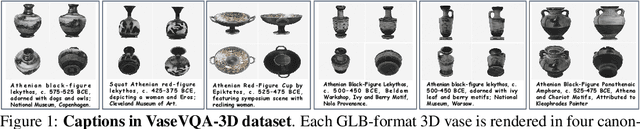
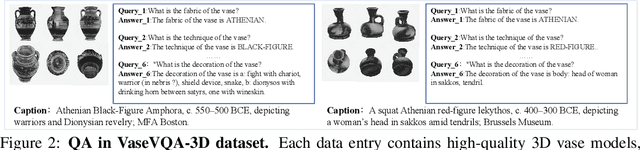
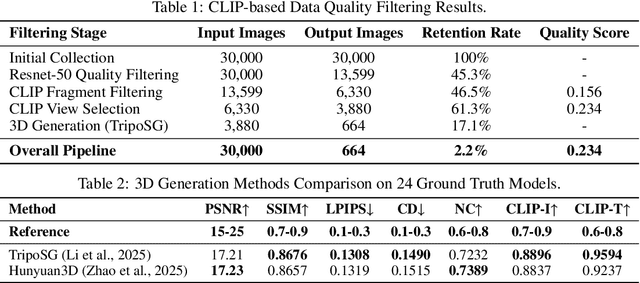
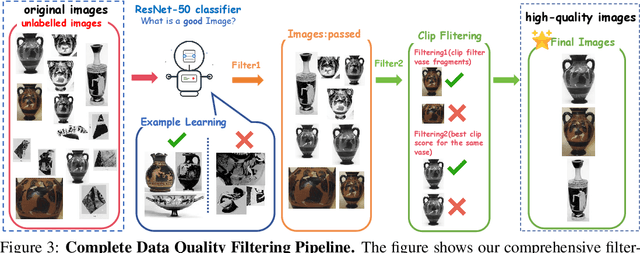
Vision-Language Models (VLMs) have achieved significant progress in multimodal understanding tasks, demonstrating strong capabilities particularly in general tasks such as image captioning and visual reasoning. However, when dealing with specialized cultural heritage domains like 3D vase artifacts, existing models face severe data scarcity issues and insufficient domain knowledge limitations. Due to the lack of targeted training data, current VLMs struggle to effectively handle such culturally significant specialized tasks. To address these challenges, we propose the VaseVQA-3D dataset, which serves as the first 3D visual question answering dataset for ancient Greek pottery analysis, collecting 664 ancient Greek vase 3D models with corresponding question-answer data and establishing a complete data construction pipeline. We further develop the VaseVLM model, enhancing model performance in vase artifact analysis through domain-adaptive training. Experimental results validate the effectiveness of our approach, where we improve by 12.8% on R@1 metrics and by 6.6% on lexical similarity compared with previous state-of-the-art on the VaseVQA-3D dataset, significantly improving the recognition and understanding of 3D vase artifacts, providing new technical pathways for digital heritage preservation research.
Text-to-Image Synthesis: A Decade Survey
Nov 25, 2024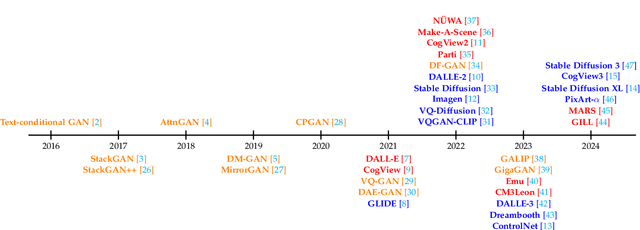
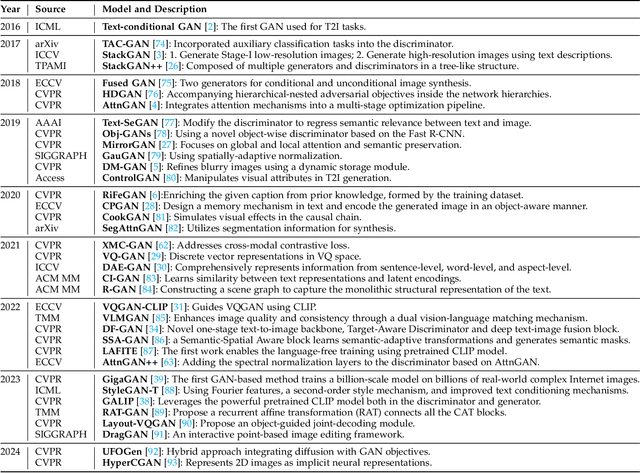
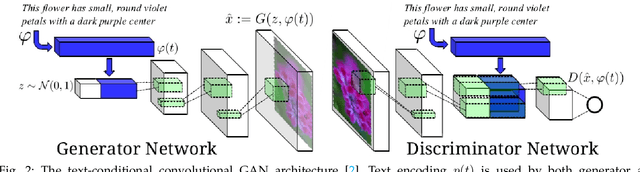
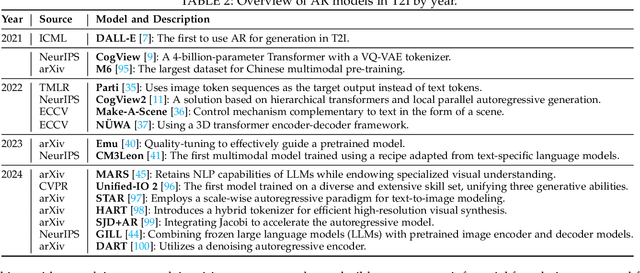
When humans read a specific text, they often visualize the corresponding images, and we hope that computers can do the same. Text-to-image synthesis (T2I), which focuses on generating high-quality images from textual descriptions, has become a significant aspect of Artificial Intelligence Generated Content (AIGC) and a transformative direction in artificial intelligence research. Foundation models play a crucial role in T2I. In this survey, we review over 440 recent works on T2I. We start by briefly introducing how GANs, autoregressive models, and diffusion models have been used for image generation. Building on this foundation, we discuss the development of these models for T2I, focusing on their generative capabilities and diversity when conditioned on text. We also explore cutting-edge research on various aspects of T2I, including performance, controllability, personalized generation, safety concerns, and consistency in content and spatial relationships. Furthermore, we summarize the datasets and evaluation metrics commonly used in T2I research. Finally, we discuss the potential applications of T2I within AIGC, along with the challenges and future research opportunities in this field.