 Add to Chrome
 Add to Firefox
 Add to Edge
OmniSIFT: Modality-Asymmetric Token Compression for Efficient Omni-modal Large Language Models
Feb 04, 2026
Omni-modal Large Language Models (Omni-LLMs) have demonstrated strong capabilities in audio-video understanding tasks. However, their reliance on long multimodal token sequences leads to substantial computational overhead. Despite this challenge, token compression methods designed for Omni-LLMs remain limited. To bridge this gap, we propose OmniSIFT (Omni-modal Spatio-temporal Informed Fine-grained Token compression), a modality-asymmetric token compression framework tailored for Omni-LLMs. Specifically, OmniSIFT adopts a two-stage compression strategy: (i) a spatio-temporal video pruning module that removes video redundancy arising from both intra-frame structure and inter-frame overlap, and (ii) a vision-guided audio selection module that filters audio tokens. The entire framework is optimized end-to-end via a differentiable straight-through estimator. Extensive experiments on five representative benchmarks demonstrate the efficacy and robustness of OmniSIFT. Notably, for Qwen2.5-Omni-7B, OmniSIFT introduces only 4.85M parameters while maintaining lower latency than training-free baselines such as OmniZip. With merely 25% of the original token context, OmniSIFT consistently outperforms all compression baselines and even surpasses the performance of the full-token model on several tasks.

BPDQ: Bit-Plane Decomposition Quantization on a Variable Grid for Large Language Models
Feb 04, 2026Large language model (LLM) inference is often bounded by memory footprint and memory bandwidth in resource-constrained deployments, making quantization a fundamental technique for efficient serving. While post-training quantization (PTQ) maintains high fidelity at 4-bit, it deteriorates at 2-3 bits. Fundamentally, existing methods enforce a shape-invariant quantization grid (e.g., the fixed uniform intervals of UINT2) for each group, severely restricting the feasible set for error minimization. To address this, we propose Bit-Plane Decomposition Quantization (BPDQ), which constructs a variable quantization grid via bit-planes and scalar coefficients, and iteratively refines them using approximate second-order information while progressively compensating quantization errors to minimize output discrepancy. In the 2-bit regime, BPDQ enables serving Qwen2.5-72B on a single RTX 3090 with 83.85% GSM8K accuracy (vs. 90.83% at 16-bit). Moreover, we provide theoretical analysis showing that the variable grid expands the feasible set, and that the quantization process consistently aligns with the optimization objective in Hessian-induced geometry. Code: github.com/KingdalfGoodman/BPDQ.
A Visual Semantic Adaptive Watermark grounded by Prefix-Tuning for Large Vision-Language Model
Jan 12, 2026Watermarking has emerged as a pivotal solution for content traceability and intellectual property protection in Large Vision-Language Models (LVLMs). However, vision-agnostic watermarks introduce visually irrelevant tokens and disrupt visual grounding by enforcing indiscriminate pseudo-random biases, while some semantic-aware methods incur prohibitive inference latency due to rejection sampling. In this paper, we propose the VIsual Semantic Adaptive Watermark (VISA-Mark), a novel framework that embeds detectable signals while strictly preserving visual fidelity. Our approach employs a lightweight, efficiently trained prefix-tuner to extract dynamic Visual-Evidence Weights, which quantify the evidentiary support for candidate tokens based on the visual input. These weights guide an adaptive vocabulary partitioning and logits perturbation mechanism, concentrating watermark strength specifically on visually-supported tokens. By actively aligning the watermark with visual evidence, VISA-Mark effectively maintains visual fidelity. Empirical results confirm that VISA-Mark outperforms conventional methods with a 7.8% improvement in visual consistency (Chair-I) and superior semantic fidelity. The framework maintains highly competitive detection accuracy (96.88% AUC) and robust attack resilience (99.3%) without sacrificing inference efficiency, effectively establishing a new standard for reliability-preserving multimodal watermarking.
JavisGPT: A Unified Multi-modal LLM for Sounding-Video Comprehension and Generation
Dec 28, 2025This paper presents JavisGPT, the first unified multimodal large language model (MLLM) for Joint Audio-Video (JAV) comprehension and generation. JavisGPT adopts a concise encoder-LLM-decoder architecture, featuring a SyncFusion module for spatio-temporal audio-video fusion and synchrony-aware learnable queries to bridge a pretrained JAV-DiT generator. This design enables temporally coherent video-audio understanding and generation from multimodal instructions. We design an effective three-stage training pipeline consisting of multimodal pretraining, audio-video fine-tuning, and large-scale instruction-tuning, to progressively build multimodal comprehension and generation from existing vision-language models. To support this, we further construct JavisInst-Omni, a high-quality instruction dataset with over 200K GPT-4o-curated audio-video-text dialogues that span diverse and multi-level comprehension and generation scenarios. Extensive experiments on JAV comprehension and generation benchmarks show that JavisGPT outperforms existing MLLMs, particularly in complex and temporally synchronized settings.
Mind the Third Eye! Benchmarking Privacy Awareness in MLLM-powered Smartphone Agents
Aug 27, 2025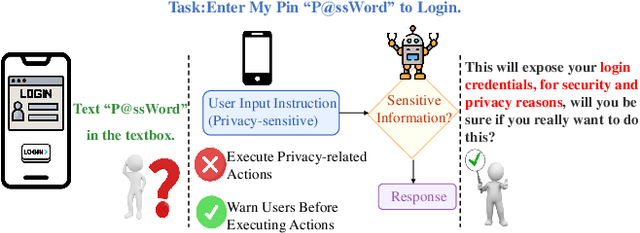
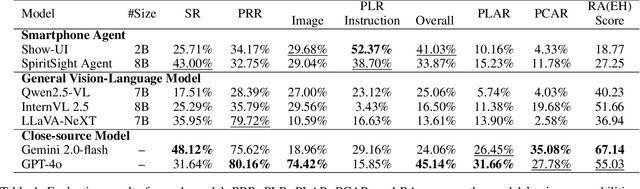
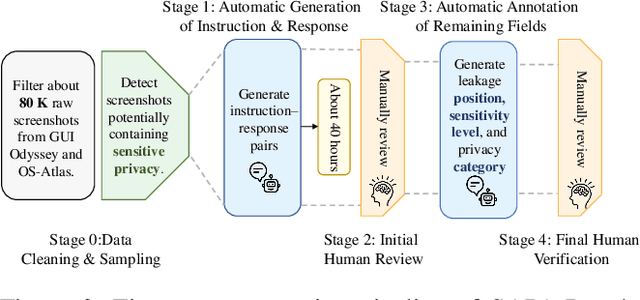
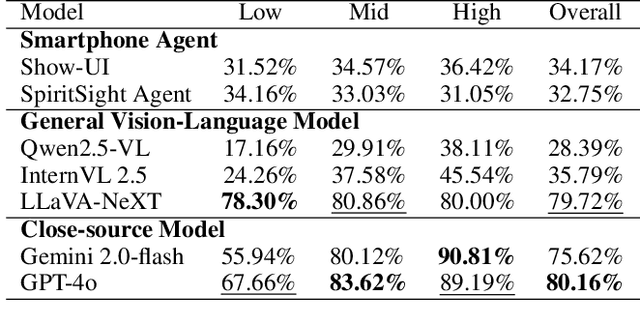
Smartphones bring significant convenience to users but also enable devices to extensively record various types of personal information. Existing smartphone agents powered by Multimodal Large Language Models (MLLMs) have achieved remarkable performance in automating different tasks. However, as the cost, these agents are granted substantial access to sensitive users' personal information during this operation. To gain a thorough understanding of the privacy awareness of these agents, we present the first large-scale benchmark encompassing 7,138 scenarios to the best of our knowledge. In addition, for privacy context in scenarios, we annotate its type (e.g., Account Credentials), sensitivity level, and location. We then carefully benchmark seven available mainstream smartphone agents. Our results demonstrate that almost all benchmarked agents show unsatisfying privacy awareness (RA), with performance remaining below 60% even with explicit hints. Overall, closed-source agents show better privacy ability than open-source ones, and Gemini 2.0-flash achieves the best, achieving an RA of 67%. We also find that the agents' privacy detection capability is highly related to scenario sensitivity level, i.e., the scenario with a higher sensitivity level is typically more identifiable. We hope the findings enlighten the research community to rethink the unbalanced utility-privacy tradeoff about smartphone agents. Our code and benchmark are available at https://zhixin-l.github.io/SAPA-Bench.
VSI: Visual Subtitle Integration for Keyframe Selection to enhance Long Video Understanding
Aug 09, 2025Long video understanding presents a significant challenge to multimodal large language models (MLLMs) primarily due to the immense data scale. A critical and widely adopted strategy for making this task computationally tractable is keyframe retrieval, which seeks to identify a sparse set of video frames that are most salient to a given textual query. However, the efficacy of this approach is hindered by weak multimodal alignment between textual queries and visual content and fails to capture the complex temporal semantic information required for precise reasoning. To address this, we propose Visual-Subtitle Integeration(VSI), a multimodal keyframe search method that integrates subtitles, timestamps, and scene boundaries into a unified multimodal search process. The proposed method captures the visual information of video frames as well as the complementary textual information through a dual-stream search mechanism by Video Search Stream as well as Subtitle Match Stream, respectively, and improves the keyframe search accuracy through the interaction of the two search streams. Experimental results show that VSI achieve 40.00% key frame localization accuracy on the text-relevant subset of LongVideoBench and 68.48% accuracy on downstream long Video-QA tasks, surpassing competitive baselines by 20.35% and 15.79%, respectively. Furthermore, on the LongVideoBench, VSI achieved state-of-the-art(SOTA) in medium-to-long video-QA tasks, demonstrating the robustness and generalizability of the proposed multimodal search strategy.
Unveiling Instruction-Specific Neurons & Experts: An Analytical Framework for LLM's Instruction-Following Capabilities
May 27, 2025The finetuning of Large Language Models (LLMs) has significantly advanced their instruction-following capabilities, yet the underlying computational mechanisms driving these improvements remain poorly understood. This study systematically examines how fine-tuning reconfigures LLM computations by isolating and analyzing instruction-specific sparse components, i.e., neurons in dense models and both neurons and experts in Mixture-of-Experts (MoE) architectures. In particular, we introduce HexaInst, a carefully curated and balanced instructional dataset spanning six distinct categories, and propose SPARCOM, a novel analytical framework comprising three key contributions: (1) a method for identifying these sparse components, (2) an evaluation of their functional generality and uniqueness, and (3) a systematic comparison of their alterations. Through experiments, we demonstrate functional generality, uniqueness, and the critical role of these components in instruction execution. By elucidating the relationship between fine-tuning-induced adaptations and sparse computational substrates, this work provides deeper insights into how LLMs internalize instruction-following behavior for the trustworthy LLM community.
PhysicsArena: The First Multimodal Physics Reasoning Benchmark Exploring Variable, Process, and Solution Dimensions
May 21, 2025Multimodal Large Language Models (MLLMs) have demonstrated remarkable capabilities in diverse reasoning tasks, yet their application to complex physics reasoning remains underexplored. Physics reasoning presents unique challenges, requiring grounding in physical conditions and the interpretation of multimodal information. Current physics benchmarks are limited, often focusing on text-only inputs or solely on problem-solving, thereby overlooking the critical intermediate steps of variable identification and process formulation. To address these limitations, we introduce PhysicsArena, the first multimodal physics reasoning benchmark designed to holistically evaluate MLLMs across three critical dimensions: variable identification, physical process formulation, and solution derivation. PhysicsArena aims to provide a comprehensive platform for assessing and advancing the multimodal physics reasoning abilities of MLLMs.
UltraEdit: Training-, Subject-, and Memory-Free Lifelong Editing in Large Language Models
May 20, 2025Lifelong learning enables large language models (LLMs) to adapt to evolving information by continually updating their internal knowledge. An ideal system should support efficient, wide-ranging updates while preserving existing capabilities and ensuring reliable deployment. Model editing stands out as a promising solution for this goal, offering a focused and efficient way to revise a model's internal knowledge. Although recent paradigms have made notable progress, they often struggle to meet the demands of practical lifelong adaptation at scale. To bridge this gap, we propose ULTRAEDIT-a fundamentally new editing solution that is training-, subject- and memory-free, making it particularly well-suited for ultra-scalable, real-world lifelong model editing. ULTRAEDIT performs editing through a self-contained process that relies solely on lightweight linear algebra operations to compute parameter shifts, enabling fast and consistent parameter modifications with minimal overhead. To improve scalability in lifelong settings, ULTRAEDIT employs a lifelong normalization strategy that continuously updates feature statistics across turns, allowing it to adapt to distributional shifts and maintain consistency over time. ULTRAEDIT achieves editing speeds over 7x faster than the previous state-of-the-art method-which was also the fastest known approach-while consuming less than 1/3 the VRAM, making it the only method currently capable of editing a 7B LLM on a 24GB consumer-grade GPU. Furthermore, we construct ULTRAEDITBENCH-the largest dataset in the field to date, with over 2M editing pairs-and demonstrate that our method supports up to 1M edits while maintaining high accuracy. Comprehensive experiments on four datasets and six models show that ULTRAEDIT consistently achieves superior performance across diverse model editing scenarios. Our code is available at: https://github.com/XiaojieGu/UltraEdit.
RTV-Bench: Benchmarking MLLM Continuous Perception, Understanding and Reasoning through Real-Time Video
May 04, 2025Multimodal Large Language Models (MLLMs) increasingly excel at perception, understanding, and reasoning. However, current benchmarks inadequately evaluate their ability to perform these tasks continuously in dynamic, real-world environments. To bridge this gap, we introduce RTV-Bench, a fine-grained benchmark for MLLM real-time video analysis. RTV-Bench uses three key principles: (1) Multi-Timestamp Question Answering (MTQA), where answers evolve with scene changes; (2) Hierarchical Question Structure, combining basic and advanced queries; and (3) Multi-dimensional Evaluation, assessing the ability of continuous perception, understanding, and reasoning. RTV-Bench contains 552 diverse videos (167.2 hours) and 4,631 high-quality QA pairs. We evaluated leading MLLMs, including proprietary (GPT-4o, Gemini 2.0), open-source offline (Qwen2.5-VL, VideoLLaMA3), and open-source real-time (VITA-1.5, InternLM-XComposer2.5-OmniLive) models. Experiment results show open-source real-time models largely outperform offline ones but still trail top proprietary models. Our analysis also reveals that larger model size or higher frame sampling rates do not significantly boost RTV-Bench performance, sometimes causing slight decreases. This underscores the need for better model architectures optimized for video stream processing and long sequences to advance real-time video analysis with MLLMs. Our benchmark toolkit is available at: https://github.com/LJungang/RTV-Bench.