 Add to Chrome
 Add to Firefox
 Add to Edge
ERNIE 5.0 Technical Report
Feb 04, 2026
In this report, we introduce ERNIE 5.0, a natively autoregressive foundation model desinged for unified multimodal understanding and generation across text, image, video, and audio. All modalities are trained from scratch under a unified next-group-of-tokens prediction objective, based on an ultra-sparse mixture-of-experts (MoE) architecture with modality-agnostic expert routing. To address practical challenges in large-scale deployment under diverse resource constraints, ERNIE 5.0 adopts a novel elastic training paradigm. Within a single pre-training run, the model learns a family of sub-models with varying depths, expert capacities, and routing sparsity, enabling flexible trade-offs among performance, model size, and inference latency in memory- or time-constrained scenarios. Moreover, we systematically address the challenges of scaling reinforcement learning to unified foundation models, thereby guaranteeing efficient and stable post-training under ultra-sparse MoE architectures and diverse multimodal settings. Extensive experiments demonstrate that ERNIE 5.0 achieves strong and balanced performance across multiple modalities. To the best of our knowledge, among publicly disclosed models, ERNIE 5.0 represents the first production-scale realization of a trillion-parameter unified autoregressive model that supports both multimodal understanding and generation. To facilitate further research, we present detailed visualizations of modality-agnostic expert routing in the unified model, alongside comprehensive empirical analysis of elastic training, aiming to offer profound insights to the community.

MEnvAgent: Scalable Polyglot Environment Construction for Verifiable Software Engineering
Jan 30, 2026The evolution of Large Language Model (LLM) agents for software engineering (SWE) is constrained by the scarcity of verifiable datasets, a bottleneck stemming from the complexity of constructing executable environments across diverse languages. To address this, we introduce MEnvAgent, a Multi-language framework for automated Environment construction that facilitates scalable generation of verifiable task instances. MEnvAgent employs a multi-agent Planning-Execution-Verification architecture to autonomously resolve construction failures and integrates a novel Environment Reuse Mechanism that reduces computational overhead by incrementally patching historical environments. Evaluations on MEnvBench, a new benchmark comprising 1,000 tasks across 10 languages, demonstrate that MEnvAgent outperforms baselines, improving Fail-to-Pass (F2P) rates by 8.6% while reducing time costs by 43%. Additionally, we demonstrate the utility of MEnvAgent by constructing MEnvData-SWE, the largest open-source polyglot dataset of realistic verifiable Docker environments to date, alongside solution trajectories that enable consistent performance gains on SWE tasks across a wide range of models. Our code, benchmark, and dataset are available at https://github.com/ernie-research/MEnvAgent.
Distributional Clarity: The Hidden Driver of RL-Friendliness in Large Language Models
Jan 11, 2026Language model families exhibit striking disparity in their capacity to benefit from reinforcement learning: under identical training, models like Qwen achieve substantial gains, while others like Llama yield limited improvements. Complementing data-centric approaches, we reveal that this disparity reflects a hidden structural property: \textbf{distributional clarity} in probability space. Through a three-stage analysis-from phenomenon to mechanism to interpretation-we uncover that RL-friendly models exhibit intra-class compactness and inter-class separation in their probability assignments to correct vs. incorrect responses. We quantify this clarity using the \textbf{Silhouette Coefficient} ($S$) and demonstrate that (1) high $S$ correlates strongly with RL performance; (2) low $S$ is associated with severe logic errors and reasoning instability. To confirm this property, we introduce a Silhouette-Aware Reweighting strategy that prioritizes low-$S$ samples during training. Experiments across six mathematical benchmarks show consistent improvements across all model families, with gains up to 5.9 points on AIME24. Our work establishes distributional clarity as a fundamental, trainable property underlying RL-Friendliness.
InfoFlow: Reinforcing Search Agent Via Reward Density Optimization
Oct 30, 2025Reinforcement Learning with Verifiable Rewards (RLVR) is a promising approach for enhancing agentic deep search. However, its application is often hindered by low \textbf{Reward Density} in deep search scenarios, where agents expend significant exploratory costs for infrequent and often null final rewards. In this paper, we formalize this challenge as the \textbf{Reward Density Optimization} problem, which aims to improve the reward obtained per unit of exploration cost. This paper introduce \textbf{InfoFlow}, a systematic framework that tackles this problem from three aspects. 1) \textbf{Subproblem decomposition}: breaking down long-range tasks to assign process rewards, thereby providing denser learning signals. 2) \textbf{Failure-guided hints}: injecting corrective guidance into stalled trajectories to increase the probability of successful outcomes. 3) \textbf{Dual-agent refinement}: employing a dual-agent architecture to offload the cognitive burden of deep exploration. A refiner agent synthesizes the search history, which effectively compresses the researcher's perceived trajectory, thereby reducing exploration cost and increasing the overall reward density. We evaluate InfoFlow on multiple agentic search benchmarks, where it significantly outperforms strong baselines, enabling lightweight LLMs to achieve performance comparable to advanced proprietary LLMs.
From Rankings to Insights: Evaluation Should Shift Focus from Leaderboard to Feedback
May 10, 2025Automatic evaluation benchmarks such as MT-Bench, Arena-Hard, and Auto-Arena are seeing growing adoption for the evaluation of Large Language Models (LLMs). Existing research has primarily focused on approximating human-based model rankings using limited data and LLM-as-a-Judge. However, the fundamental premise of these studies, which attempts to replicate human rankings, is flawed. Specifically, these benchmarks typically offer only overall scores, limiting their utility to leaderboard rankings, rather than providing feedback that can guide model optimization and support model profiling. Therefore, we advocate for an evaluation paradigm shift from approximating human-based model rankings to providing feedback with analytical value. To this end, we introduce Feedbacker, an evaluation framework that provides comprehensive and fine-grained results, thereby enabling thorough identification of a model's specific strengths and weaknesses. Such feedback not only supports the targeted optimization of the model but also enhances the understanding of its behavior. Feedbacker comprises three key components: an extensible tree-based query taxonomy builder, an automated query synthesis scheme, and a suite of visualization and analysis tools. Furthermore, we propose a novel LLM-as-a-Judge method: PC2 (Pre-Comparison-derived Criteria) pointwise evaluation. This method derives evaluation criteria by pre-comparing the differences between several auxiliary responses, achieving the accuracy of pairwise evaluation while maintaining the time complexity of pointwise evaluation. Finally, leveraging the evaluation results of 17 mainstream LLMs, we demonstrate the usage of Feedbacker and highlight its effectiveness and potential. Our homepage project is available at https://liudan193.github.io/Feedbacker.
Query Enhanced Knowledge-Intensive Conversation via Unsupervised Joint Modeling
Dec 19, 2022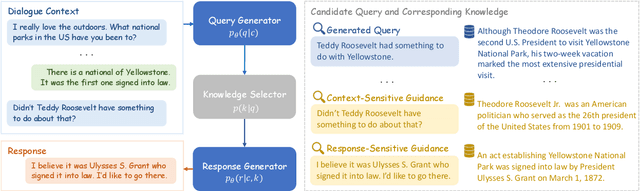
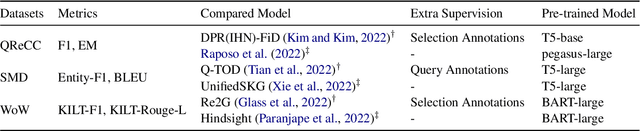

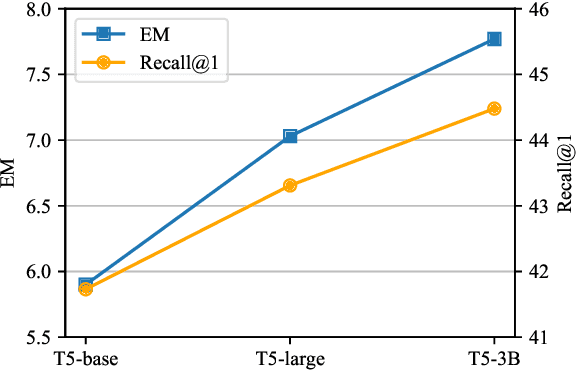
The quality of knowledge retrieval is crucial in knowledge-intensive conversations. Two common strategies to improve the retrieval quality are finetuning the retriever or generating a self-contained query, while they encounter heavy burdens on expensive computation and elaborate annotations. In this paper, we propose an unsupervised query enhanced approach for knowledge-intensive conversations, namely QKConv. There are three modules in QKConv: a query generator, an off-the-shelf knowledge selector, and a response generator. Without extra supervision, the end-to-end joint training of QKConv explores multiple candidate queries and utilizes corresponding selected knowledge to yield the target response. To evaluate the effectiveness of the proposed method, we conducted comprehensive experiments on conversational question-answering, task-oriented dialogue, and knowledge-grounded conversation. Experimental results demonstrate that QKConv achieves state-of-the-art performance compared to unsupervised methods and competitive performance compared to supervised methods.
PLATO-K: Internal and External Knowledge Enhanced Dialogue Generation
Nov 02, 2022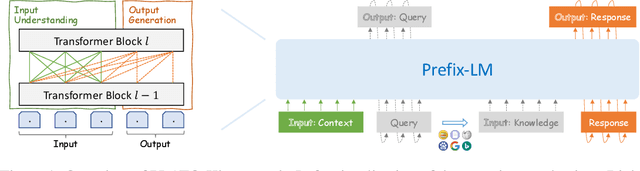
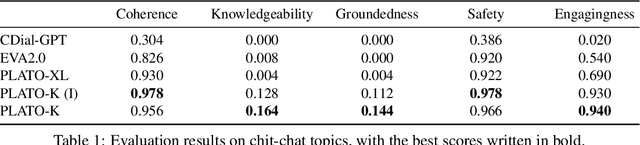
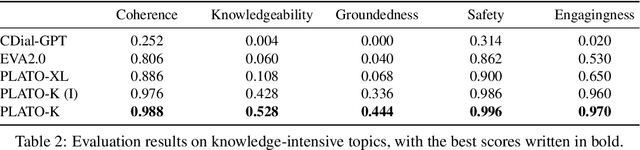
Recently, the practical deployment of open-domain dialogue systems has been plagued by the knowledge issue of information deficiency and factual inaccuracy. To this end, we introduce PLATO-K based on two-stage dialogic learning to strengthen internal knowledge memorization and external knowledge exploitation. In the first stage, PLATO-K learns through massive dialogue corpora and memorizes essential knowledge into model parameters. In the second stage, PLATO-K mimics human beings to search for external information and to leverage the knowledge in response generation. Extensive experiments reveal that the knowledge issue is alleviated significantly in PLATO-K with such comprehensive internal and external knowledge enhancement. Compared to the existing state-of-the-art Chinese dialogue model, the overall engagingness of PLATO-K is improved remarkably by 36.2% and 49.2% on chit-chat and knowledge-intensive conversations.
Q-TOD: A Query-driven Task-oriented Dialogue System
Oct 14, 2022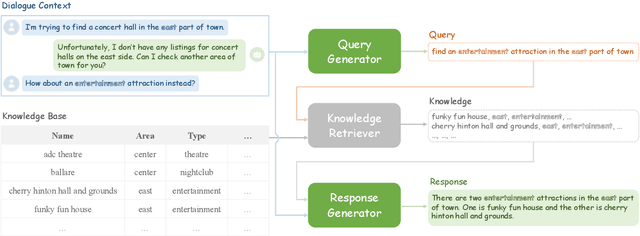
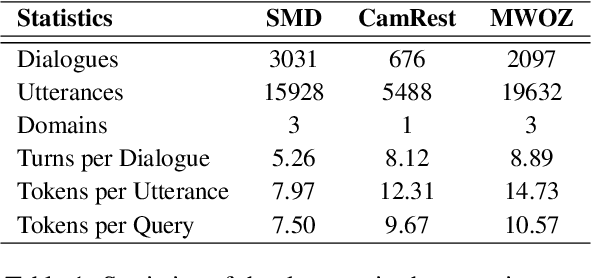
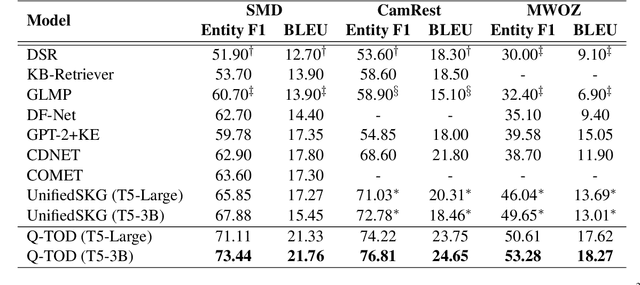
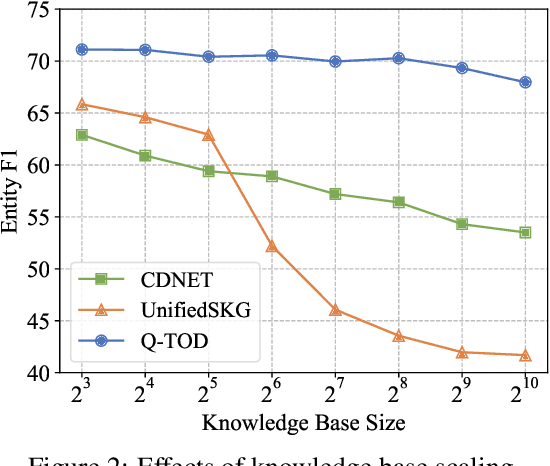
Existing pipelined task-oriented dialogue systems usually have difficulties adapting to unseen domains, whereas end-to-end systems are plagued by large-scale knowledge bases in practice. In this paper, we introduce a novel query-driven task-oriented dialogue system, namely Q-TOD. The essential information from the dialogue context is extracted into a query, which is further employed to retrieve relevant knowledge records for response generation. Firstly, as the query is in the form of natural language and not confined to the schema of the knowledge base, the issue of domain adaption is alleviated remarkably in Q-TOD. Secondly, as the query enables the decoupling of knowledge retrieval from the generation, Q-TOD gets rid of the issue of knowledge base scalability. To evaluate the effectiveness of the proposed Q-TOD, we collect query annotations for three publicly available task-oriented dialogue datasets. Comprehensive experiments verify that Q-TOD outperforms strong baselines and establishes a new state-of-the-art performance on these datasets.
Towards Boosting the Open-Domain Chatbot with Human Feedback
Aug 30, 2022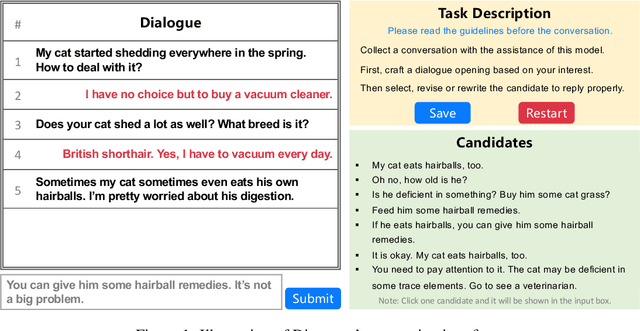
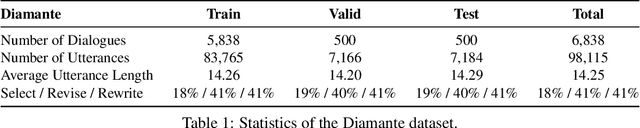
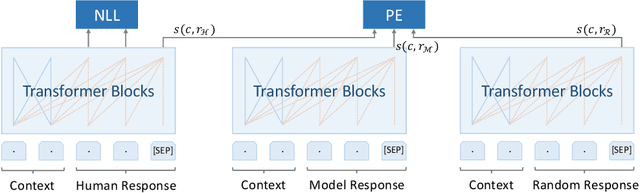

Many open-domain dialogue models pre-trained with social media comments can generate coherent replies but have difficulties producing engaging responses when interacting with real users. This phenomenon might mainly result from the deficiency of annotated human-human conversations and the misalignment with human preference. In this paper, we propose a novel and efficient approach Diamante to boost the open-domain chatbot, where two kinds of human feedback (including explicit demonstration and implicit preference) are collected and leveraged. By asking annotators to select or amend the model-generated candidate responses, Diamante efficiently collects the human demonstrated responses and constructs a Chinese chit-chat dataset. To enhance the alignment with human preference, Diamante leverages the implicit preference in the data collection process and introduces the generation-evaluation joint training. Comprehensive experiments indicate that the Diamante dataset and joint training paradigm can significantly boost the performance of Chinese pre-trained dialogue models.
SINC: Service Information Augmented Open-Domain Conversation
Jun 28, 2022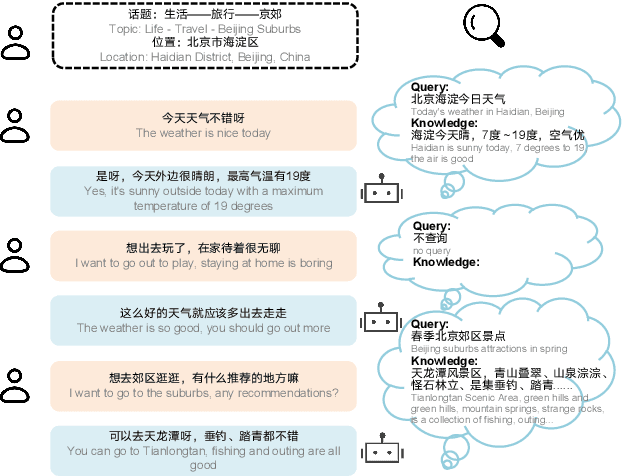
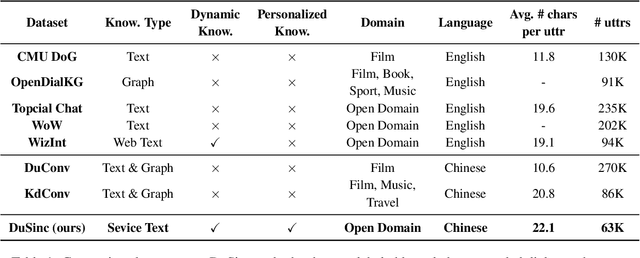
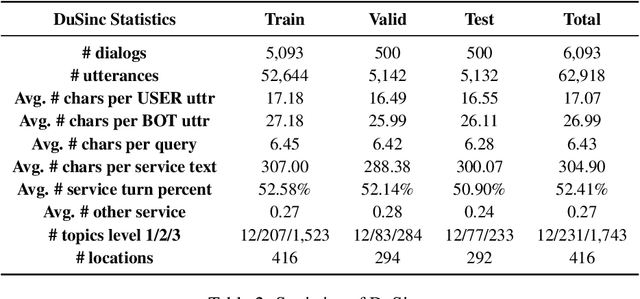
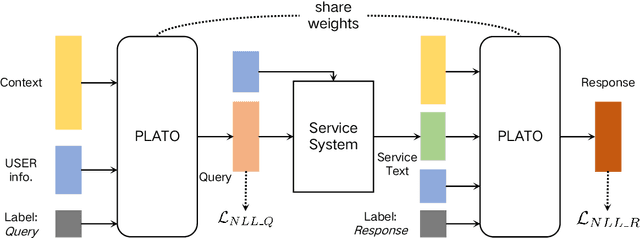
Generative open-domain dialogue systems can benefit from external knowledge, but the lack of external knowledge resources and the difficulty in finding relevant knowledge limit the development of this technology. To this end, we propose a knowledge-driven dialogue task using dynamic service information. Specifically, we use a large number of service APIs that can provide high coverage and spatiotemporal sensitivity as external knowledge sources. The dialogue system generates queries to request external services along with user information, get the relevant knowledge, and generate responses based on this knowledge. To implement this method, we collect and release the first open domain Chinese service knowledge dialogue dataset DuSinc. At the same time, we construct a baseline model PLATO-SINC, which realizes the automatic utilization of service information for dialogue. Both automatic evaluation and human evaluation show that our proposed new method can significantly improve the effect of open-domain conversation, and the session-level overall score in human evaluation is improved by 59.29% compared with the dialogue pre-training model PLATO-2. The dataset and benchmark model will be open sourced.