 Add to Chrome
 Add to Firefox
 Add to Edge
ERNIE 5.0 Technical Report
Feb 04, 2026
In this report, we introduce ERNIE 5.0, a natively autoregressive foundation model desinged for unified multimodal understanding and generation across text, image, video, and audio. All modalities are trained from scratch under a unified next-group-of-tokens prediction objective, based on an ultra-sparse mixture-of-experts (MoE) architecture with modality-agnostic expert routing. To address practical challenges in large-scale deployment under diverse resource constraints, ERNIE 5.0 adopts a novel elastic training paradigm. Within a single pre-training run, the model learns a family of sub-models with varying depths, expert capacities, and routing sparsity, enabling flexible trade-offs among performance, model size, and inference latency in memory- or time-constrained scenarios. Moreover, we systematically address the challenges of scaling reinforcement learning to unified foundation models, thereby guaranteeing efficient and stable post-training under ultra-sparse MoE architectures and diverse multimodal settings. Extensive experiments demonstrate that ERNIE 5.0 achieves strong and balanced performance across multiple modalities. To the best of our knowledge, among publicly disclosed models, ERNIE 5.0 represents the first production-scale realization of a trillion-parameter unified autoregressive model that supports both multimodal understanding and generation. To facilitate further research, we present detailed visualizations of modality-agnostic expert routing in the unified model, alongside comprehensive empirical analysis of elastic training, aiming to offer profound insights to the community.

Distributional Clarity: The Hidden Driver of RL-Friendliness in Large Language Models
Jan 11, 2026Language model families exhibit striking disparity in their capacity to benefit from reinforcement learning: under identical training, models like Qwen achieve substantial gains, while others like Llama yield limited improvements. Complementing data-centric approaches, we reveal that this disparity reflects a hidden structural property: \textbf{distributional clarity} in probability space. Through a three-stage analysis-from phenomenon to mechanism to interpretation-we uncover that RL-friendly models exhibit intra-class compactness and inter-class separation in their probability assignments to correct vs. incorrect responses. We quantify this clarity using the \textbf{Silhouette Coefficient} ($S$) and demonstrate that (1) high $S$ correlates strongly with RL performance; (2) low $S$ is associated with severe logic errors and reasoning instability. To confirm this property, we introduce a Silhouette-Aware Reweighting strategy that prioritizes low-$S$ samples during training. Experiments across six mathematical benchmarks show consistent improvements across all model families, with gains up to 5.9 points on AIME24. Our work establishes distributional clarity as a fundamental, trainable property underlying RL-Friendliness.
Query Enhanced Knowledge-Intensive Conversation via Unsupervised Joint Modeling
Dec 19, 2022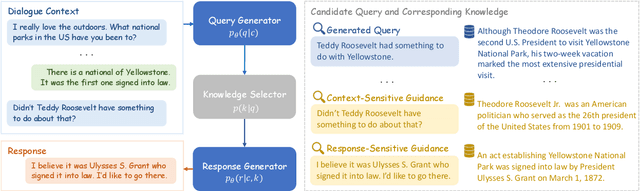
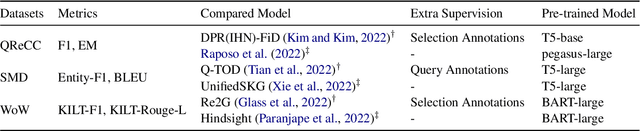

The quality of knowledge retrieval is crucial in knowledge-intensive conversations. Two common strategies to improve the retrieval quality are finetuning the retriever or generating a self-contained query, while they encounter heavy burdens on expensive computation and elaborate annotations. In this paper, we propose an unsupervised query enhanced approach for knowledge-intensive conversations, namely QKConv. There are three modules in QKConv: a query generator, an off-the-shelf knowledge selector, and a response generator. Without extra supervision, the end-to-end joint training of QKConv explores multiple candidate queries and utilizes corresponding selected knowledge to yield the target response. To evaluate the effectiveness of the proposed method, we conducted comprehensive experiments on conversational question-answering, task-oriented dialogue, and knowledge-grounded conversation. Experimental results demonstrate that QKConv achieves state-of-the-art performance compared to unsupervised methods and competitive performance compared to supervised methods.