 Add to Chrome
 Add to Firefox
 Add to Edge
TC-IDM: Grounding Video Generation for Executable Zero-shot Robot Motion
Jan 26, 2026
The vision-language-action (VLA) paradigm has enabled powerful robotic control by leveraging vision-language models, but its reliance on large-scale, high-quality robot data limits its generalization. Generative world models offer a promising alternative for general-purpose embodied AI, yet a critical gap remains between their pixel-level plans and physically executable actions. To this end, we propose the Tool-Centric Inverse Dynamics Model (TC-IDM). By focusing on the tool's imagined trajectory as synthesized by the world model, TC-IDM establishes a robust intermediate representation that bridges the gap between visual planning and physical control. TC-IDM extracts the tool's point cloud trajectories via segmentation and 3D motion estimation from generated videos. Considering diverse tool attributes, our architecture employs decoupled action heads to project these planned trajectories into 6-DoF end-effector motions and corresponding control signals. This plan-and-translate paradigm not only supports a wide range of end-effectors but also significantly improves viewpoint invariance. Furthermore, it exhibits strong generalization capabilities across long-horizon and out-of-distribution tasks, including interacting with deformable objects. In real-world evaluations, the world model with TC-IDM achieves an average success rate of 61.11 percent, with 77.7 percent on simple tasks and 38.46 percent on zero-shot deformable object tasks. It substantially outperforms end-to-end VLA-style baselines and other inverse dynamics models.

PhysicsMind: Sim and Real Mechanics Benchmarking for Physical Reasoning and Prediction in Foundational VLMs and World Models
Jan 22, 2026Modern foundational Multimodal Large Language Models (MLLMs) and video world models have advanced significantly in mathematical, common-sense, and visual reasoning, but their grasp of the underlying physics remains underexplored. Existing benchmarks attempting to measure this matter rely on synthetic, Visual Question Answer templates or focus on perceptual video quality that is tangential to measuring how well the video abides by physical laws. To address this fragmentation, we introduce PhysicsMind, a unified benchmark with both real and simulation environments that evaluates law-consistent reasoning and generation over three canonical principles: Center of Mass, Lever Equilibrium, and Newton's First Law. PhysicsMind comprises two main tasks: i) VQA tasks, testing whether models can reason and determine physical quantities and values from images or short videos, and ii) Video Generation(VG) tasks, evaluating if predicted motion trajectories obey the same center-of-mass, torque, and inertial constraints as the ground truth. A broad range of recent models and video generation models is evaluated on PhysicsMind and found to rely on appearance heuristics while often violating basic mechanics. These gaps indicate that current scaling and training are still insufficient for robust physical understanding, underscoring PhysicsMind as a focused testbed for physics-aware multimodal models. Our data will be released upon acceptance.
Wow, wo, val! A Comprehensive Embodied World Model Evaluation Turing Test
Jan 07, 2026As world models gain momentum in Embodied AI, an increasing number of works explore using video foundation models as predictive world models for downstream embodied tasks like 3D prediction or interactive generation. However, before exploring these downstream tasks, video foundation models still have two critical questions unanswered: (1) whether their generative generalization is sufficient to maintain perceptual fidelity in the eyes of human observers, and (2) whether they are robust enough to serve as a universal prior for real-world embodied agents. To provide a standardized framework for answering these questions, we introduce the Embodied Turing Test benchmark: WoW-World-Eval (Wow,wo,val). Building upon 609 robot manipulation data, Wow-wo-val examines five core abilities, including perception, planning, prediction, generalization, and execution. We propose a comprehensive evaluation protocol with 22 metrics to assess the models' generation ability, which achieves a high Pearson Correlation between the overall score and human preference (>0.93) and establishes a reliable foundation for the Human Turing Test. On Wow-wo-val, models achieve only 17.27 on long-horizon planning and at best 68.02 on physical consistency, indicating limited spatiotemporal consistency and physical reasoning. For the Inverse Dynamic Model Turing Test, we first use an IDM to evaluate the video foundation models' execution accuracy in the real world. However, most models collapse to $\approx$ 0% success, while WoW maintains a 40.74% success rate. These findings point to a noticeable gap between the generated videos and the real world, highlighting the urgency and necessity of benchmarking World Model in Embodied AI.
Can World Models Benefit VLMs for World Dynamics?
Oct 01, 2025Trained on internet-scale video data, generative world models are increasingly recognized as powerful world simulators that can generate consistent and plausible dynamics over structure, motion, and physics. This raises a natural question: with the advent of strong video foundational models, might they supplant conventional vision encoder paradigms for general-purpose multimodal understanding? While recent studies have begun to explore the potential of world models on common vision tasks, these explorations typically lack a systematic investigation of generic, multimodal tasks. In this work, we strive to investigate the capabilities when world model priors are transferred into Vision-Language Models: we re-purpose a video diffusion model as a generative encoder to perform a single denoising step and treat the resulting latents as a set of visual embedding. We empirically investigate this class of models, which we refer to as World-Language Models (WorldLMs), and we find that generative encoders can capture latents useful for downstream understanding that show distinctions from conventional encoders. Naming our best-performing variant Dynamic Vision Aligner (DyVA), we further discover that this method significantly enhances spatial reasoning abilities and enables single-image models to perform multi-frame reasoning. Through the curation of a suite of visual reasoning tasks, we find DyVA to surpass both open-source and proprietary baselines, achieving state-of-the-art or comparable performance. We attribute these gains to WorldLM's inherited motion-consistency internalization from video pre-training. Finally, we systematically explore extensive model designs to highlight promising directions for future work. We hope our study can pave the way for a new family of VLMs that leverage priors from world models and are on a promising path towards generalist vision learners.
WoW: Towards a World omniscient World model Through Embodied Interaction
Sep 26, 2025Humans develop an understanding of intuitive physics through active interaction with the world. This approach is in stark contrast to current video models, such as Sora, which rely on passive observation and therefore struggle with grasping physical causality. This observation leads to our central hypothesis: authentic physical intuition of the world model must be grounded in extensive, causally rich interactions with the real world. To test this hypothesis, we present WoW, a 14-billion-parameter generative world model trained on 2 million robot interaction trajectories. Our findings reveal that the model's understanding of physics is a probabilistic distribution of plausible outcomes, leading to stochastic instabilities and physical hallucinations. Furthermore, we demonstrate that this emergent capability can be actively constrained toward physical realism by SOPHIA, where vision-language model agents evaluate the DiT-generated output and guide its refinement by iteratively evolving the language instructions. In addition, a co-trained Inverse Dynamics Model translates these refined plans into executable robotic actions, thus closing the imagination-to-action loop. We establish WoWBench, a new benchmark focused on physical consistency and causal reasoning in video, where WoW achieves state-of-the-art performance in both human and autonomous evaluation, demonstrating strong ability in physical causality, collision dynamics, and object permanence. Our work provides systematic evidence that large-scale, real-world interaction is a cornerstone for developing physical intuition in AI. Models, data, and benchmarks will be open-sourced.
MinD: Unified Visual Imagination and Control via Hierarchical World Models
Jun 23, 2025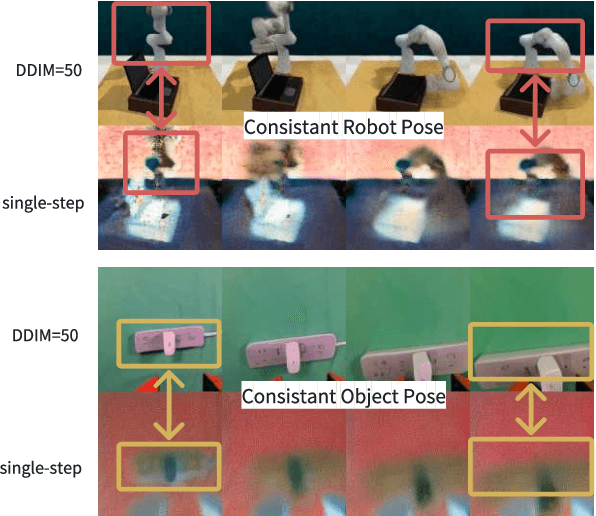
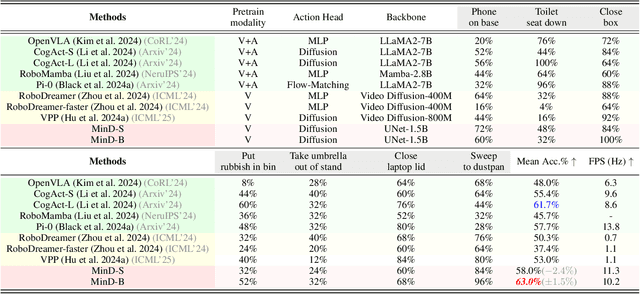
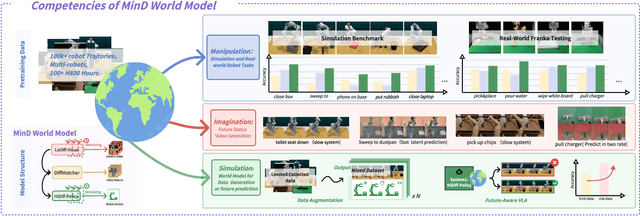
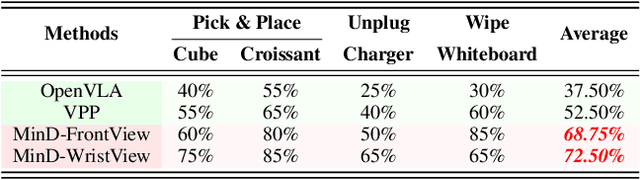
Video generation models (VGMs) offer a promising pathway for unified world modeling in robotics by integrating simulation, prediction, and manipulation. However, their practical application remains limited due to (1) slowgeneration speed, which limits real-time interaction, and (2) poor consistency between imagined videos and executable actions. To address these challenges, we propose Manipulate in Dream (MinD), a hierarchical diffusion-based world model framework that employs a dual-system design for vision-language manipulation. MinD executes VGM at low frequencies to extract video prediction features, while leveraging a high-frequency diffusion policy for real-time interaction. This architecture enables low-latency, closed-loop control in manipulation with coherent visual guidance. To better coordinate the two systems, we introduce a video-action diffusion matching module (DiffMatcher), with a novel co-training strategy that uses separate schedulers for each diffusion model. Specifically, we introduce a diffusion-forcing mechanism to DiffMatcher that aligns their intermediate representations during training, helping the fast action model better understand video-based predictions. Beyond manipulation, MinD also functions as a world simulator, reliably predicting task success or failure in latent space before execution. Trustworthy analysis further shows that VGMs can preemptively evaluate task feasibility and mitigate risks. Extensive experiments across multiple benchmarks demonstrate that MinD achieves state-of-the-art manipulation (63%+) in RL-Bench, advancing the frontier of unified world modeling in robotics.
SCBench: A Sports Commentary Benchmark for Video LLMs
Dec 23, 2024Recently, significant advances have been made in Video Large Language Models (Video LLMs) in both academia and industry. However, methods to evaluate and benchmark the performance of different Video LLMs, especially their fine-grained, temporal visual capabilities, remain very limited. On one hand, current benchmarks use relatively simple videos (e.g., subtitled movie clips) where the model can understand the entire video by processing just a few frames. On the other hand, their datasets lack diversity in task format, comprising only QA or multi-choice QA, which overlooks the models' capacity for generating in-depth and precise texts. Sports videos, which feature intricate visual information, sequential events, and emotionally charged commentary, present a critical challenge for Video LLMs, making sports commentary an ideal benchmarking task. Inspired by these challenges, we propose a novel task: sports video commentary generation, developed $\textbf{SCBench}$ for Video LLMs. To construct such a benchmark, we introduce (1) $\textbf{SCORES}$, a six-dimensional metric specifically designed for our task, upon which we propose a GPT-based evaluation method, and (2) $\textbf{CommentarySet}$, a dataset consisting of 5,775 annotated video clips and ground-truth labels tailored to our metric. Based on SCBench, we conduct comprehensive evaluations on multiple Video LLMs (e.g. VILA, Video-LLaVA, etc.) and chain-of-thought baseline methods. Our results found that InternVL-Chat-2 achieves the best performance with 5.44, surpassing the second-best by 1.04. Our work provides a fresh perspective for future research, aiming to enhance models' overall capabilities in complex visual understanding tasks. Our dataset will be released soon.