 Add to Chrome
 Add to Firefox
 Add to Edge
PhysicsMind: Sim and Real Mechanics Benchmarking for Physical Reasoning and Prediction in Foundational VLMs and World Models
Jan 22, 2026
Modern foundational Multimodal Large Language Models (MLLMs) and video world models have advanced significantly in mathematical, common-sense, and visual reasoning, but their grasp of the underlying physics remains underexplored. Existing benchmarks attempting to measure this matter rely on synthetic, Visual Question Answer templates or focus on perceptual video quality that is tangential to measuring how well the video abides by physical laws. To address this fragmentation, we introduce PhysicsMind, a unified benchmark with both real and simulation environments that evaluates law-consistent reasoning and generation over three canonical principles: Center of Mass, Lever Equilibrium, and Newton's First Law. PhysicsMind comprises two main tasks: i) VQA tasks, testing whether models can reason and determine physical quantities and values from images or short videos, and ii) Video Generation(VG) tasks, evaluating if predicted motion trajectories obey the same center-of-mass, torque, and inertial constraints as the ground truth. A broad range of recent models and video generation models is evaluated on PhysicsMind and found to rely on appearance heuristics while often violating basic mechanics. These gaps indicate that current scaling and training are still insufficient for robust physical understanding, underscoring PhysicsMind as a focused testbed for physics-aware multimodal models. Our data will be released upon acceptance.

Scaling-up Perceptual Video Quality Assessment
May 28, 2025The data scaling law has been shown to significantly enhance the performance of large multi-modal models (LMMs) across various downstream tasks. However, in the domain of perceptual video quality assessment (VQA), the potential of scaling law remains unprecedented due to the scarcity of labeled resources and the insufficient scale of datasets. To address this, we propose \textbf{OmniVQA}, an efficient framework designed to efficiently build high-quality, human-in-the-loop VQA multi-modal instruction databases (MIDBs). We then scale up to create \textbf{OmniVQA-Chat-400K}, the largest MIDB in the VQA field concurrently. Our focus is on the technical and aesthetic quality dimensions, with abundant in-context instruction data to provide fine-grained VQA knowledge. Additionally, we have built the \textbf{OmniVQA-MOS-20K} dataset to enhance the model's quantitative quality rating capabilities. We then introduce a \textbf{complementary} training strategy that effectively leverages the knowledge from datasets for quality understanding and quality rating tasks. Furthermore, we propose the \textbf{OmniVQA-FG (fine-grain)-Benchmark} to evaluate the fine-grained performance of the models. Our results demonstrate that our models achieve state-of-the-art performance in both quality understanding and rating tasks.
SFR-GNN: Simple and Fast Robust GNNs against Structural Attacks
Sep 01, 2024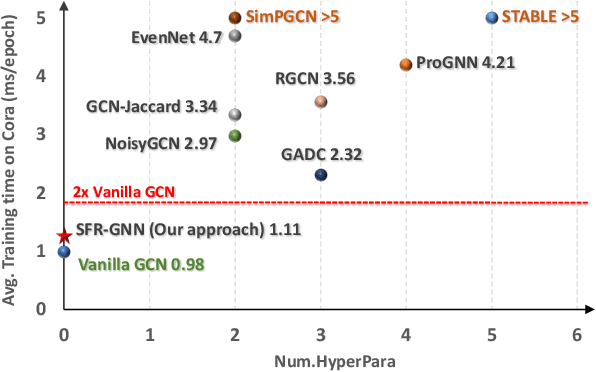
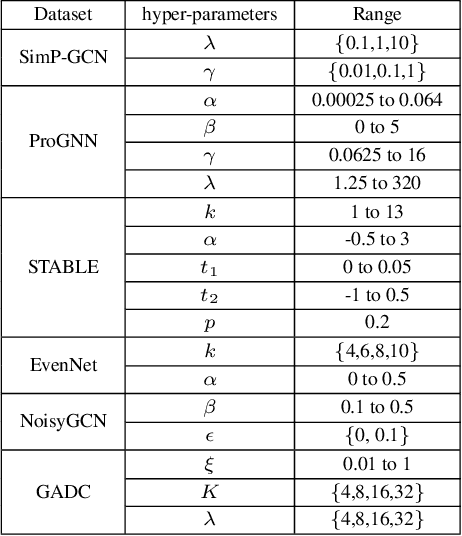
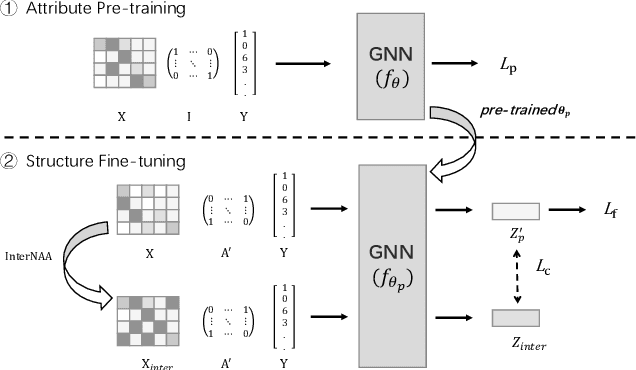
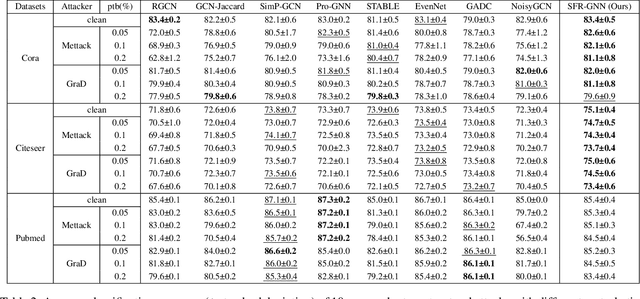
Graph Neural Networks (GNNs) have demonstrated commendable performance for graph-structured data. Yet, GNNs are often vulnerable to adversarial structural attacks as embedding generation relies on graph topology. Existing efforts are dedicated to purifying the maliciously modified structure or applying adaptive aggregation, thereby enhancing the robustness against adversarial structural attacks. It is inevitable for a defender to consume heavy computational costs due to lacking prior knowledge about modified structures. To this end, we propose an efficient defense method, called Simple and Fast Robust Graph Neural Network (SFR-GNN), supported by mutual information theory. The SFR-GNN first pre-trains a GNN model using node attributes and then fine-tunes it over the modified graph in the manner of contrastive learning, which is free of purifying modified structures and adaptive aggregation, thus achieving great efficiency gains. Consequently, SFR-GNN exhibits a 24%--162% speedup compared to advanced robust models, demonstrating superior robustness for node classification tasks.