 Add to Chrome
 Add to Firefox
 Add to Edge
understand empathy
Papers and Code
EEmo-Logic: A Unified Dataset and Multi-Stage Framework for Comprehensive Image-Evoked Emotion Assessment
Feb 01, 2026
Understanding the multi-dimensional attributes and intensity nuances of image-evoked emotions is pivotal for advancing machine empathy and empowering diverse human-computer interaction applications. However, existing models are still limited to coarse-grained emotion perception or deficient reasoning capabilities. To bridge this gap, we introduce EEmoDB, the largest image-evoked emotion understanding dataset to date. It features $5$ analysis dimensions spanning $5$ distinct task categories, facilitating comprehensive interpretation. Specifically, we compile $1.2M$ question-answering (QA) pairs (EEmoDB-QA) from $125k$ images via automated generation, alongside a $36k$ dataset (EEmoDB-Assess) curated from $25k$ images for fine-grained assessment. Furthermore, we propose EEmo-Logic, an all-in-one multimodal large language model (MLLM) developed via instruction fine-tuning and task-customized group relative preference optimization (GRPO) with novel reward design. Extensive experiments demonstrate that EEmo-Logic achieves robust performance in in-domain and cross-domain datasets, excelling in emotion QA and fine-grained assessment. The code is available at https://anonymous.4open.science/r/EEmoLogic.

AI and My Values: User Perceptions of LLMs' Ability to Extract, Embody, and Explain Human Values from Casual Conversations
Jan 30, 2026Does AI understand human values? While this remains an open philosophical question, we take a pragmatic stance by introducing VAPT, the Value-Alignment Perception Toolkit, for studying how LLMs reflect people's values and how people judge those reflections. 20 participants texted a human-like chatbot over a month, then completed a 2-hour interview with our toolkit evaluating AI's ability to extract (pull details regarding), embody (make decisions guided by), and explain (provide proof of) human values. 13 participants left our study convinced that AI can understand human values. Participants found the experience insightful for self-reflection and found themselves getting persuaded by the AI's reasoning. Thus, we warn about "weaponized empathy": a potentially dangerous design pattern that may arise in value-aligned, yet welfare-misaligned AI. VAPT offers concrete artifacts and design implications to evaluate and responsibly build value-aligned conversational agents with transparency, consent, and safeguards as AI grows more capable and human-like into the future.
Do You Understand How I Feel?: Towards Verified Empathy in Therapy Chatbots
Jan 13, 2026Conversational agents are increasingly used as support tools along mental therapeutic pathways with significant societal impacts. In particular, empathy is a key non-functional requirement in therapeutic contexts, yet current chatbot development practices provide no systematic means to specify or verify it. This paper envisions a framework integrating natural language processing and formal verification to deliver empathetic therapy chatbots. A Transformer-based model extracts dialogue features, which are then translated into a Stochastic Hybrid Automaton model of dyadic therapy sessions. Empathy-related properties can then be verified through Statistical Model Checking, while strategy synthesis provides guidance for shaping agent behavior. Preliminary results show that the formal model captures therapy dynamics with good fidelity and that ad-hoc strategies improve the probability of satisfying empathy requirements.
Personalization of Large Foundation Models for Health Interventions
Jan 07, 2026Large foundation models (LFMs) transform healthcare AI in prevention, diagnostics, and treatment. However, whether LFMs can provide truly personalized treatment recommendations remains an open question. Recent research has revealed multiple challenges for personalization, including the fundamental generalizability paradox: models achieving high accuracy in one clinical study perform at chance level in others, demonstrating that personalization and external validity exist in tension. This exemplifies broader contradictions in AI-driven healthcare: the privacy-performance paradox, scale-specificity paradox, and the automation-empathy paradox. As another challenge, the degree of causal understanding required for personalized recommendations, as opposed to mere predictive capacities of LFMs, remains an open question. N-of-1 trials -- crossover self-experiments and the gold standard for individual causal inference in personalized medicine -- resolve these tensions by providing within-person causal evidence while preserving privacy through local experimentation. Despite their impressive capabilities, this paper argues that LFMs cannot replace N-of-1 trials. We argue that LFMs and N-of-1 trials are complementary: LFMs excel at rapid hypothesis generation from population patterns using multimodal data, while N-of-1 trials excel at causal validation for a given individual. We propose a hybrid framework that combines the strengths of both to enable personalization and navigate the identified paradoxes: LFMs generate ranked intervention candidates with uncertainty estimates, which trigger subsequent N-of-1 trials. Clarifying the boundary between prediction and causation and explicitly addressing the paradoxical tensions are essential for responsible AI integration in personalized medicine.
Reasoning Over Recall: Evaluating the Efficacy of Generalist Architectures vs. Specialized Fine-Tunes in RAG-Based Mental Health Dialogue Systems
Jan 04, 2026The deployment of Large Language Models (LLMs) in mental health counseling faces the dual challenges of hallucinations and lack of empathy. While the former may be mitigated by RAG (retrieval-augmented generation) by anchoring answers in trusted clinical sources, there remains an open question as to whether the most effective model under this paradigm would be one that is fine-tuned on mental health data, or a more general and powerful model that succeeds purely on the basis of reasoning. In this paper, we perform a direct comparison by running four open-source models through the same RAG pipeline using ChromaDB: two generalist reasoners (Qwen2.5-3B and Phi-3-Mini) and two domain-specific fine-tunes (MentalHealthBot-7B and TherapyBot-7B). We use an LLM-as-a-Judge framework to automate evaluation over 50 turns. We find a clear trend: the generalist models outperform the domain-specific ones in empathy (3.72 vs. 3.26, $p < 0.001$) in spite of being much smaller (3B vs. 7B), and all models perform well in terms of safety, but the generalist models show better contextual understanding and are less prone to overfitting as we observe in the domain-specific models. Overall, our results indicate that for RAG-based therapy systems, strong reasoning is more important than training on mental health-specific vocabulary; i.e. a well-reasoned general model would provide more empathetic and balanced support than a larger narrowly fine-tuned model, so long as the answer is already grounded in clinical evidence.
Fun-Audio-Chat Technical Report
Dec 23, 2025Recent advancements in joint speech-text models show great potential for seamless voice interactions. However, existing models face critical challenges: temporal resolution mismatch between speech tokens (25Hz) and text tokens (~3Hz) dilutes semantic information, incurs high computational costs, and causes catastrophic forgetting of text LLM knowledge. We introduce Fun-Audio-Chat, a Large Audio Language Model addressing these limitations via two innovations from our previous work DrVoice. First, Dual-Resolution Speech Representations (DRSR): the Shared LLM processes audio at efficient 5Hz (via token grouping), while the Speech Refined Head generates high-quality tokens at 25Hz, balancing efficiency (~50% GPU reduction) and quality. Second, Core-Cocktail Training, a two-stage fine-tuning with intermediate merging that mitigates catastrophic forgetting. We then apply Multi-Task DPO Training to enhance robustness, audio understanding, instruction-following and voice empathy. This multi-stage post-training enables Fun-Audio-Chat to retain text LLM knowledge while gaining powerful audio understanding, reasoning, and generation. Unlike recent LALMs requiring large-scale audio-text pre-training, Fun-Audio-Chat leverages pre-trained models and extensive post-training. Fun-Audio-Chat 8B and MoE 30B-A3B achieve competitive performance on Speech-to-Text and Speech-to-Speech tasks, ranking top among similar-scale models on Spoken QA benchmarks. They also achieve competitive to superior performance on Audio Understanding, Speech Function Calling, Instruction-Following and Voice Empathy. We develop Fun-Audio-Chat-Duplex, a full-duplex variant with strong performance on Spoken QA and full-duplex interactions. We open-source Fun-Audio-Chat-8B with training and inference code, and provide an interactive demo.
Assessing the Capabilities of LLMs in Humor:A Multi-dimensional Analysis of Oogiri Generation and Evaluation
Nov 12, 2025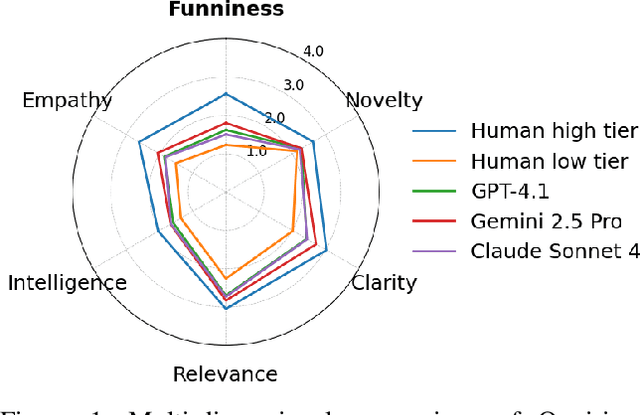
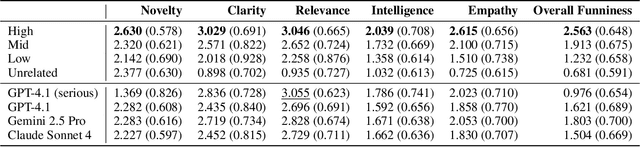
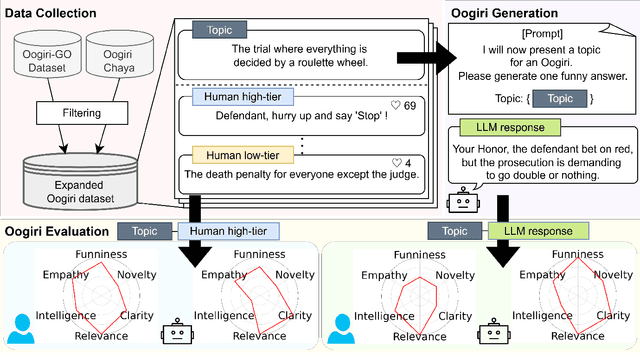
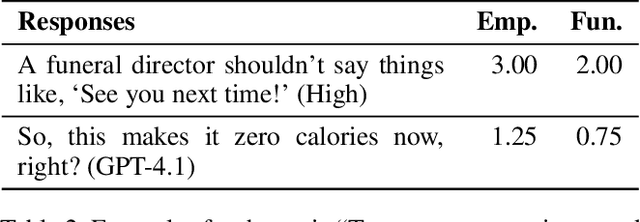
Computational humor is a frontier for creating advanced and engaging natural language processing (NLP) applications, such as sophisticated dialogue systems. While previous studies have benchmarked the humor capabilities of Large Language Models (LLMs), they have often relied on single-dimensional evaluations, such as judging whether something is simply ``funny.'' This paper argues that a multifaceted understanding of humor is necessary and addresses this gap by systematically evaluating LLMs through the lens of Oogiri, a form of Japanese improvisational comedy games. To achieve this, we expanded upon existing Oogiri datasets with data from new sources and then augmented the collection with Oogiri responses generated by LLMs. We then manually annotated this expanded collection with 5-point absolute ratings across six dimensions: Novelty, Clarity, Relevance, Intelligence, Empathy, and Overall Funniness. Using this dataset, we assessed the capabilities of state-of-the-art LLMs on two core tasks: their ability to generate creative Oogiri responses and their ability to evaluate the funniness of responses using a six-dimensional evaluation. Our results show that while LLMs can generate responses at a level between low- and mid-tier human performance, they exhibit a notable lack of Empathy. This deficit in Empathy helps explain their failure to replicate human humor assessment. Correlation analyses of human and model evaluation data further reveal a fundamental divergence in evaluation criteria: LLMs prioritize Novelty, whereas humans prioritize Empathy. We release our annotated corpus to the community to pave the way for the development of more emotionally intelligent and sophisticated conversational agents.
Towards Emotionally Intelligent and Responsible Reinforcement Learning
Nov 13, 2025Personalized decision systems in healthcare and behavioral support often rely on static rule-based or engagement-maximizing heuristics that overlook users' emotional context and ethical constraints. Such approaches risk recommending insensitive or unsafe interventions, especially in domains involving serious mental illness, substance use disorders, or depression. To address this limitation, we propose a Responsible Reinforcement Learning (RRL) framework that integrates emotional and contextual understanding with ethical considerations into the sequential decision-making process. RRL formulates personalization as a Constrained Markov Decision Process (CMDP), where the agent optimizes engagement and adherence while ensuring emotional alignment and ethical safety. We introduce a multi-objective reward function that explicitly balances short-term behavioral engagement with long-term user well-being, and define an emotion-informed state representation that captures fluctuations in emotional readiness, affect, and risk. The proposed architecture can be instantiated with any RL algorithm (e.g., DQN, PPO) augmented with safety constraints or Lagrangian regularization. Conceptually, this framework operationalizes empathy and responsibility within machine learning policy optimization, bridging safe RL, affective computing and responsible AI. We discuss the implications of this approach for human-centric domains such as behavioral health, education, and digital therapeutics, and outline simulation-based validation paths for future empirical work. This paper aims to initiate a methodological conversation about ethically aligned reinforcement learning for emotionally aware and trustworthy personalization systems.
EchoMind: An Interrelated Multi-level Benchmark for Evaluating Empathetic Speech Language Models
Oct 26, 2025Speech Language Models (SLMs) have made significant progress in spoken language understanding. Yet it remains unclear whether they can fully perceive non lexical vocal cues alongside spoken words, and respond with empathy that aligns with both emotional and contextual factors. Existing benchmarks typically evaluate linguistic, acoustic, reasoning, or dialogue abilities in isolation, overlooking the integration of these skills that is crucial for human-like, emotionally intelligent conversation. We present EchoMind, the first interrelated, multi-level benchmark that simulates the cognitive process of empathetic dialogue through sequential, context-linked tasks: spoken-content understanding, vocal-cue perception, integrated reasoning, and response generation. All tasks share identical and semantically neutral scripts that are free of explicit emotional or contextual cues, and controlled variations in vocal style are used to test the effect of delivery independent of the transcript. EchoMind is grounded in an empathy-oriented framework spanning 3 coarse and 12 fine-grained dimensions, encompassing 39 vocal attributes, and evaluated using both objective and subjective metrics. Testing 12 advanced SLMs reveals that even state-of-the-art models struggle with high-expressive vocal cues, limiting empathetic response quality. Analyses of prompt strength, speech source, and ideal vocal cue recognition reveal persistent weaknesses in instruction-following, resilience to natural speech variability, and effective use of vocal cues for empathy. These results underscore the need for SLMs that integrate linguistic content with diverse vocal cues to achieve truly empathetic conversational ability.
Feeling Machines: Ethics, Culture, and the Rise of Emotional AI
Jun 14, 2025This paper explores the growing presence of emotionally responsive artificial intelligence through a critical and interdisciplinary lens. Bringing together the voices of early-career researchers from multiple fields, it explores how AI systems that simulate or interpret human emotions are reshaping our interactions in areas such as education, healthcare, mental health, caregiving, and digital life. The analysis is structured around four central themes: the ethical implications of emotional AI, the cultural dynamics of human-machine interaction, the risks and opportunities for vulnerable populations, and the emerging regulatory, design, and technical considerations. The authors highlight the potential of affective AI to support mental well-being, enhance learning, and reduce loneliness, as well as the risks of emotional manipulation, over-reliance, misrepresentation, and cultural bias. Key challenges include simulating empathy without genuine understanding, encoding dominant sociocultural norms into AI systems, and insufficient safeguards for individuals in sensitive or high-risk contexts. Special attention is given to children, elderly users, and individuals with mental health challenges, who may interact with AI in emotionally significant ways. However, there remains a lack of cognitive or legal protections which are necessary to navigate such engagements safely. The report concludes with ten recommendations, including the need for transparency, certification frameworks, region-specific fine-tuning, human oversight, and longitudinal research. A curated supplementary section provides practical tools, models, and datasets to support further work in this domain.