 Add to Chrome
 Add to Firefox
 Add to Edge
Arabic Text Summarization
Papers and Code
Multilingual Sentiment Analysis of Summarized Texts: A Cross-Language Study of Text Shortening Effects
Mar 31, 2025
Summarization significantly impacts sentiment analysis across languages with diverse morphologies. This study examines extractive and abstractive summarization effects on sentiment classification in English, German, French, Spanish, Italian, Finnish, Hungarian, and Arabic. We assess sentiment shifts post-summarization using multilingual transformers (mBERT, XLM-RoBERTa, T5, and BART) and language-specific models (FinBERT, AraBERT). Results show extractive summarization better preserves sentiment, especially in morphologically complex languages, while abstractive summarization improves readability but introduces sentiment distortion, affecting sentiment accuracy. Languages with rich inflectional morphology, such as Finnish, Hungarian, and Arabic, experience greater accuracy drops than English or German. Findings emphasize the need for language-specific adaptations in sentiment analysis and propose a hybrid summarization approach balancing readability and sentiment preservation. These insights benefit multilingual sentiment applications, including social media monitoring, market analysis, and cross-lingual opinion mining.

The Text Classification Pipeline: Starting Shallow going Deeper
Dec 30, 2024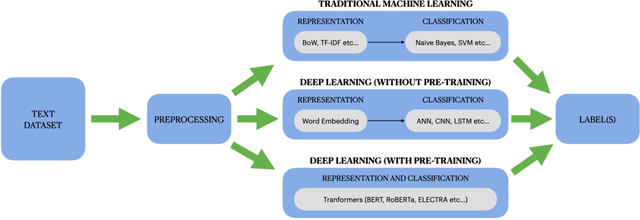
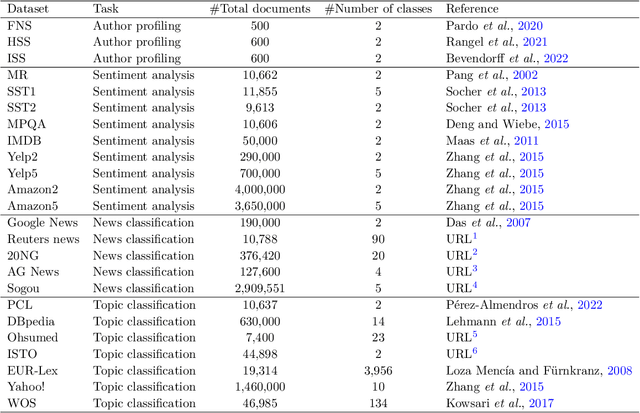
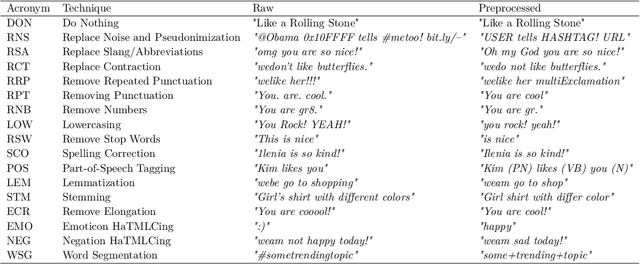
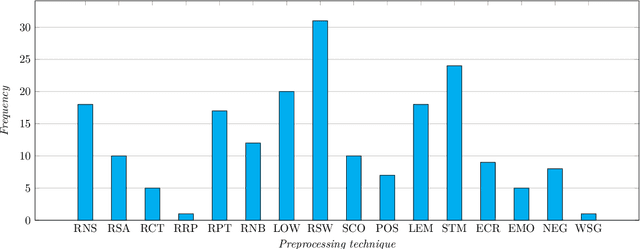
Text Classification (TC) stands as a cornerstone within the realm of Natural Language Processing (NLP), particularly when viewed through the lens of computer science and engineering. The past decade has seen deep learning revolutionize TC, propelling advancements in text retrieval, categorization, information extraction, and summarization. The scholarly literature is rich with datasets, models, and evaluation criteria, with English being the predominant language of focus, despite studies involving Arabic, Chinese, Hindi, and others. The efficacy of TC models relies heavily on their ability to capture intricate textual relationships and nonlinear correlations, necessitating a comprehensive examination of the entire TC pipeline. This monograph provides an in-depth exploration of the TC pipeline, with a particular emphasis on evaluating the impact of each component on the overall performance of TC models. The pipeline includes state-of-the-art datasets, text preprocessing techniques, text representation methods, classification models, evaluation metrics, current results and future trends. Each chapter meticulously examines these stages, presenting technical innovations and significant recent findings. The work critically assesses various classification strategies, offering comparative analyses, examples, case studies, and experimental evaluations. These contributions extend beyond a typical survey, providing a detailed and insightful exploration of TC.
BiMediX2: Bio-Medical EXpert LMM for Diverse Medical Modalities
Dec 10, 2024
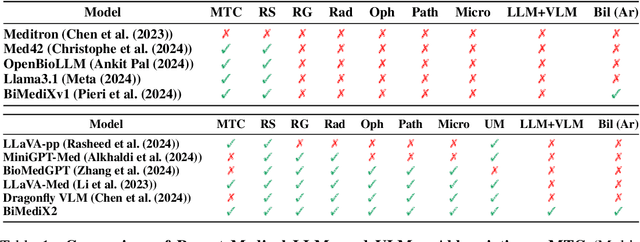


This paper introduces BiMediX2, a bilingual (Arabic-English) Bio-Medical EXpert Large Multimodal Model (LMM) with a unified architecture that integrates text and visual modalities, enabling advanced image understanding and medical applications. BiMediX2 leverages the Llama3.1 architecture and integrates text and visual capabilities to facilitate seamless interactions in both English and Arabic, supporting text-based inputs and multi-turn conversations involving medical images. The model is trained on an extensive bilingual healthcare dataset consisting of 1.6M samples of diverse medical interactions for both text and image modalities, mixed in Arabic and English. We also propose the first bilingual GPT-4o based medical LMM benchmark named BiMed-MBench. BiMediX2 is benchmarked on both text-based and image-based tasks, achieving state-of-the-art performance across several medical benchmarks. It outperforms recent state-of-the-art models in medical LLM evaluation benchmarks. Our model also sets a new benchmark in multimodal medical evaluations with over 9% improvement in English and over 20% in Arabic evaluations. Additionally, it surpasses GPT-4 by around 9% in UPHILL factual accuracy evaluations and excels in various medical Visual Question Answering, Report Generation, and Report Summarization tasks. The project page including source code and the trained model, is available at https://github.com/mbzuai-oryx/BiMediX2.
Transformer Models in Education: Summarizing Science Textbooks with AraBART, MT5, AraT5, and mBART
Jun 11, 2024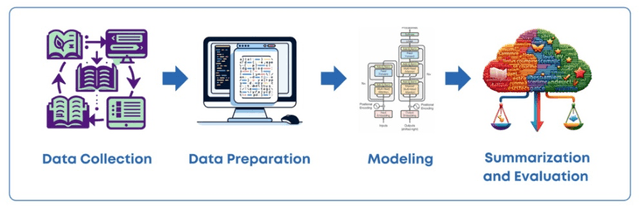
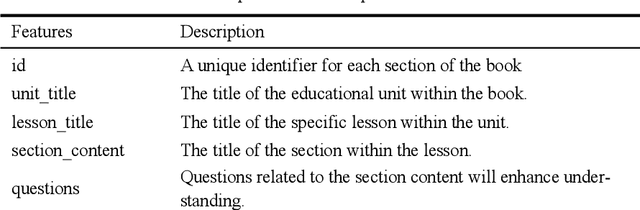
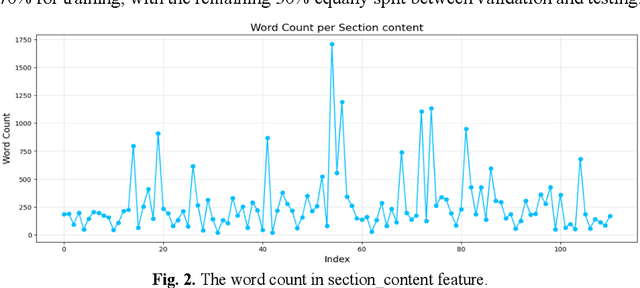
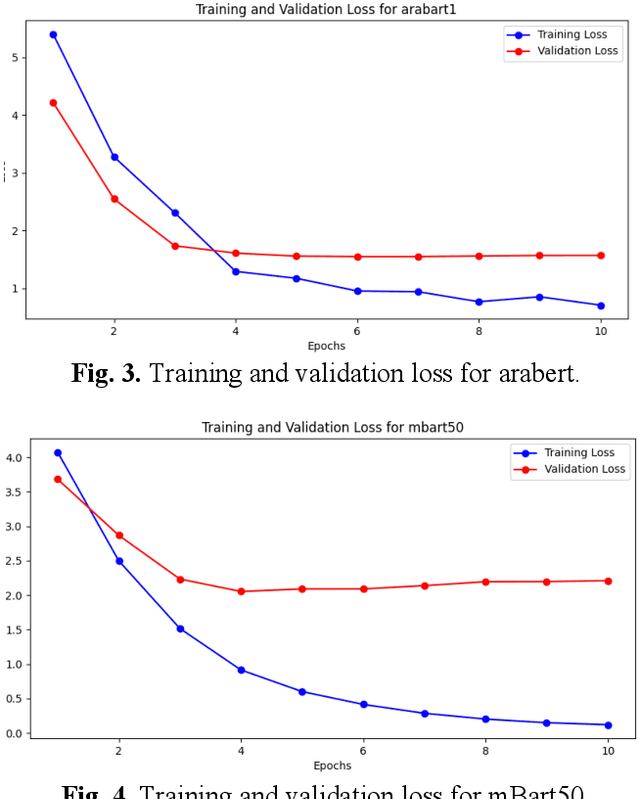
Recently, with the rapid development in the fields of technology and the increasing amount of text t available on the internet, it has become urgent to develop effective tools for processing and understanding texts in a way that summaries the content without losing the fundamental essence of the information. Given this challenge, we have developed an advanced text summarization system targeting Arabic textbooks. Relying on modern natu-ral language processing models such as MT5, AraBART, AraT5, and mBART50, this system evaluates and extracts the most important sentences found in biology textbooks for the 11th and 12th grades in the Palestinian curriculum, which enables students and teachers to obtain accurate and useful summaries that help them easily understand the content. We utilized the Rouge metric to evaluate the performance of the trained models. Moreover, experts in education Edu textbook authoring assess the output of the trained models. This approach aims to identify the best solutions and clarify areas needing improvement. This research provides a solution for summarizing Arabic text. It enriches the field by offering results that can open new horizons for research and development in the technologies for understanding and generating the Arabic language. Additionally, it contributes to the field with Arabic texts through creating and compiling schoolbook texts and building a dataset.
Creating Arabic LLM Prompts at Scale
Aug 12, 2024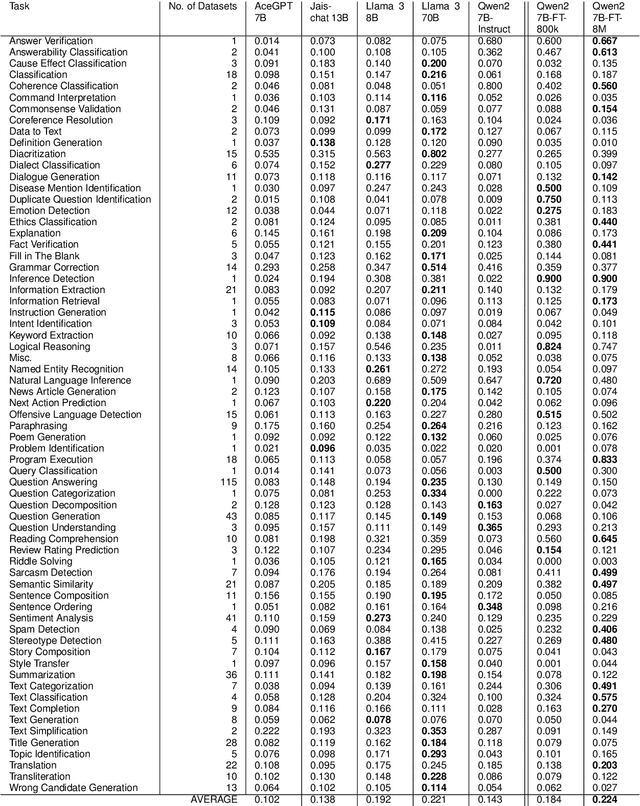
The debut of chatGPT and BARD has popularized instruction following text generation using LLMs, where a user can interrogate an LLM using natural language requests and obtain natural language answers that matches their requests. Training LLMs to respond in this manner requires a large number of worked out examples of user requests (aka prompts) with corresponding gold responses. In this paper, we introduce two methods for creating such prompts for Arabic cheaply and quickly. The first methods entails automatically translating existing prompt datasets from English, such as PromptSource and Super-NaturalInstructions, and then using machine translation quality estimation to retain high quality translations only. The second method involves creating natural language prompts on top of existing Arabic NLP datasets. Using these two methods we were able to create more than 67.4 million Arabic prompts that cover a variety of tasks including summarization, headline generation, grammar checking, open/closed question answering, creative writing, etc. We show that fine tuning an open 7 billion parameter large language model, namely base Qwen2 7B, enables it to outperform a state-of-the-art 70 billion parameter instruction tuned model, namely Llama3 70B, in handling Arabic prompts.
HYBRINFOX at CheckThat! 2024 -- Task 1: Enhancing Language Models with Structured Information for Check-Worthiness Estimation
Jul 04, 2024


This paper summarizes the experiments and results of the HYBRINFOX team for the CheckThat! 2024 - Task 1 competition. We propose an approach enriching Language Models such as RoBERTa with embeddings produced by triples (subject ; predicate ; object) extracted from the text sentences. Our analysis of the developmental data shows that this method improves the performance of Language Models alone. On the evaluation data, its best performance was in English, where it achieved an F1 score of 71.1 and ranked 12th out of 27 candidates. On the other languages (Dutch and Arabic), it obtained more mixed results. Future research tracks are identified toward adapting this processing pipeline to more recent Large Language Models.
NLU-STR at SemEval-2024 Task 1: Generative-based Augmentation and Encoder-based Scoring for Semantic Textual Relatedness
May 01, 2024Semantic textual relatedness is a broader concept of semantic similarity. It measures the extent to which two chunks of text convey similar meaning or topics, or share related concepts or contexts. This notion of relatedness can be applied in various applications, such as document clustering and summarizing. SemRel-2024, a shared task in SemEval-2024, aims at reducing the gap in the semantic relatedness task by providing datasets for fourteen languages and dialects including Arabic. This paper reports on our participation in Track A (Algerian and Moroccan dialects) and Track B (Modern Standard Arabic). A BERT-based model is augmented and fine-tuned for regression scoring in supervised track (A), while BERT-based cosine similarity is employed for unsupervised track (B). Our system ranked 1st in SemRel-2024 for MSA with a Spearman correlation score of 0.49. We ranked 5th for Moroccan and 12th for Algerian with scores of 0.83 and 0.53, respectively.
ArabianGPT: Native Arabic GPT-based Large Language Model
Feb 26, 2024The predominance of English and Latin-based large language models (LLMs) has led to a notable deficit in native Arabic LLMs. This discrepancy is accentuated by the prevalent inclusion of English tokens in existing Arabic models, detracting from their efficacy in processing native Arabic's intricate morphology and syntax. Consequently, there is a theoretical and practical imperative for developing LLMs predominantly focused on Arabic linguistic elements. To address this gap, this paper proposes ArabianGPT, a series of transformer-based models within the ArabianLLM suite designed explicitly for Arabic. These models, including ArabianGPT-0.1B and ArabianGPT-0.3B, vary in size and complexity, aligning with the nuanced linguistic characteristics of Arabic. The AraNizer tokenizer, integral to these models, addresses the unique morphological aspects of Arabic script, ensuring more accurate text processing. Empirical results from fine-tuning the models on tasks like sentiment analysis and summarization demonstrate significant improvements. For sentiment analysis, the fine-tuned ArabianGPT-0.1B model achieved a remarkable accuracy of 95%, a substantial increase from the base model's 56%. Similarly, in summarization tasks, fine-tuned models showed enhanced F1 scores, indicating improved precision and recall in generating concise summaries. Comparative analysis of fine-tuned ArabianGPT models against their base versions across various benchmarks reveals nuanced differences in performance, with fine-tuning positively impacting specific tasks like question answering and summarization. These findings underscore the efficacy of fine-tuning in aligning ArabianGPT models more closely with specific NLP tasks, highlighting the potential of tailored transformer architectures in advancing Arabic NLP.
Prediction of Arabic Legal Rulings using Large Language Models
Oct 16, 2023
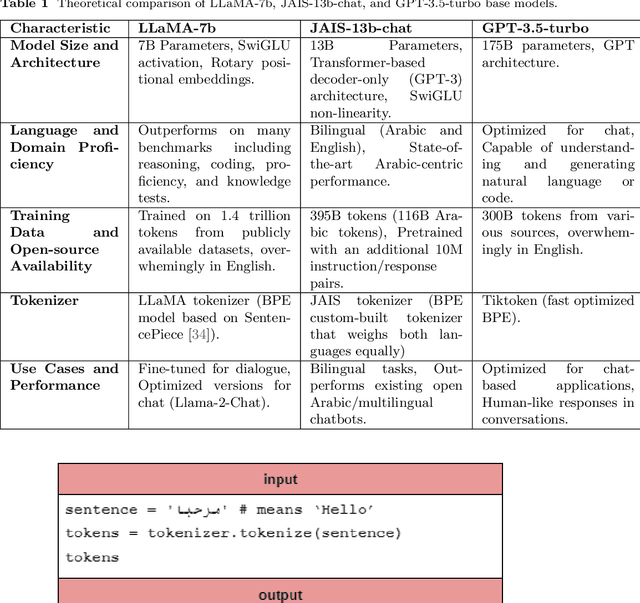
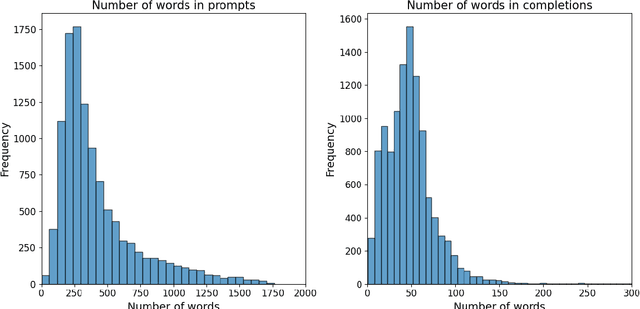
In the intricate field of legal studies, the analysis of court decisions is a cornerstone for the effective functioning of the judicial system. The ability to predict court outcomes helps judges during the decision-making process and equips lawyers with invaluable insights, enhancing their strategic approaches to cases. Despite its significance, the domain of Arabic court analysis remains under-explored. This paper pioneers a comprehensive predictive analysis of Arabic court decisions on a dataset of 10,813 commercial court real cases, leveraging the advanced capabilities of the current state-of-the-art large language models. Through a systematic exploration, we evaluate three prevalent foundational models (LLaMA-7b, JAIS-13b, and GPT3.5-turbo) and three training paradigms: zero-shot, one-shot, and tailored fine-tuning. Besides, we assess the benefit of summarizing and/or translating the original Arabic input texts. This leads to a spectrum of 14 model variants, for which we offer a granular performance assessment with a series of different metrics (human assessment, GPT evaluation, ROUGE, and BLEU scores). We show that all variants of LLaMA models yield limited performance, whereas GPT-3.5-based models outperform all other models by a wide margin, surpassing the average score of the dedicated Arabic-centric JAIS model by 50%. Furthermore, we show that all scores except human evaluation are inconsistent and unreliable for assessing the performance of large language models on court decision predictions. This study paves the way for future research, bridging the gap between computational linguistics and Arabic legal analytics.
LANS: Large-scale Arabic News Summarization Corpus
Oct 24, 2022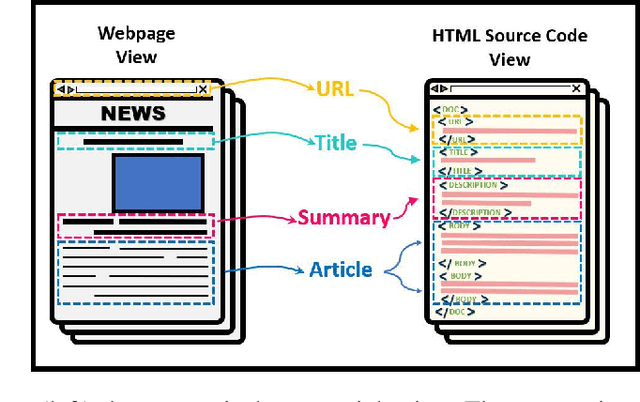
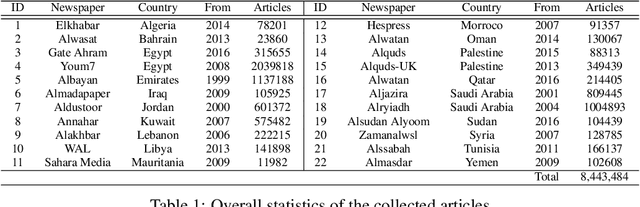
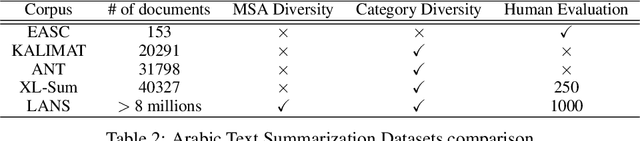
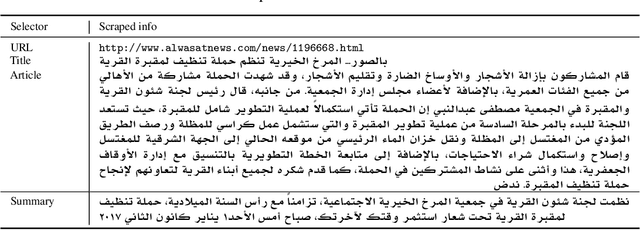
Text summarization has been intensively studied in many languages, and some languages have reached advanced stages. Yet, Arabic Text Summarization (ATS) is still in its developing stages. Existing ATS datasets are either small or lack diversity. We build, LANS, a large-scale and diverse dataset for Arabic Text Summarization task. LANS offers 8.4 million articles and their summaries extracted from newspapers websites metadata between 1999 and 2019. The high-quality and diverse summaries are written by journalists from 22 major Arab newspapers, and include an eclectic mix of at least more than 7 topics from each source. We conduct an intrinsic evaluation on LANS by both automatic and human evaluations. Human evaluation of 1000 random samples reports 95.4% accuracy for our collected summaries, and automatic evaluation quantifies the diversity and abstractness of the summaries. The dataset is publicly available upon request.