 Add to Chrome
 Add to Firefox
 Add to Edge
RoboStriker: Hierarchical Decision-Making for Autonomous Humanoid Boxing
Jan 30, 2026
Achieving human-level competitive intelligence and physical agility in humanoid robots remains a major challenge, particularly in contact-rich and highly dynamic tasks such as boxing. While Multi-Agent Reinforcement Learning (MARL) offers a principled framework for strategic interaction, its direct application to humanoid control is hindered by high-dimensional contact dynamics and the absence of strong physical motion priors. We propose RoboStriker, a hierarchical three-stage framework that enables fully autonomous humanoid boxing by decoupling high-level strategic reasoning from low-level physical execution. The framework first learns a comprehensive repertoire of boxing skills by training a single-agent motion tracker on human motion capture data. These skills are subsequently distilled into a structured latent manifold, regularized by projecting the Gaussian-parameterized distribution onto a unit hypersphere. This topological constraint effectively confines exploration to the subspace of physically plausible motions. In the final stage, we introduce Latent-Space Neural Fictitious Self-Play (LS-NFSP), where competing agents learn competitive tactics by interacting within the latent action space rather than the raw motor space, significantly stabilizing multi-agent training. Experimental results demonstrate that RoboStriker achieves superior competitive performance in simulation and exhibits sim-to-real transfer. Our website is available at RoboStriker.

UniTracker: Learning Universal Whole-Body Motion Tracker for Humanoid Robots
Jul 10, 2025Humanoid robots must achieve diverse, robust, and generalizable whole-body control to operate effectively in complex, human-centric environments. However, existing methods, particularly those based on teacher-student frameworks often suffer from a loss of motion diversity during policy distillation and exhibit limited generalization to unseen behaviors. In this work, we present UniTracker, a simplified yet powerful framework that integrates a Conditional Variational Autoencoder (CVAE) into the student policy to explicitly model the latent diversity of human motion. By leveraging a learned CVAE prior, our method enables the student to retain expressive motion characteristics while improving robustness and adaptability under partial observations. The result is a single policy capable of tracking a wide spectrum of whole-body motions with high fidelity and stability. Comprehensive experiments in both simulation and real-world deployments demonstrate that UniTracker significantly outperforms MLP-based DAgger baselines in motion quality, generalization to unseen references, and deployment robustness, offering a practical and scalable solution for expressive humanoid control.
RL from Physical Feedback: Aligning Large Motion Models with Humanoid Control
Jun 15, 2025This paper focuses on a critical challenge in robotics: translating text-driven human motions into executable actions for humanoid robots, enabling efficient and cost-effective learning of new behaviors. While existing text-to-motion generation methods achieve semantic alignment between language and motion, they often produce kinematically or physically infeasible motions unsuitable for real-world deployment. To bridge this sim-to-real gap, we propose Reinforcement Learning from Physical Feedback (RLPF), a novel framework that integrates physics-aware motion evaluation with text-conditioned motion generation. RLPF employs a motion tracking policy to assess feasibility in a physics simulator, generating rewards for fine-tuning the motion generator. Furthermore, RLPF introduces an alignment verification module to preserve semantic fidelity to text instructions. This joint optimization ensures both physical plausibility and instruction alignment. Extensive experiments show that RLPF greatly outperforms baseline methods in generating physically feasible motions while maintaining semantic correspondence with text instruction, enabling successful deployment on real humanoid robots.
From Experts to a Generalist: Toward General Whole-Body Control for Humanoid Robots
Jun 15, 2025Achieving general agile whole-body control on humanoid robots remains a major challenge due to diverse motion demands and data conflicts. While existing frameworks excel in training single motion-specific policies, they struggle to generalize across highly varied behaviors due to conflicting control requirements and mismatched data distributions. In this work, we propose BumbleBee (BB), an expert-generalist learning framework that combines motion clustering and sim-to-real adaptation to overcome these challenges. BB first leverages an autoencoder-based clustering method to group behaviorally similar motions using motion features and motion descriptions. Expert policies are then trained within each cluster and refined with real-world data through iterative delta action modeling to bridge the sim-to-real gap. Finally, these experts are distilled into a unified generalist controller that preserves agility and robustness across all motion types. Experiments on two simulations and a real humanoid robot demonstrate that BB achieves state-of-the-art general whole-body control, setting a new benchmark for agile, robust, and generalizable humanoid performance in the real world.
JAEGER: Dual-Level Humanoid Whole-Body Controller
May 10, 2025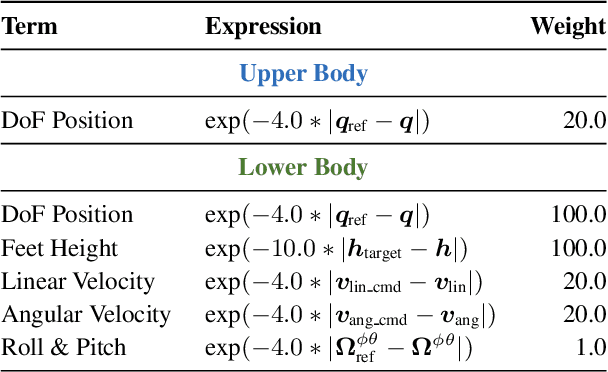
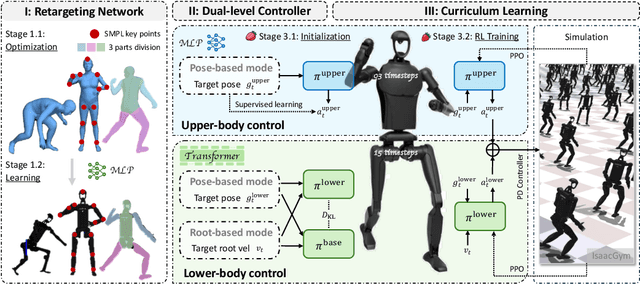
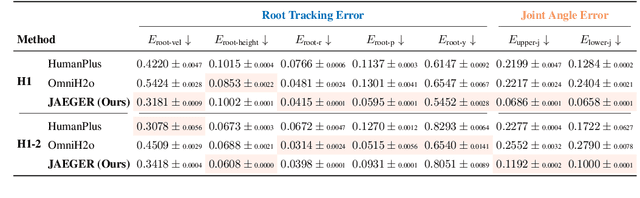
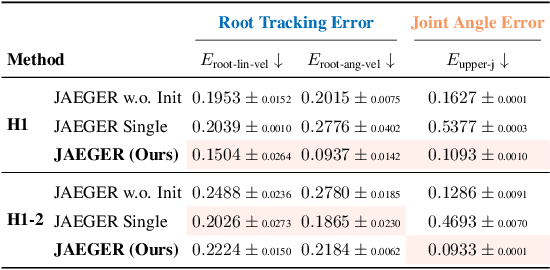
This paper presents JAEGER, a dual-level whole-body controller for humanoid robots that addresses the challenges of training a more robust and versatile policy. Unlike traditional single-controller approaches, JAEGER separates the control of the upper and lower bodies into two independent controllers, so that they can better focus on their distinct tasks. This separation alleviates the dimensionality curse and improves fault tolerance. JAEGER supports both root velocity tracking (coarse-grained control) and local joint angle tracking (fine-grained control), enabling versatile and stable movements. To train the controller, we utilize a human motion dataset (AMASS), retargeting human poses to humanoid poses through an efficient retargeting network, and employ a curriculum learning approach. This method performs supervised learning for initialization, followed by reinforcement learning for further exploration. We conduct our experiments on two humanoid platforms and demonstrate the superiority of our approach against state-of-the-art methods in both simulation and real environments.
Egocentric Vision Language Planning
Aug 11, 2024We explore leveraging large multi-modal models (LMMs) and text2image models to build a more general embodied agent. LMMs excel in planning long-horizon tasks over symbolic abstractions but struggle with grounding in the physical world, often failing to accurately identify object positions in images. A bridge is needed to connect LMMs to the physical world. The paper proposes a novel approach, egocentric vision language planning (EgoPlan), to handle long-horizon tasks from an egocentric perspective in varying household scenarios. This model leverages a diffusion model to simulate the fundamental dynamics between states and actions, integrating techniques like style transfer and optical flow to enhance generalization across different environmental dynamics. The LMM serves as a planner, breaking down instructions into sub-goals and selecting actions based on their alignment with these sub-goals, thus enabling more generalized and effective decision-making. Experiments show that EgoPlan improves long-horizon task success rates from the egocentric view compared to baselines across household scenarios.