 Add to Chrome
 Add to Firefox
 Add to Edge
PurifyGen: A Risk-Discrimination and Semantic-Purification Model for Safe Text-to-Image Generation
Dec 29, 2025
Recent advances in diffusion models have notably enhanced text-to-image (T2I) generation quality, but they also raise the risk of generating unsafe content. Traditional safety methods like text blacklisting or harmful content classification have significant drawbacks: they can be easily circumvented or require extensive datasets and extra training. To overcome these challenges, we introduce PurifyGen, a novel, training-free approach for safe T2I generation that retains the model's original weights. PurifyGen introduces a dual-stage strategy for prompt purification. First, we evaluate the safety of each token in a prompt by computing its complementary semantic distance, which measures the semantic proximity between the prompt tokens and concept embeddings from predefined toxic and clean lists. This enables fine-grained prompt classification without explicit keyword matching or retraining. Tokens closer to toxic concepts are flagged as risky. Second, for risky prompts, we apply a dual-space transformation: we project toxic-aligned embeddings into the null space of the toxic concept matrix, effectively removing harmful semantic components, and simultaneously align them into the range space of clean concepts. This dual alignment purifies risky prompts by both subtracting unsafe semantics and reinforcing safe ones, while retaining the original intent and coherence. We further define a token-wise strategy to selectively replace only risky token embeddings, ensuring minimal disruption to safe content. PurifyGen offers a plug-and-play solution with theoretical grounding and strong generalization to unseen prompts and models. Extensive testing shows that PurifyGen surpasses current methods in reducing unsafe content across five datasets and competes well with training-dependent approaches. The code can refer to https://github.com/AI-Researcher-Team/PurifyGen.

TV-RAG: A Temporal-aware and Semantic Entropy-Weighted Framework for Long Video Retrieval and Understanding
Dec 29, 2025Large Video Language Models (LVLMs) have rapidly emerged as the focus of multimedia AI research. Nonetheless, when confronted with lengthy videos, these models struggle: their temporal windows are narrow, and they fail to notice fine-grained semantic shifts that unfold over extended durations. Moreover, mainstream text-based retrieval pipelines, which rely chiefly on surface-level lexical overlap, ignore the rich temporal interdependence among visual, audio, and subtitle channels. To mitigate these limitations, we propose TV-RAG, a training-free architecture that couples temporal alignment with entropy-guided semantics to improve long-video reasoning. The framework contributes two main mechanisms: \emph{(i)} a time-decay retrieval module that injects explicit temporal offsets into the similarity computation, thereby ranking text queries according to their true multimedia context; and \emph{(ii)} an entropy-weighted key-frame sampler that selects evenly spaced, information-dense frames, reducing redundancy while preserving representativeness. By weaving these temporal and semantic signals together, TV-RAG realises a dual-level reasoning routine that can be grafted onto any LVLM without re-training or fine-tuning. The resulting system offers a lightweight, budget-friendly upgrade path and consistently surpasses most leading baselines across established long-video benchmarks such as Video-MME, MLVU, and LongVideoBench, confirming the effectiveness of our model. The code can be found at https://github.com/AI-Researcher-Team/TV-RAG.
CoFi-Dec: Hallucination-Resistant Decoding via Coarse-to-Fine Generative Feedback in Large Vision-Language Models
Dec 29, 2025Large Vision-Language Models (LVLMs) have achieved impressive progress in multi-modal understanding and generation. However, they still tend to produce hallucinated content that is inconsistent with the visual input, which limits their reliability in real-world applications. We propose \textbf{CoFi-Dec}, a training-free decoding framework that mitigates hallucinations by integrating generative self-feedback with coarse-to-fine visual conditioning. Inspired by the human visual process from global scene perception to detailed inspection, CoFi-Dec first generates two intermediate textual responses conditioned on coarse- and fine-grained views of the original image. These responses are then transformed into synthetic images using a text-to-image model, forming multi-level visual hypotheses that enrich grounding cues. To unify the predictions from these multiple visual conditions, we introduce a Wasserstein-based fusion mechanism that aligns their predictive distributions into a geometrically consistent decoding trajectory. This principled fusion reconciles high-level semantic consistency with fine-grained visual grounding, leading to more robust and faithful outputs. Extensive experiments on six hallucination-focused benchmarks show that CoFi-Dec substantially reduces both entity-level and semantic-level hallucinations, outperforming existing decoding strategies. The framework is model-agnostic, requires no additional training, and can be seamlessly applied to a wide range of LVLMs. The implementation is available at https://github.com/AI-Researcher-Team/CoFi-Dec.
Controllable Pedestrian Video Editing for Multi-View Driving Scenarios via Motion Sequence
Aug 01, 2025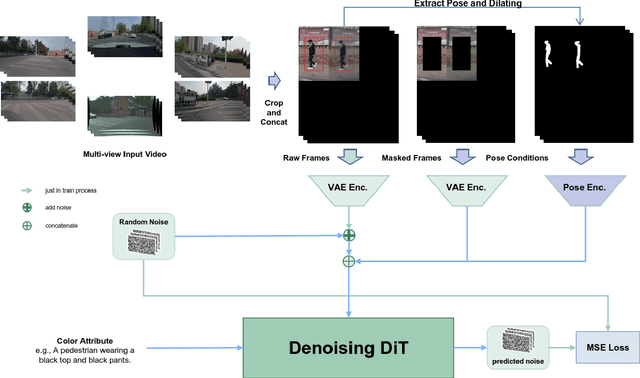
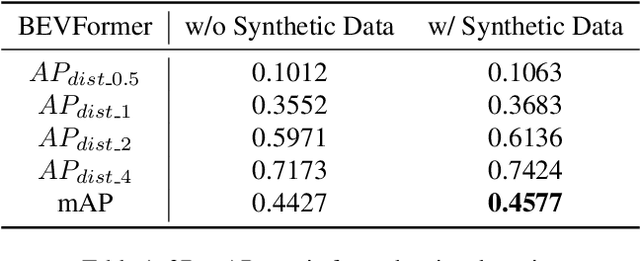
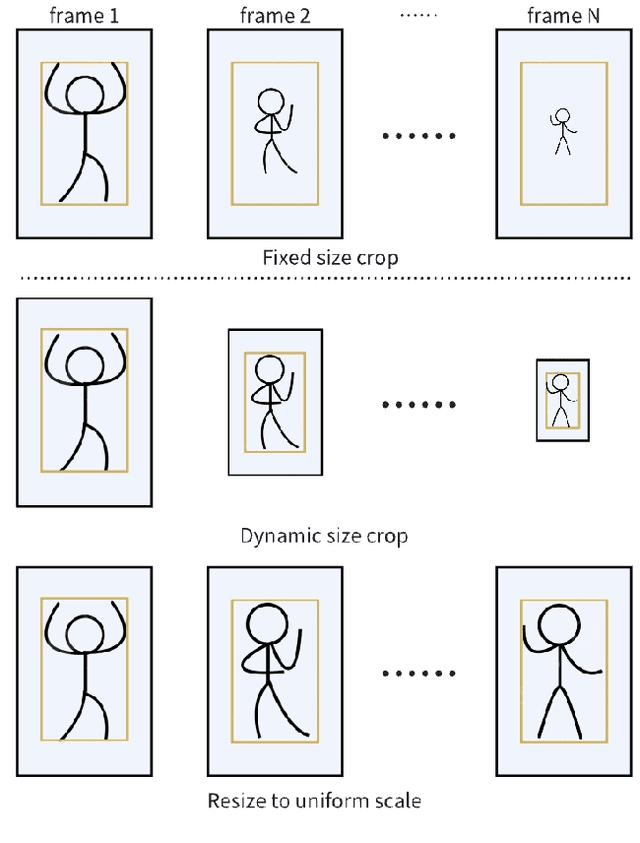
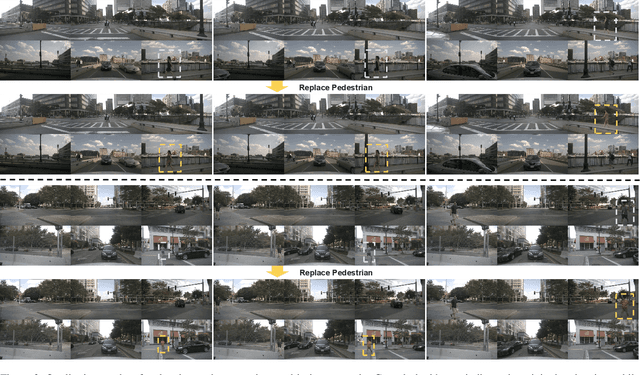
Pedestrian detection models in autonomous driving systems often lack robustness due to insufficient representation of dangerous pedestrian scenarios in training datasets. To address this limitation, we present a novel framework for controllable pedestrian video editing in multi-view driving scenarios by integrating video inpainting and human motion control techniques. Our approach begins by identifying pedestrian regions of interest across multiple camera views, expanding detection bounding boxes with a fixed ratio, and resizing and stitching these regions into a unified canvas while preserving cross-view spatial relationships. A binary mask is then applied to designate the editable area, within which pedestrian editing is guided by pose sequence control conditions. This enables flexible editing functionalities, including pedestrian insertion, replacement, and removal. Extensive experiments demonstrate that our framework achieves high-quality pedestrian editing with strong visual realism, spatiotemporal coherence, and cross-view consistency. These results establish the proposed method as a robust and versatile solution for multi-view pedestrian video generation, with broad potential for applications in data augmentation and scenario simulation in autonomous driving.
RL from Physical Feedback: Aligning Large Motion Models with Humanoid Control
Jun 15, 2025This paper focuses on a critical challenge in robotics: translating text-driven human motions into executable actions for humanoid robots, enabling efficient and cost-effective learning of new behaviors. While existing text-to-motion generation methods achieve semantic alignment between language and motion, they often produce kinematically or physically infeasible motions unsuitable for real-world deployment. To bridge this sim-to-real gap, we propose Reinforcement Learning from Physical Feedback (RLPF), a novel framework that integrates physics-aware motion evaluation with text-conditioned motion generation. RLPF employs a motion tracking policy to assess feasibility in a physics simulator, generating rewards for fine-tuning the motion generator. Furthermore, RLPF introduces an alignment verification module to preserve semantic fidelity to text instructions. This joint optimization ensures both physical plausibility and instruction alignment. Extensive experiments show that RLPF greatly outperforms baseline methods in generating physically feasible motions while maintaining semantic correspondence with text instruction, enabling successful deployment on real humanoid robots.
Rethinking the Principle of Gradient Smooth Methods in Model Explanation
Oct 10, 2024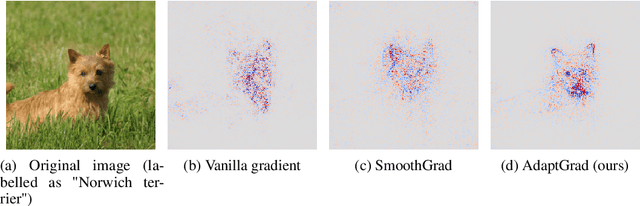

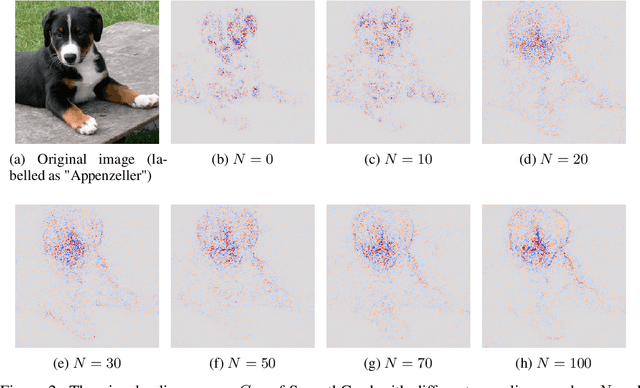
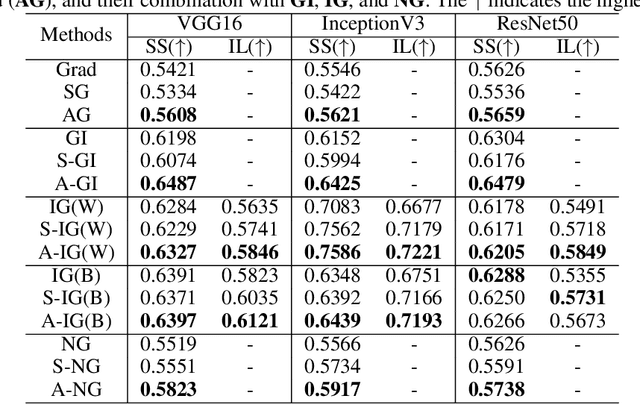
Gradient Smoothing is an efficient approach to reducing noise in gradient-based model explanation method. SmoothGrad adds Gaussian noise to mitigate much of these noise. However, the crucial hyper-parameter in this method, the variance $\sigma$ of Gaussian noise, is set manually or with heuristic approach. However, it results in the smoothed gradients still containing a certain amount of noise. In this paper, we aim to interpret SmoothGrad as a corollary of convolution, thereby re-understanding the gradient noise and the role of $\sigma$ from the perspective of confidence level. Furthermore, we propose an adaptive gradient smoothing method, AdaptGrad, based on these insights. Through comprehensive experiments, both qualitative and quantitative results demonstrate that AdaptGrad could effectively reduce almost all the noise in vanilla gradients compared with baselines methods. AdaptGrad is simple and universal, making it applicable for enhancing gradient-based interpretability methods for better visualization.
$\mathrm{E^{2}CFD}$: Towards Effective and Efficient Cost Function Design for Safe Reinforcement Learning via Large Language Model
Jul 08, 2024Different classes of safe reinforcement learning algorithms have shown satisfactory performance in various types of safety requirement scenarios. However, the existing methods mainly address one or several classes of specific safety requirement scenario problems and cannot be applied to arbitrary safety requirement scenarios. In addition, the optimization objectives of existing reinforcement learning algorithms are misaligned with the task requirements. Based on the need to address these issues, we propose $\mathrm{E^{2}CFD}$, an effective and efficient cost function design framework. $\mathrm{E^{2}CFD}$ leverages the capabilities of a large language model (LLM) to comprehend various safety scenarios and generate corresponding cost functions. It incorporates the \textit{fast performance evaluation (FPE)} method to facilitate rapid and iterative updates to the generated cost function. Through this iterative process, $\mathrm{E^{2}CFD}$ aims to obtain the most suitable cost function for policy training, tailored to the specific tasks within the safety scenario. Experiments have proven that the performance of policies trained using this framework is superior to traditional safe reinforcement learning algorithms and policies trained with carefully designed cost functions.
Axiomatization of Gradient Smoothing in Neural Networks
Jun 29, 2024Gradients play a pivotal role in neural networks explanation. The inherent high dimensionality and structural complexity of neural networks result in the original gradients containing a significant amount of noise. While several approaches were proposed to reduce noise with smoothing, there is little discussion of the rationale behind smoothing gradients in neural networks. In this work, we proposed a gradient smooth theoretical framework for neural networks based on the function mollification and Monte Carlo integration. The framework intrinsically axiomatized gradient smoothing and reveals the rationale of existing methods. Furthermore, we provided an approach to design new smooth methods derived from the framework. By experimental measurement of several newly designed smooth methods, we demonstrated the research potential of our framework.