 Add to Chrome
 Add to Firefox
 Add to Edge
A Progressive Training Strategy for Vision-Language Models to Counteract Spatio-Temporal Hallucinations in Embodied Reasoning
Apr 12, 2026
Vision-Language Models (VLMs) have made significant strides in static image understanding but continue to face critical hurdles in spatiotemporal reasoning. A major bottleneck is "multi-image reasoning hallucination", where a massive performance drop between forward and reverse temporal queries reveals a dependence on superficial shortcuts instead of genuine causal understanding. To mitigate this, we first develop a new Chain-of-Thought (CoT) dataset that decomposes intricate reasoning into detailed spatiotemporal steps and definitive judgments. Building on this, we present a progressive training framework: it initiates with supervised pre-training on our CoT dataset to instill logical structures, followed by fine-tuning with scalable weakly-labeled data for broader generalization. Our experiments demonstrate that this approach not only improves backbone accuracy but also slashes the forward-backward performance gap from over 70\% to only 6.53\%. This confirms the method's ability to develop authentic dynamic reasoning and reduce the inherent temporal biases of current VLMs.

Bi-Adapt: Few-shot Bimanual Adaptation for Novel Categories of 3D Objects via Semantic Correspondence
Feb 09, 2026Bimanual manipulation is imperative yet challenging for robots to execute complex tasks, requiring coordinated collaboration between two arms. However, existing methods for bimanual manipulation often rely on costly data collection and training, struggling to generalize to unseen objects in novel categories efficiently. In this paper, we present Bi-Adapt, a novel framework designed for efficient generalization for bimanual manipulation via semantic correspondence. Bi-Adapt achieves cross-category affordance mapping by leveraging the strong capability of vision foundation models. Fine-tuning with restricted data on novel categories, Bi-Adapt exhibits notable generalization to out-of-category objects in a zero-shot manner. Extensive experiments conducted in both simulation and real-world environments validate the effectiveness of our approach and demonstrate its high efficiency, achieving a high success rate on different benchmark tasks across novel categories with limited data. Project website: https://biadapt-project.github.io/
$χ_{0}$: Resource-Aware Robust Manipulation via Taming Distributional Inconsistencies
Feb 09, 2026High-reliability long-horizon robotic manipulation has traditionally relied on large-scale data and compute to understand complex real-world dynamics. However, we identify that the primary bottleneck to real-world robustness is not resource scale alone, but the distributional shift among the human demonstration distribution, the inductive bias learned by the policy, and the test-time execution distribution -- a systematic inconsistency that causes compounding errors in multi-stage tasks. To mitigate these inconsistencies, we propose $χ_{0}$, a resource-efficient framework with effective modules designated to achieve production-level robustness in robotic manipulation. Our approach builds off three technical pillars: (i) Model Arithmetic, a weight-space merging strategy that efficiently soaks up diverse distributions of different demonstrations, varying from object appearance to state variations; (ii) Stage Advantage, a stage-aware advantage estimator that provides stable, dense progress signals, overcoming the numerical instability of prior non-stage approaches; and (iii) Train-Deploy Alignment, which bridges the distribution gap via spatio-temporal augmentation, heuristic DAgger corrections, and temporal chunk-wise smoothing. $χ_{0}$ enables two sets of dual-arm robots to collaboratively orchestrate long-horizon garment manipulation, spanning tasks from flattening, folding, to hanging different clothes. Our method exhibits high-reliability autonomy; we are able to run the system from arbitrary initial state for consecutive 24 hours non-stop. Experiments validate that $χ_{0}$ surpasses the state-of-the-art $π_{0.5}$ in success rate by nearly 250%, with only 20-hour data and 8 A100 GPUs. Code, data and models will be released to facilitate the community.
OmniCam: Unified Multimodal Video Generation via Camera Control
Apr 03, 2025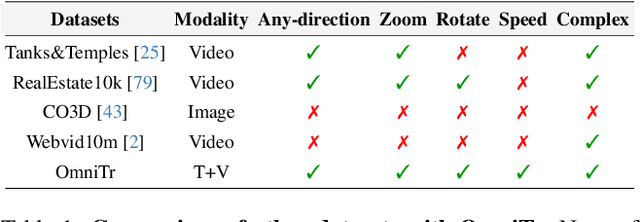
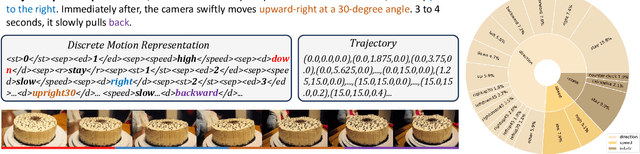
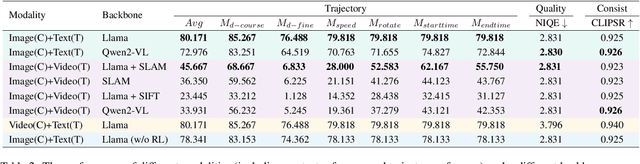
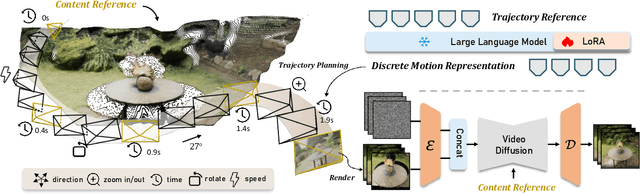
Camera control, which achieves diverse visual effects by changing camera position and pose, has attracted widespread attention. However, existing methods face challenges such as complex interaction and limited control capabilities. To address these issues, we present OmniCam, a unified multimodal camera control framework. Leveraging large language models and video diffusion models, OmniCam generates spatio-temporally consistent videos. It supports various combinations of input modalities: the user can provide text or video with expected trajectory as camera path guidance, and image or video as content reference, enabling precise control over camera motion. To facilitate the training of OmniCam, we introduce the OmniTr dataset, which contains a large collection of high-quality long-sequence trajectories, videos, and corresponding descriptions. Experimental results demonstrate that our model achieves state-of-the-art performance in high-quality camera-controlled video generation across various metrics.
$\textbf{EMOS}$: $\textbf{E}$mbodiment-aware Heterogeneous $\textbf{M}$ulti-robot $\textbf{O}$perating $\textbf{S}$ystem with LLM Agents
Oct 30, 2024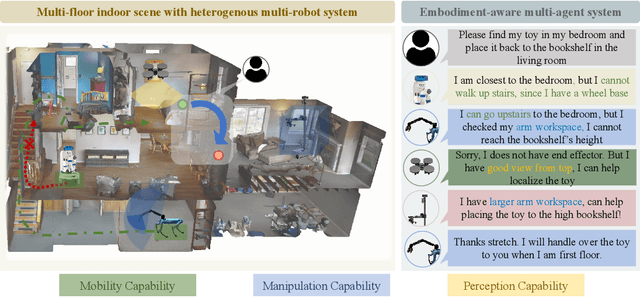

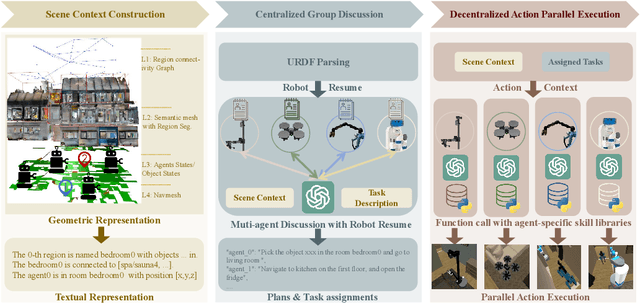

Heterogeneous multi-robot systems (HMRS) have emerged as a powerful approach for tackling complex tasks that single robots cannot manage alone. Current large-language-model-based multi-agent systems (LLM-based MAS) have shown success in areas like software development and operating systems, but applying these systems to robot control presents unique challenges. In particular, the capabilities of each agent in a multi-robot system are inherently tied to the physical composition of the robots, rather than predefined roles. To address this issue, we introduce a novel multi-agent framework designed to enable effective collaboration among heterogeneous robots with varying embodiments and capabilities, along with a new benchmark named Habitat-MAS. One of our key designs is $\textit{Robot Resume}$: Instead of adopting human-designed role play, we propose a self-prompted approach, where agents comprehend robot URDF files and call robot kinematics tools to generate descriptions of their physics capabilities to guide their behavior in task planning and action execution. The Habitat-MAS benchmark is designed to assess how a multi-agent framework handles tasks that require embodiment-aware reasoning, which includes 1) manipulation, 2) perception, 3) navigation, and 4) comprehensive multi-floor object rearrangement. The experimental results indicate that the robot's resume and the hierarchical design of our multi-agent system are essential for the effective operation of the heterogeneous multi-robot system within this intricate problem context.