 Add to Chrome
 Add to Firefox
 Add to Edge
Conformal Language Modeling via Posterior Sampling
Jun 02, 2026
Large Language Models remain plagued by hallucinations. Recent work has sought to tame their prevalence using statistical techniques based on conformal prediction, with both theoretical and empirical success. However, these methods operate in a post-hoc fashion, treating the sampling procedure itself as atomic and then surgically altering samples to remove hallucinated claims. This disconnect between filtering and generation can result in samples that are incoherent, inconsistent, or simply unlikely under the model itself. Moreover, post-hoc surgery is unable to shift probability mass towards more useful and helpful responses. To address these issues, we propose to instead sample from approximations to an LLM posterior, where the conditioning event corresponds to a calibrated, high-scoring region. We develop a calibration procedure tailored to the setting of conditional sequential generation that effectively identifies this region and achieves target risk control. Empirically, we apply our method to case studies focused on open-ended biography generation and mathematical problem solving; compared to prior work, we obtain the same statistical guarantees, with higher downstream utility.

An Enigma of Artificial Reason: Investigating the Production-Evaluation Gap in Large Reasoning Models
May 31, 2026Studies of human reasoning have shown that people are typically stronger at evaluating reasoning than producing it from scratch. In contrast, large reasoning models (LRMs) are trained to excel at producing long chains of reasoning to solve complex problems. How then do LRMs perform at evaluating reasons? We investigate this with the Valid-Answer-Invalid-Reasoning (VAIR) dataset: math problems and solutions with trivial reasoning flaws but valid answers, designed to isolate reasoning evaluation from the confound of reasoning production. Unlike humans, who we find are only 6% worse at grading than solving such problems, we find a substantial production-evaluation gap in LRMs: frontier models score as low as 48% when evaluating VAIR solutions, despite near-perfect solution production. Why this enigma? Through chain-of-thought (CoT) analysis, we find evidence of an answer confirmation bias: LRMs often produce then check for the correct answer instead of carefully verifying each step, fabricating rationalizations even when noticing anomalous reasoning. Linear probes corroborate this, showing that while LRM activations encode some representation of valid reasoning, they fail to robustly represent VAIR solutions as invalid. Causal patching of the final answer's representations causes LRM verdicts and activations to flip, demonstrating that answer validity is responsible for models' confirmation biases. These findings indicate an outstanding limitation in dominant approaches to reasoning training, which incentivize LRMs to produce and confirm reasoning towards correct answers, but not to robustly evaluate the underlying reasons.
MeMo: Memory as a Model
May 14, 2026Large language models (LLMs) achieve strong performance across a wide range of tasks, but remain frozen after pretraining until subsequent updates. Many real-world applications require timely, domain-specific information, motivating the need for efficient mechanisms to incorporate new knowledge. In this paper, we introduce MeMo (Memory as a Model), a modular framework that encodes new knowledge into a dedicated memory model while keeping the LLM parameters unchanged. Compared to existing methods, MeMo offers several advantages: (a) it captures complex cross-document relationships, (b) it is robust to retrieval noise, (c) it avoids catastrophic forgetting in the LLM, (d) it does not require access to the LLM's weights or output logits, enabling plug-and-play integration with both open and proprietary closed-source LLMs, and (e) its retrieval cost is independent of corpus size at inference time. Our experimental results on three benchmarks, BrowseComp-Plus, NarrativeQA, and MuSiQue, show that MeMo achieves strong performance compared to existing methods across diverse settings.
A Tale of Two Temperatures: Simple, Efficient, and Diverse Sampling from Diffusion Language Models
Apr 10, 2026Much work has been done on designing fast and accurate sampling for diffusion language models (dLLMs). However, these efforts have largely focused on the tradeoff between speed and quality of individual samples; how to additionally ensure diversity across samples remains less well understood. In this work, we show that diversity can be increased by using softened, tempered versions of familiar confidence-based remasking heuristics, retaining their computational benefits and offering simple implementations. We motivate this approach by introducing an idealized formal model of fork tokens and studying the impact of remasking on the expected entropy at the forks. Empirically, the proposed tempered heuristics close the exploration gap (pass@k) between existing confidence-based and autoregressive sampling, hence outperforming both when controlling for cost (pass@NFE). We further study how the increase in diversity translates to downstream post-training and test-time compute scaling. Overall, our findings demonstrate that simple, efficient, and diverse sampling from dLLMs is possible.
Power Term Polynomial Algebra for Boolean Logic
Mar 14, 2026We introduce power term polynomial algebra, a representation language for Boolean formulae designed to bridge conjunctive normal form (CNF) and algebraic normal form (ANF). The language is motivated by the tiling mismatch between these representations: direct CNF<->ANF conversion may cause exponential blowup unless formulas are decomposed into smaller fragments, typically through auxiliary variables and side constraints. In contrast, our framework addresses this mismatch within the representation itself, compactly encoding structured families of monomials while representing CNF clauses directly, thereby avoiding auxiliary variables and constraints at the abstraction level. We formalize the language through power terms and power term polynomials, define their semantics, and show that they admit algebraic operations corresponding to Boolean polynomial addition and multiplication. We prove several key properties of the language: disjunctive clauses admit compact canonical representations; power terms support local shortening and expansion rewrite rules; and products of atomic terms can be systematically rewritten within the language. Together, these results yield a symbolic calculus that enables direct manipulation of formulas without expanding them into ordinary ANF. The resulting framework provides a new intermediate representation and rewriting calculus that bridges clause-based and algebraic reasoning and suggests new directions for structure-aware CNF<->ANF conversion and hybrid reasoning methods.
Adaptive Problem Generation via Symbolic Representations
Feb 22, 2026We present a method for generating training data for reinforcement learning with verifiable rewards to improve small open-weights language models on mathematical tasks. Existing data generation approaches rely on open-loop pipelines and fixed modifications that do not adapt to the model's capabilities. Furthermore, they typically operate directly on word problems, limiting control over problem structure. To address this, we perform modifications in a symbolic problem space, representing each problem as a set of symbolic variables and constraints (e.g., via algebraic frameworks such as SymPy or SMT formulations). This representation enables precise control over problem structure, automatic generation of ground-truth solutions, and decouples mathematical reasoning from linguistic realization. We also show that this results in more diverse generations. To adapt the problem difficulty to the model, we introduce a closed-loop framework that learns modification strategies through prompt optimization in symbolic space. Experimental results demonstrate that both adaptive problem generation and symbolic representation modifications contribute to improving the model's math solving ability.
Challenges and Paths Towards AI for Software Engineering
Mar 28, 2025AI for software engineering has made remarkable progress recently, becoming a notable success within generative AI. Despite this, there are still many challenges that need to be addressed before automated software engineering reaches its full potential. It should be possible to reach high levels of automation where humans can focus on the critical decisions of what to build and how to balance difficult tradeoffs while most routine development effort is automated away. Reaching this level of automation will require substantial research and engineering efforts across academia and industry. In this paper, we aim to discuss progress towards this in a threefold manner. First, we provide a structured taxonomy of concrete tasks in AI for software engineering, emphasizing the many other tasks in software engineering beyond code generation and completion. Second, we outline several key bottlenecks that limit current approaches. Finally, we provide an opinionated list of promising research directions toward making progress on these bottlenecks, hoping to inspire future research in this rapidly maturing field.
MimeQA: Towards Socially-Intelligent Nonverbal Foundation Models
Feb 23, 2025Socially intelligent AI that can understand and interact seamlessly with humans in daily lives is increasingly important as AI becomes more closely integrated with peoples' daily activities. However, current works in artificial social reasoning all rely on language-only, or language-dominant approaches to benchmark and training models, resulting in systems that are improving in verbal communication but struggle with nonverbal social understanding. To address this limitation, we tap into a novel source of data rich in nonverbal and social interactions -- mime videos. Mimes refer to the art of expression through gesture and movement without spoken words, which presents unique challenges and opportunities in interpreting non-verbal social communication. We contribute a new dataset called MimeQA, obtained by sourcing 221 videos from YouTube, through rigorous annotation and verification, resulting in a benchmark with 101 videos and 806 question-answer pairs. Using MimeQA, we evaluate state-of-the-art video large language models (vLLMs) and find that their overall accuracy ranges from 15-30%. Our analysis reveals that vLLMs often fail to ground imagined objects and over-rely on the text prompt while ignoring subtle nonverbal interactions. Our data resources are released at https://github.com/MIT-MI/MimeQA to inspire future work in foundation models that embody true social intelligence capable of interpreting non-verbal human interactions.
Randomly Sampled Language Reasoning Problems Reveal Limits of LLMs
Jan 07, 2025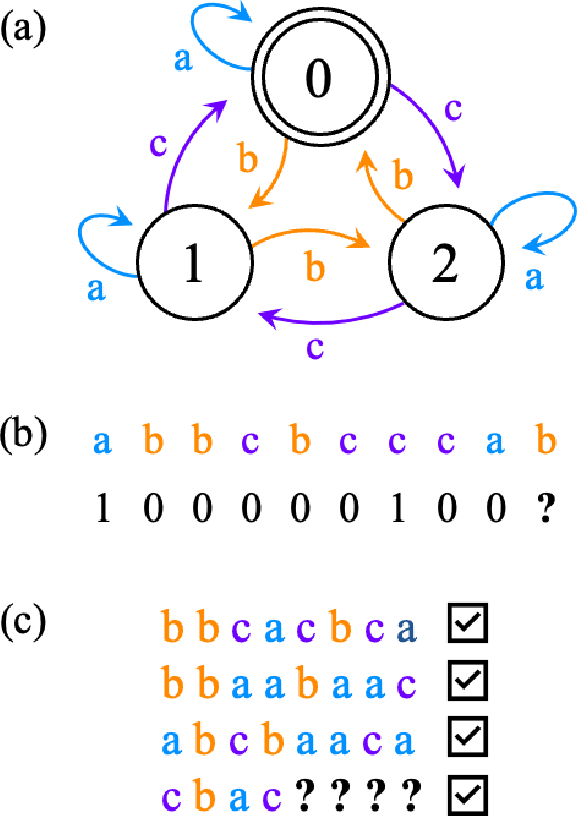
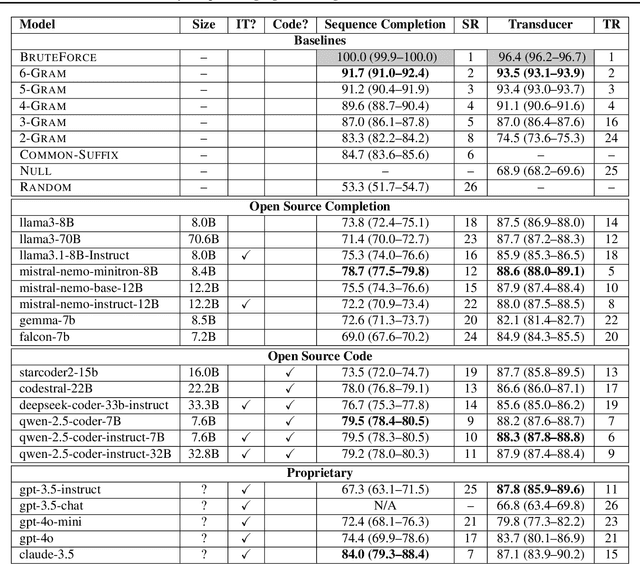
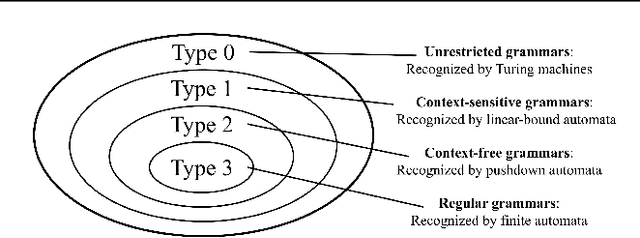
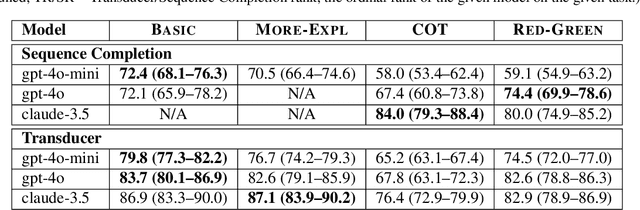
Can LLMs pick up language structure from examples? Evidence in prior work seems to indicate yes, as pretrained models repeatedly demonstrate the ability to adapt to new language structures and vocabularies. However, this line of research typically considers languages that are present within common pretraining datasets, or otherwise share notable similarities with these seen languages. In contrast, in this work we attempt to measure models' language understanding capacity while circumventing the risk of dataset recall. We parameterize large families of language tasks recognized by deterministic finite automata (DFAs), and can thus sample novel language reasoning problems to fairly evaulate LLMs regardless of training data. We find that, even in the strikingly simple setting of 3-state DFAs, LLMs underperform unparameterized ngram models on both language recognition and synthesis tasks. These results suggest that LLMs struggle to match the ability of basic language models in recognizing and reasoning over languages that are sufficiently distinct from the ones they see at training time, underscoring the distinction between learning individual languages and possessing a general theory of language.
MathDSL: A Domain-Specific Language for Concise Mathematical Solutions Via Program Synthesis
Sep 26, 2024We present MathDSL, a Domain-Specific Language (DSL) for mathematical equation solving, which, when deployed in program synthesis models, outperforms state-of-the-art reinforcement-learning-based methods. We also introduce a quantitative metric for measuring the conciseness of a mathematical solution and demonstrate the improvement in the quality of generated solutions compared to other methods. Our system demonstrates that a program synthesis system (DreamCoder) using MathDSL can generate programs that solve linear equations with greater accuracy and conciseness than using reinforcement learning systems. Additionally, we demonstrate that if we use the action spaces of previous reinforcement learning systems as DSLs, MathDSL outperforms the action-space-DSLs. We use DreamCoder to store equation-solving strategies as learned abstractions in its program library and demonstrate that by using MathDSL, these can be converted into human-interpretable solution strategies that could have applications in mathematical education.