 Add to Chrome
 Add to Firefox
 Add to Edge
Unified Embodied VLM Reasoning with Robotic Action via Autoregressive Discretized Pre-training
Dec 30, 2025
General-purpose robotic systems operating in open-world environments must achieve both broad generalization and high-precision action execution, a combination that remains challenging for existing Vision-Language-Action (VLA) models. While large Vision-Language Models (VLMs) improve semantic generalization, insufficient embodied reasoning leads to brittle behavior, and conversely, strong reasoning alone is inadequate without precise control. To provide a decoupled and quantitative assessment of this bottleneck, we introduce Embodied Reasoning Intelligence Quotient (ERIQ), a large-scale embodied reasoning benchmark in robotic manipulation, comprising 6K+ question-answer pairs across four reasoning dimensions. By decoupling reasoning from execution, ERIQ enables systematic evaluation and reveals a strong positive correlation between embodied reasoning capability and end-to-end VLA generalization. To bridge the gap from reasoning to precise execution, we propose FACT, a flow-matching-based action tokenizer that converts continuous control into discrete sequences while preserving high-fidelity trajectory reconstruction. The resulting GenieReasoner jointly optimizes reasoning and action in a unified space, outperforming both continuous-action and prior discrete-action baselines in real-world tasks. Together, ERIQ and FACT provide a principled framework for diagnosing and overcoming the reasoning-precision trade-off, advancing robust, general-purpose robotic manipulation.

Genie Centurion: Accelerating Scalable Real-World Robot Training with Human Rewind-and-Refine Guidance
May 24, 2025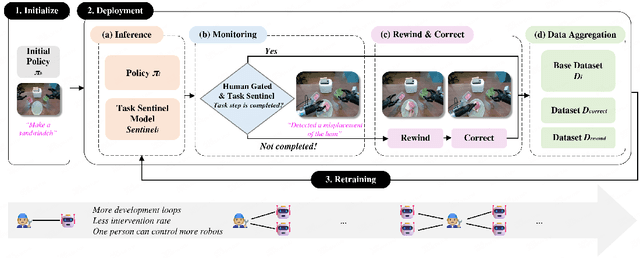
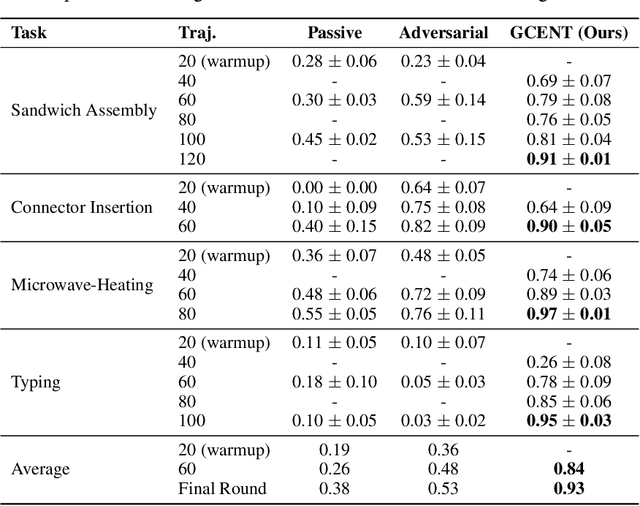
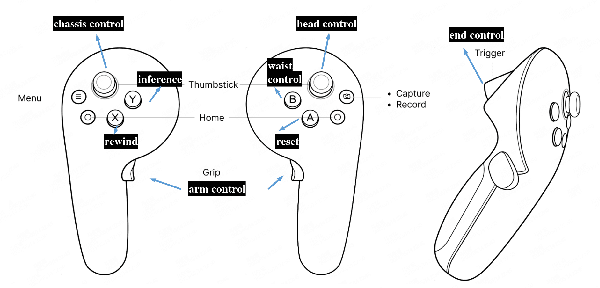
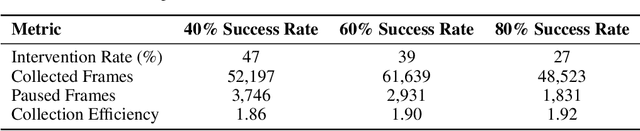
While Vision-Language-Action (VLA) models show strong generalizability in various tasks, real-world deployment of robotic policy still requires large-scale, high-quality human expert demonstrations. However, passive data collection via human teleoperation is costly, hard to scale, and often biased toward passive demonstrations with limited diversity. To address this, we propose Genie Centurion (GCENT), a scalable and general data collection paradigm based on human rewind-and-refine guidance. When the robot execution failures occur, GCENT enables the system revert to a previous state with a rewind mechanism, after which a teleoperator provides corrective demonstrations to refine the policy. This framework supports a one-human-to-many-robots supervision scheme with a Task Sentinel module, which autonomously predicts task success and solicits human intervention when necessary, enabling scalable supervision. Empirical results show that GCENT achieves up to 40% higher task success rates than state-of-the-art data collection methods, and reaches comparable performance using less than half the data. We also quantify the data yield-to-effort ratio under multi-robot scenarios, demonstrating GCENT's potential for scalable and cost-efficient robot policy training in real-world environments.
EnerVerse-AC: Envisioning Embodied Environments with Action Condition
May 14, 2025Robotic imitation learning has advanced from solving static tasks to addressing dynamic interaction scenarios, but testing and evaluation remain costly and challenging due to the need for real-time interaction with dynamic environments. We propose EnerVerse-AC (EVAC), an action-conditional world model that generates future visual observations based on an agent's predicted actions, enabling realistic and controllable robotic inference. Building on prior architectures, EVAC introduces a multi-level action-conditioning mechanism and ray map encoding for dynamic multi-view image generation while expanding training data with diverse failure trajectories to improve generalization. As both a data engine and evaluator, EVAC augments human-collected trajectories into diverse datasets and generates realistic, action-conditioned video observations for policy testing, eliminating the need for physical robots or complex simulations. This approach significantly reduces costs while maintaining high fidelity in robotic manipulation evaluation. Extensive experiments validate the effectiveness of our method. Code, checkpoints, and datasets can be found at <https://annaj2178.github.io/EnerverseAC.github.io>.
AgiBot World Colosseo: A Large-scale Manipulation Platform for Scalable and Intelligent Embodied Systems
Mar 09, 2025We explore how scalable robot data can address real-world challenges for generalized robotic manipulation. Introducing AgiBot World, a large-scale platform comprising over 1 million trajectories across 217 tasks in five deployment scenarios, we achieve an order-of-magnitude increase in data scale compared to existing datasets. Accelerated by a standardized collection pipeline with human-in-the-loop verification, AgiBot World guarantees high-quality and diverse data distribution. It is extensible from grippers to dexterous hands and visuo-tactile sensors for fine-grained skill acquisition. Building on top of data, we introduce Genie Operator-1 (GO-1), a novel generalist policy that leverages latent action representations to maximize data utilization, demonstrating predictable performance scaling with increased data volume. Policies pre-trained on our dataset achieve an average performance improvement of 30% over those trained on Open X-Embodiment, both in in-domain and out-of-distribution scenarios. GO-1 exhibits exceptional capability in real-world dexterous and long-horizon tasks, achieving over 60% success rate on complex tasks and outperforming prior RDT approach by 32%. By open-sourcing the dataset, tools, and models, we aim to democratize access to large-scale, high-quality robot data, advancing the pursuit of scalable and general-purpose intelligence.