 Add to Chrome
 Add to Firefox
 Add to Edge
Wpf
Papers and Code
Fast-Powerformer: A Memory-Efficient Transformer for Accurate Mid-Term Wind Power Forecasting
Apr 15, 2025

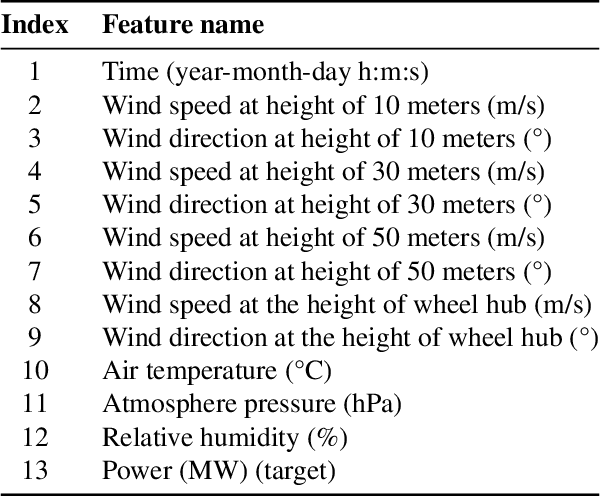
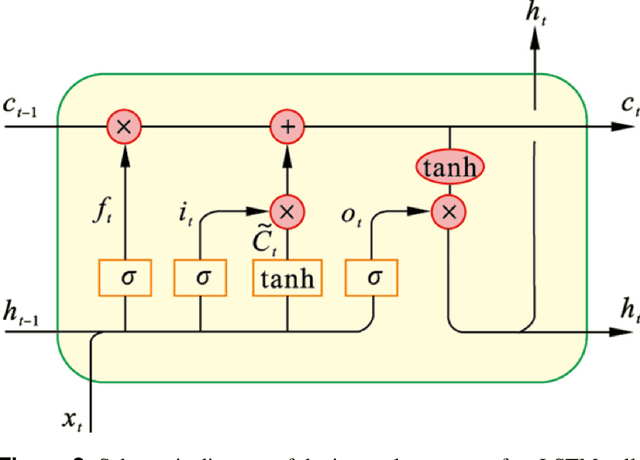
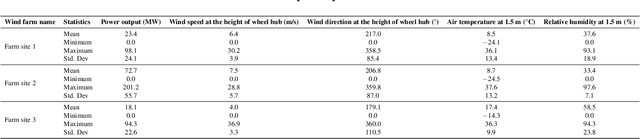
Wind power forecasting (WPF), as a significant research topic within renewable energy, plays a crucial role in enhancing the security, stability, and economic operation of power grids. However, due to the high stochasticity of meteorological factors (e.g., wind speed) and significant fluctuations in wind power output, mid-term wind power forecasting faces a dual challenge of maintaining high accuracy and computational efficiency. To address these issues, this paper proposes an efficient and lightweight mid-term wind power forecasting model, termed Fast-Powerformer. The proposed model is built upon the Reformer architecture, incorporating structural enhancements such as a lightweight Long Short-Term Memory (LSTM) embedding module, an input transposition mechanism, and a Frequency Enhanced Channel Attention Mechanism (FECAM). These improvements enable the model to strengthen temporal feature extraction, optimize dependency modeling across variables, significantly reduce computational complexity, and enhance sensitivity to periodic patterns and dominant frequency components. Experimental results conducted on multiple real-world wind farm datasets demonstrate that the proposed Fast-Powerformer achieves superior prediction accuracy and operational efficiency compared to mainstream forecasting approaches. Furthermore, the model exhibits fast inference speed and low memory consumption, highlighting its considerable practical value for real-world deployment scenarios.

Applying Ensemble Models based on Graph Neural Network and Reinforcement Learning for Wind Power Forecasting
Jan 28, 2025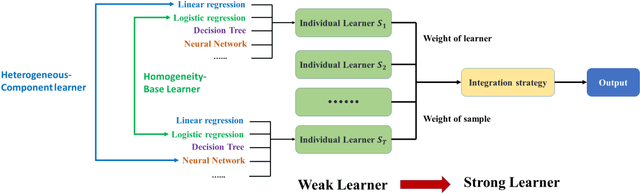
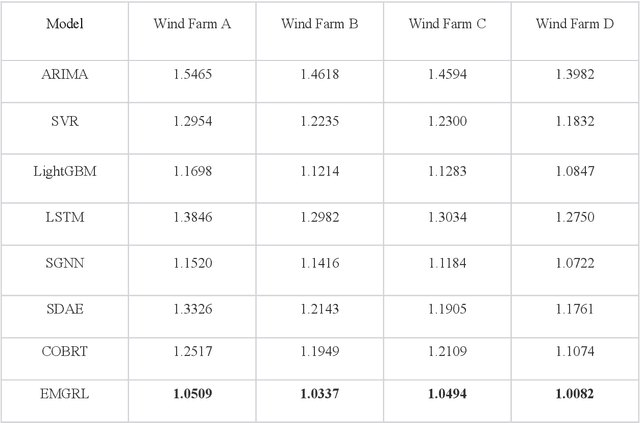
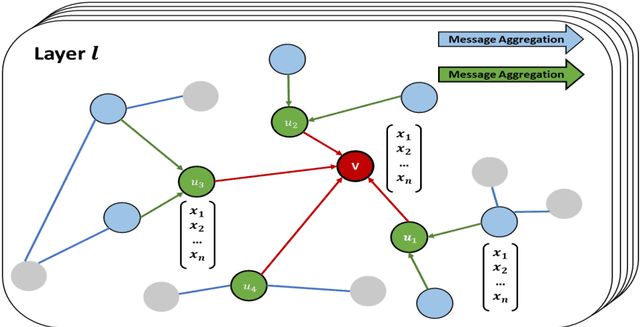
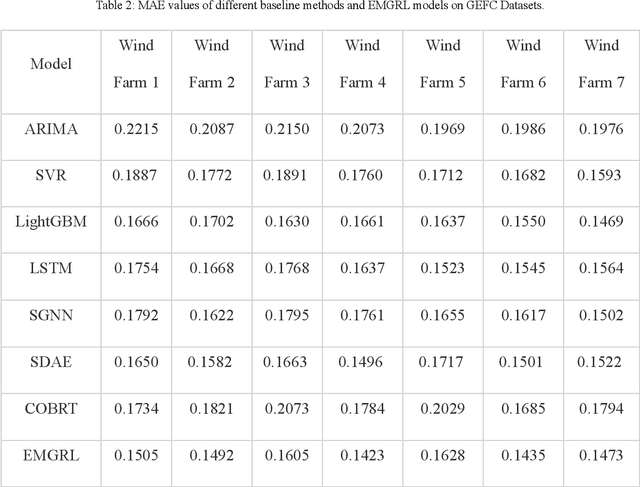
Accurately predicting the wind power output of a wind farm across various time scales utilizing Wind Power Forecasting (WPF) is a critical issue in wind power trading and utilization. The WPF problem remains unresolved due to numerous influencing variables, such as wind speed, temperature, latitude, and longitude. Furthermore, achieving high prediction accuracy is crucial for maintaining electric grid stability and ensuring supply security. In this paper, we model all wind turbines within a wind farm as graph nodes in a graph built by their geographical locations. Accordingly, we propose an ensemble model based on graph neural networks and reinforcement learning (EMGRL) for WPF. Our approach includes: (1) applying graph neural networks to capture the time-series data from neighboring wind farms relevant to the target wind farm; (2) establishing a general state embedding that integrates the target wind farm's data with the historical performance of base models on the target wind farm; (3) ensembling and leveraging the advantages of all base models through an actor-critic reinforcement learning framework for WPF.
Towards Fine-Grained Webpage Fingerprinting at Scale
Sep 06, 2024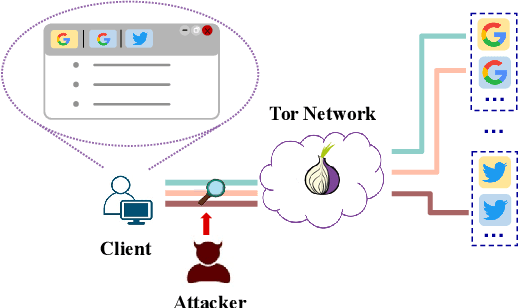
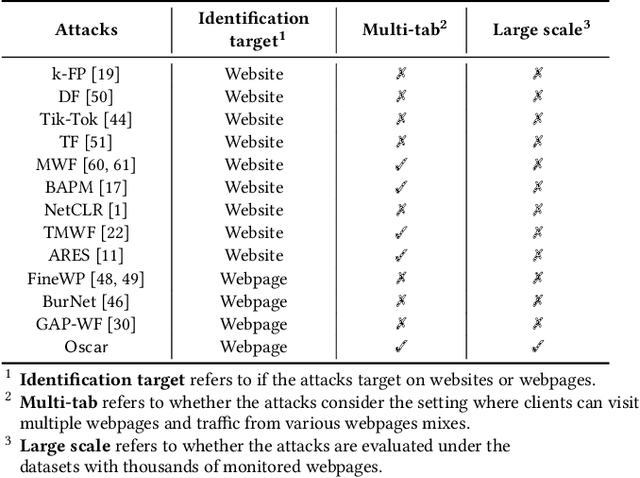
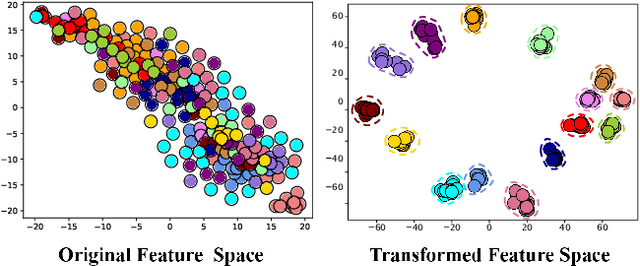
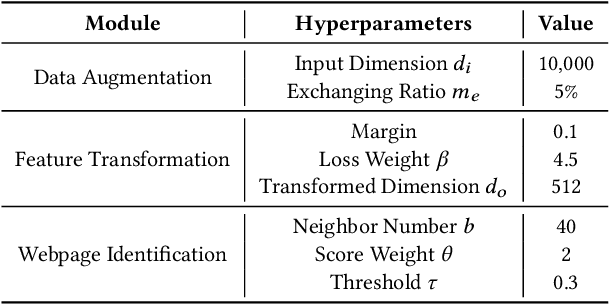
Website Fingerprinting (WF) attacks can effectively identify the websites visited by Tor clients via analyzing encrypted traffic patterns. Existing attacks focus on identifying different websites, but their accuracy dramatically decreases when applied to identify fine-grained webpages, especially when distinguishing among different subpages of the same website. WebPage Fingerprinting (WPF) attacks face the challenges of highly similar traffic patterns and a much larger scale of webpages. Furthermore, clients often visit multiple webpages concurrently, increasing the difficulty of extracting the traffic patterns of each webpage from the obfuscated traffic. In this paper, we propose Oscar, a WPF attack based on multi-label metric learning that identifies different webpages from obfuscated traffic by transforming the feature space. Oscar can extract the subtle differences among various webpages, even those with similar traffic patterns. In particular, Oscar combines proxy-based and sample-based metric learning losses to extract webpage features from obfuscated traffic and identify multiple webpages. We prototype Oscar and evaluate its performance using traffic collected from 1,000 monitored webpages and over 9,000 unmonitored webpages in the real world. Oscar demonstrates an 88.6% improvement in the multi-label metric Recall@5 compared to the state-of-the-art attacks.
An Adaptive Approach for Probabilistic Wind Power Forecasting Based on Meta-Learning
Aug 15, 2023This paper studies an adaptive approach for probabilistic wind power forecasting (WPF) including offline and online learning procedures. In the offline learning stage, a base forecast model is trained via inner and outer loop updates of meta-learning, which endows the base forecast model with excellent adaptability to different forecast tasks, i.e., probabilistic WPF with different lead times or locations. In the online learning stage, the base forecast model is applied to online forecasting combined with incremental learning techniques. On this basis, the online forecast takes full advantage of recent information and the adaptability of the base forecast model. Two applications are developed based on our proposed approach concerning forecasting with different lead times (temporal adaptation) and forecasting for newly established wind farms (spatial adaptation), respectively. Numerical tests were conducted on real-world wind power data sets. Simulation results validate the advantages in adaptivity of the proposed methods compared with existing alternatives.
Long-term Wind Power Forecasting with Hierarchical Spatial-Temporal Transformer
May 30, 2023Wind power is attracting increasing attention around the world due to its renewable, pollution-free, and other advantages. However, safely and stably integrating the high permeability intermittent power energy into electric power systems remains challenging. Accurate wind power forecasting (WPF) can effectively reduce power fluctuations in power system operations. Existing methods are mainly designed for short-term predictions and lack effective spatial-temporal feature augmentation. In this work, we propose a novel end-to-end wind power forecasting model named Hierarchical Spatial-Temporal Transformer Network (HSTTN) to address the long-term WPF problems. Specifically, we construct an hourglass-shaped encoder-decoder framework with skip-connections to jointly model representations aggregated in hierarchical temporal scales, which benefits long-term forecasting. Based on this framework, we capture the inter-scale long-range temporal dependencies and global spatial correlations with two parallel Transformer skeletons and strengthen the intra-scale connections with downsampling and upsampling operations. Moreover, the complementary information from spatial and temporal features is fused and propagated in each other via Contextual Fusion Blocks (CFBs) to promote the prediction further. Extensive experimental results on two large-scale real-world datasets demonstrate the superior performance of our HSTTN over existing solutions.
SDWPF: A Dataset for Spatial Dynamic Wind Power Forecasting Challenge at KDD Cup 2022
Aug 08, 2022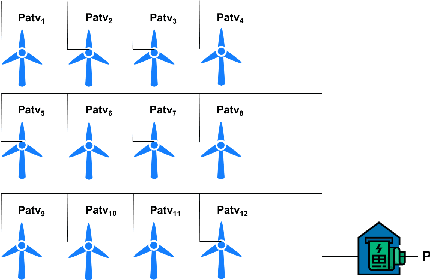

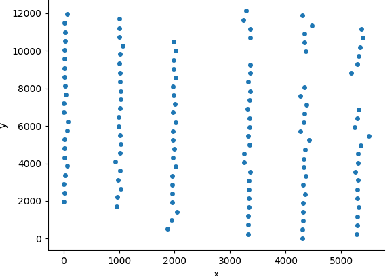
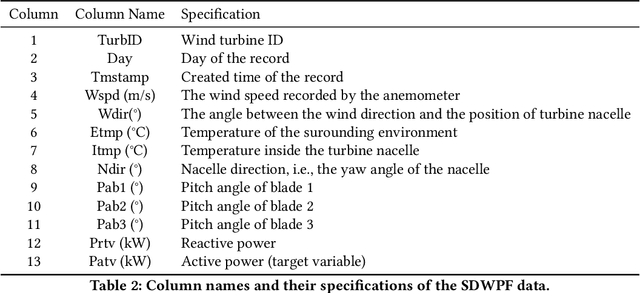
The variability of wind power supply can present substantial challenges to incorporating wind power into a grid system. Thus, Wind Power Forecasting (WPF) has been widely recognized as one of the most critical issues in wind power integration and operation. There has been an explosion of studies on wind power forecasting problems in the past decades. Nevertheless, how to well handle the WPF problem is still challenging, since high prediction accuracy is always demanded to ensure grid stability and security of supply. We present a unique Spatial Dynamic Wind Power Forecasting dataset: SDWPF, which includes the spatial distribution of wind turbines, as well as the dynamic context factors. Whereas, most of the existing datasets have only a small number of wind turbines without knowing the locations and context information of wind turbines at a fine-grained time scale. By contrast, SDWPF provides the wind power data of 134 wind turbines from a wind farm over half a year with their relative positions and internal statuses. We use this dataset to launch the Baidu KDD Cup 2022 to examine the limit of current WPF solutions. The dataset is released at https://aistudio.baidu.com/aistudio/competition/detail/152/0/datasets.