 Add to Chrome
 Add to Firefox
 Add to Edge
FASA: Frequency-aware Sparse Attention
Feb 03, 2026
The deployment of Large Language Models (LLMs) faces a critical bottleneck when handling lengthy inputs: the prohibitive memory footprint of the Key Value (KV) cache. To address this bottleneck, the token pruning paradigm leverages attention sparsity to selectively retain a small, critical subset of tokens. However, existing approaches fall short, with static methods risking irreversible information loss and dynamic strategies employing heuristics that insufficiently capture the query-dependent nature of token importance. We propose FASA, a novel framework that achieves query-aware token eviction by dynamically predicting token importance. FASA stems from a novel insight into RoPE: the discovery of functional sparsity at the frequency-chunk (FC) level. Our key finding is that a small, identifiable subset of "dominant" FCs consistently exhibits high contextual agreement with the full attention head. This provides a robust and computationally free proxy for identifying salient tokens. %making them a powerful and efficient proxy for token importance. Building on this insight, FASA first identifies a critical set of tokens using dominant FCs, and then performs focused attention computation solely on this pruned subset. % Since accessing only a small fraction of the KV cache, FASA drastically lowers memory bandwidth requirements and computational cost. Across a spectrum of long-context tasks, from sequence modeling to complex CoT reasoning, FASA consistently outperforms all token-eviction baselines and achieves near-oracle accuracy, demonstrating remarkable robustness even under constraint budgets. Notably, on LongBench-V1, FASA reaches nearly 100\% of full-KV performance when only keeping 256 tokens, and achieves 2.56$\times$ speedup using just 18.9\% of the cache on AIME24.

Dr. Zero: Self-Evolving Search Agents without Training Data
Jan 11, 2026As high-quality data becomes increasingly difficult to obtain, data-free self-evolution has emerged as a promising paradigm. This approach allows large language models (LLMs) to autonomously generate and solve complex problems, thereby improving their reasoning capabilities. However, multi-turn search agents struggle in data-free self-evolution due to the limited question diversity and the substantial compute required for multi-step reasoning and tool using. In this work, we introduce Dr. Zero, a framework enabling search agents to effectively self-evolve without any training data. In particular, we design a self-evolution feedback loop where a proposer generates diverse questions to train a solver initialized from the same base model. As the solver evolves, it incentivizes the proposer to produce increasingly difficult yet solvable tasks, thus establishing an automated curriculum to refine both agents. To enhance training efficiency, we also introduce hop-grouped relative policy optimization (HRPO). This method clusters structurally similar questions to construct group-level baselines, effectively minimizing the sampling overhead in evaluating each query's individual difficulty and solvability. Consequently, HRPO significantly reduces the compute requirements for solver training without compromising performance or stability. Extensive experiment results demonstrate that the data-free Dr. Zero matches or surpasses fully supervised search agents, proving that complex reasoning and search capabilities can emerge solely through self-evolution.
Boosting Data Utilization for Multilingual Dense Retrieval
Sep 11, 2025Multilingual dense retrieval aims to retrieve relevant documents across different languages based on a unified retriever model. The challenge lies in aligning representations of different languages in a shared vector space. The common practice is to fine-tune the dense retriever via contrastive learning, whose effectiveness highly relies on the quality of the negative sample and the efficacy of mini-batch data. Different from the existing studies that focus on developing sophisticated model architecture, we propose a method to boost data utilization for multilingual dense retrieval by obtaining high-quality hard negative samples and effective mini-batch data. The extensive experimental results on a multilingual retrieval benchmark, MIRACL, with 16 languages demonstrate the effectiveness of our method by outperforming several existing strong baselines.
Hybrid Latent Reasoning via Reinforcement Learning
May 24, 2025Recent advances in large language models (LLMs) have introduced latent reasoning as a promising alternative to autoregressive reasoning. By performing internal computation with hidden states from previous steps, latent reasoning benefit from more informative features rather than sampling a discrete chain-of-thought (CoT) path. Yet latent reasoning approaches are often incompatible with LLMs, as their continuous paradigm conflicts with the discrete nature of autoregressive generation. Moreover, these methods rely on CoT traces for training and thus fail to exploit the inherent reasoning patterns of LLMs. In this work, we explore latent reasoning by leveraging the intrinsic capabilities of LLMs via reinforcement learning (RL). To this end, we introduce hybrid reasoning policy optimization (HRPO), an RL-based hybrid latent reasoning approach that (1) integrates prior hidden states into sampled tokens with a learnable gating mechanism, and (2) initializes training with predominantly token embeddings while progressively incorporating more hidden features. This design maintains LLMs' generative capabilities and incentivizes hybrid reasoning using both discrete and continuous representations. In addition, the hybrid HRPO introduces stochasticity into latent reasoning via token sampling, thereby enabling RL-based optimization without requiring CoT trajectories. Extensive evaluations across diverse benchmarks show that HRPO outperforms prior methods in both knowledge- and reasoning-intensive tasks. Furthermore, HRPO-trained LLMs remain interpretable and exhibit intriguing behaviors like cross-lingual patterns and shorter completion lengths, highlighting the potential of our RL-based approach and offer insights for future work in latent reasoning.
Can Pre-training Indicators Reliably Predict Fine-tuning Outcomes of LLMs?
Apr 16, 2025While metrics available during pre-training, such as perplexity, correlate well with model performance at scaling-laws studies, their predictive capacities at a fixed model size remain unclear, hindering effective model selection and development. To address this gap, we formulate the task of selecting pre-training checkpoints to maximize downstream fine-tuning performance as a pairwise classification problem: predicting which of two LLMs, differing in their pre-training, will perform better after supervised fine-tuning (SFT). We construct a dataset using 50 1B parameter LLM variants with systematically varied pre-training configurations, e.g., objectives or data, and evaluate them on diverse downstream tasks after SFT. We first conduct a study and demonstrate that the conventional perplexity is a misleading indicator. As such, we introduce novel unsupervised and supervised proxy metrics derived from pre-training that successfully reduce the relative performance prediction error rate by over 50%. Despite the inherent complexity of this task, we demonstrate the practical utility of our proposed proxies in specific scenarios, paving the way for more efficient design of pre-training schemes optimized for various downstream tasks.
Search-R1: Training LLMs to Reason and Leverage Search Engines with Reinforcement Learning
Mar 12, 2025Efficiently acquiring external knowledge and up-to-date information is essential for effective reasoning and text generation in large language models (LLMs). Retrieval augmentation and tool-use training approaches where a search engine is treated as a tool lack complex multi-turn retrieval flexibility or require large-scale supervised data. Prompting advanced LLMs with reasoning capabilities during inference to use search engines is not optimal, since the LLM does not learn how to optimally interact with the search engine. This paper introduces Search-R1, an extension of the DeepSeek-R1 model where the LLM learns -- solely through reinforcement learning (RL) -- to autonomously generate (multiple) search queries during step-by-step reasoning with real-time retrieval. Search-R1 optimizes LLM rollouts with multi-turn search interactions, leveraging retrieved token masking for stable RL training and a simple outcome-based reward function. Experiments on seven question-answering datasets show that Search-R1 improves performance by 26% (Qwen2.5-7B), 21% (Qwen2.5-3B), and 10% (LLaMA3.2-3B) over SOTA baselines. This paper further provides empirical insights into RL optimization methods, LLM choices, and response length dynamics in retrieval-augmented reasoning. The code and model checkpoints are available at https://github.com/PeterGriffinJin/Search-R1.
Transferable Sequential Recommendation via Vector Quantized Meta Learning
Nov 04, 2024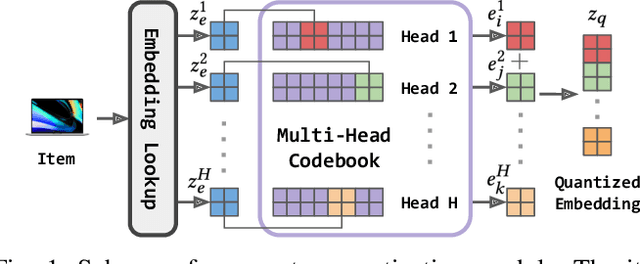
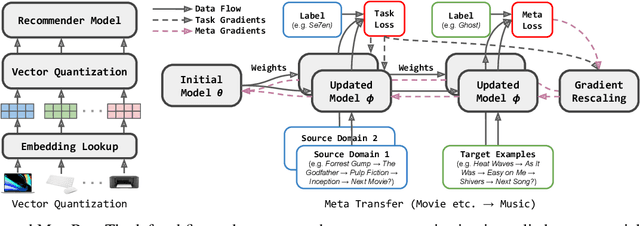
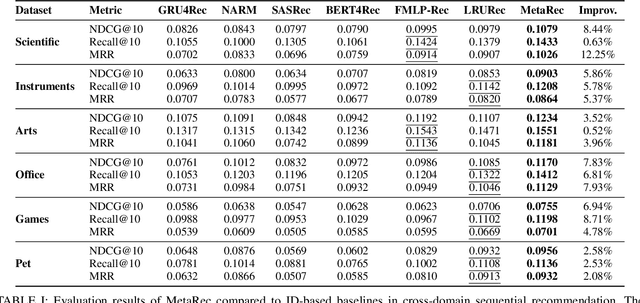
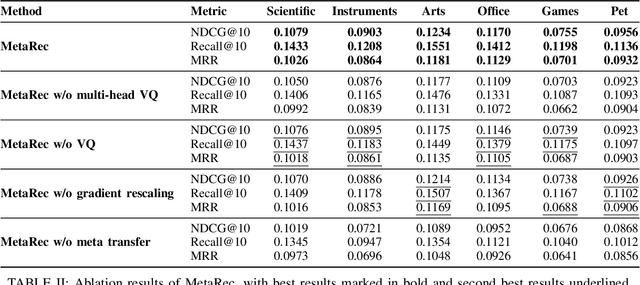
While sequential recommendation achieves significant progress on capturing user-item transition patterns, transferring such large-scale recommender systems remains challenging due to the disjoint user and item groups across domains. In this paper, we propose a vector quantized meta learning for transferable sequential recommenders (MetaRec). Without requiring additional modalities or shared information across domains, our approach leverages user-item interactions from multiple source domains to improve the target domain performance. To solve the input heterogeneity issue, we adopt vector quantization that maps item embeddings from heterogeneous input spaces to a shared feature space. Moreover, our meta transfer paradigm exploits limited target data to guide the transfer of source domain knowledge to the target domain (i.e., learn to transfer). In addition, MetaRec adaptively transfers from multiple source tasks by rescaling meta gradients based on the source-target domain similarity, enabling selective learning to improve recommendation performance. To validate the effectiveness of our approach, we perform extensive experiments on benchmark datasets, where MetaRec consistently outperforms baseline methods by a considerable margin.
Inference Scaling for Long-Context Retrieval Augmented Generation
Oct 06, 2024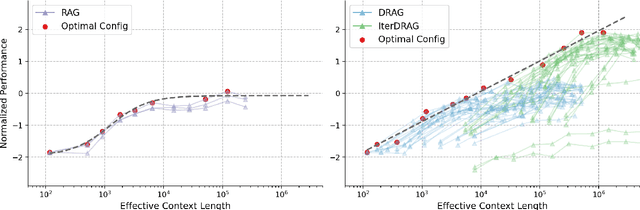
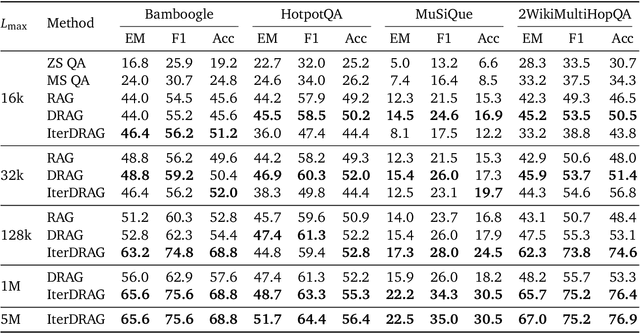
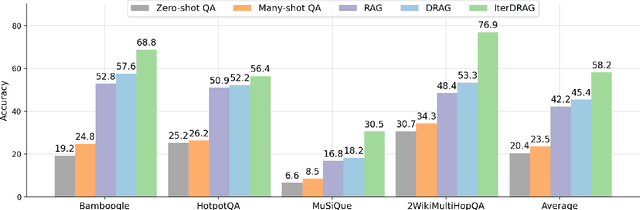

The scaling of inference computation has unlocked the potential of long-context large language models (LLMs) across diverse settings. For knowledge-intensive tasks, the increased compute is often allocated to incorporate more external knowledge. However, without effectively utilizing such knowledge, solely expanding context does not always enhance performance. In this work, we investigate inference scaling for retrieval augmented generation (RAG), exploring strategies beyond simply increasing the quantity of knowledge. We focus on two inference scaling strategies: in-context learning and iterative prompting. These strategies provide additional flexibility to scale test-time computation (e.g., by increasing retrieved documents or generation steps), thereby enhancing LLMs' ability to effectively acquire and utilize contextual information. We address two key questions: (1) How does RAG performance benefit from the scaling of inference computation when optimally configured? (2) Can we predict the optimal test-time compute allocation for a given budget by modeling the relationship between RAG performance and inference parameters? Our observations reveal that increasing inference computation leads to nearly linear gains in RAG performance when optimally allocated, a relationship we describe as the inference scaling laws for RAG. Building on this, we further develop the computation allocation model to estimate RAG performance across different inference configurations. The model predicts optimal inference parameters under various computation constraints, which align closely with the experimental results. By applying these optimal configurations, we demonstrate that scaling inference compute on long-context LLMs achieves up to 58.9% gains on benchmark datasets compared to standard RAG.
Train Once, Deploy Anywhere: Matryoshka Representation Learning for Multimodal Recommendation
Sep 25, 2024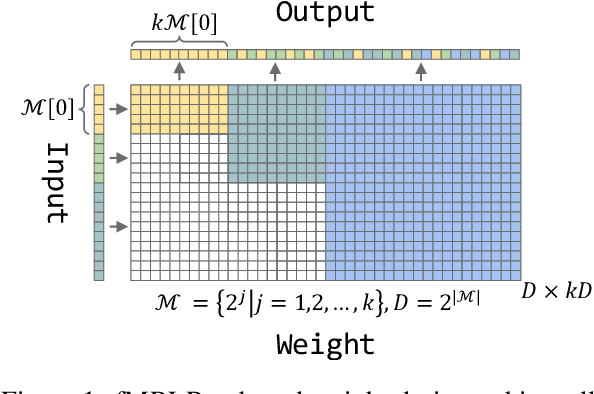
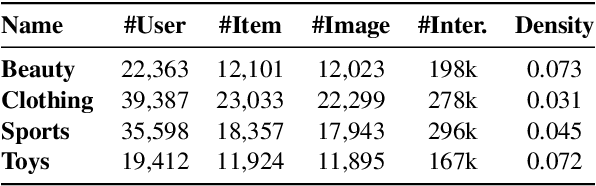
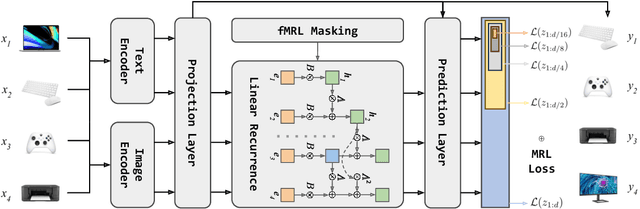
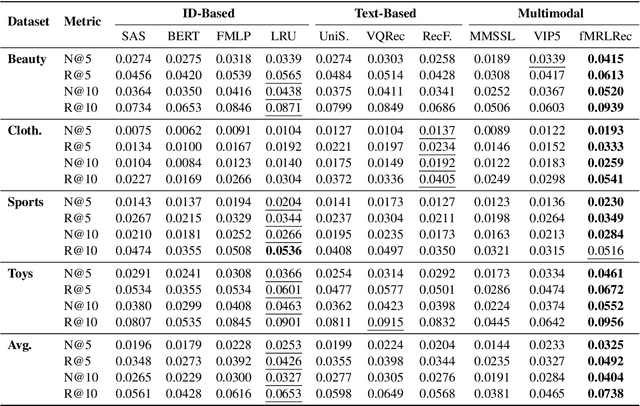
Despite recent advancements in language and vision modeling, integrating rich multimodal knowledge into recommender systems continues to pose significant challenges. This is primarily due to the need for efficient recommendation, which requires adaptive and interactive responses. In this study, we focus on sequential recommendation and introduce a lightweight framework called full-scale Matryoshka representation learning for multimodal recommendation (fMRLRec). Our fMRLRec captures item features at different granularities, learning informative representations for efficient recommendation across multiple dimensions. To integrate item features from diverse modalities, fMRLRec employs a simple mapping to project multimodal item features into an aligned feature space. Additionally, we design an efficient linear transformation that embeds smaller features into larger ones, substantially reducing memory requirements for large-scale training on recommendation data. Combined with improved state space modeling techniques, fMRLRec scales to different dimensions and only requires one-time training to produce multiple models tailored to various granularities. We demonstrate the effectiveness and efficiency of fMRLRec on multiple benchmark datasets, which consistently achieves superior performance over state-of-the-art baseline methods.
Retrieval Augmented Fact Verification by Synthesizing Contrastive Arguments
Jun 14, 2024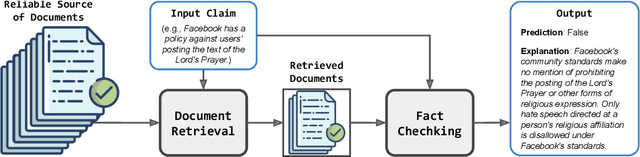
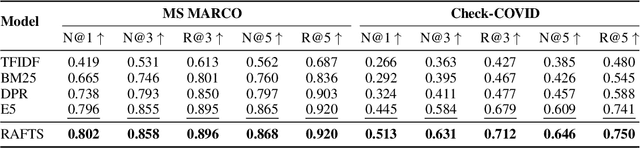
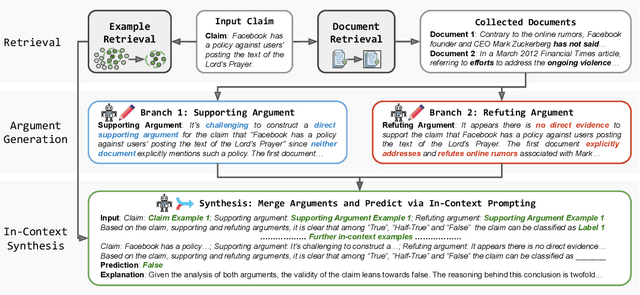
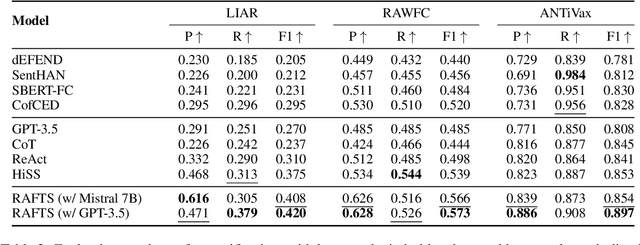
The rapid propagation of misinformation poses substantial risks to public interest. To combat misinformation, large language models (LLMs) are adapted to automatically verify claim credibility. Nevertheless, existing methods heavily rely on the embedded knowledge within LLMs and / or black-box APIs for evidence collection, leading to subpar performance with smaller LLMs or upon unreliable context. In this paper, we propose retrieval augmented fact verification through the synthesis of contrasting arguments (RAFTS). Upon input claims, RAFTS starts with evidence retrieval, where we design a retrieval pipeline to collect and re-rank relevant documents from verifiable sources. Then, RAFTS forms contrastive arguments (i.e., supporting or refuting) conditioned on the retrieved evidence. In addition, RAFTS leverages an embedding model to identify informative demonstrations, followed by in-context prompting to generate the prediction and explanation. Our method effectively retrieves relevant documents as evidence and evaluates arguments from varying perspectives, incorporating nuanced information for fine-grained decision-making. Combined with informative in-context examples as prior, RAFTS achieves significant improvements to supervised and LLM baselines without complex prompts. We demonstrate the effectiveness of our method through extensive experiments, where RAFTS can outperform GPT-based methods with a significantly smaller 7B LLM.