 Add to Chrome
 Add to Firefox
 Add to Edge
FraudShield: Knowledge Graph Empowered Defense for LLMs against Fraud Attacks
Jan 30, 2026
Large language models (LLMs) have been widely integrated into critical automated workflows, including contract review and job application processes. However, LLMs are susceptible to manipulation by fraudulent information, which can lead to harmful outcomes. Although advanced defense methods have been developed to address this issue, they often exhibit limitations in effectiveness, interpretability, and generalizability, particularly when applied to LLM-based applications. To address these challenges, we introduce FraudShield, a novel framework designed to protect LLMs from fraudulent content by leveraging a comprehensive analysis of fraud tactics. Specifically, FraudShield constructs and refines a fraud tactic-keyword knowledge graph to capture high-confidence associations between suspicious text and fraud techniques. The structured knowledge graph augments the original input by highlighting keywords and providing supporting evidence, guiding the LLM toward more secure responses. Extensive experiments show that FraudShield consistently outperforms state-of-the-art defenses across four mainstream LLMs and five representative fraud types, while also offering interpretable clues for the model's generations.

SpecTran: Spectral-Aware Transformer-based Adapter for LLM-Enhanced Sequential Recommendation
Jan 29, 2026Traditional sequential recommendation (SR) models learn low-dimensional item ID embeddings from user-item interactions, often overlooking textual information such as item titles or descriptions. Recent advances in Large Language Models (LLMs) have inspired a surge of research that encodes item textual information with high-dimensional semantic embeddings, and designs transformation methods to inject such embeddings into SR models. These embedding transformation strategies can be categorized into two types, both of which exhibits notable drawbacks: 1) adapter-based methods suffer from pronounced dimension collapse, concentrating information into a few dominant dimensions; 2) SVD-based methods are rigid and manual, considering only a few principal spectral components while discarding rich information in the remaining spectrum. To address these limitations, we propose SpecTran, a spectral-aware transformer-based adapter that operates in the spectral domain, attending to the full spectrum to select and aggregates informative components. A learnable spectral-position encoding injects singular-value cues as an inductive bias, guiding attention toward salient spectral components and promoting diversity across embedding dimensions. Across four real-world datasets and three SR backbones, it consistently outperforms strong baselines, achieving an average improvement of 9.17%.
MARS2 2025 Challenge on Multimodal Reasoning: Datasets, Methods, Results, Discussion, and Outlook
Sep 17, 2025
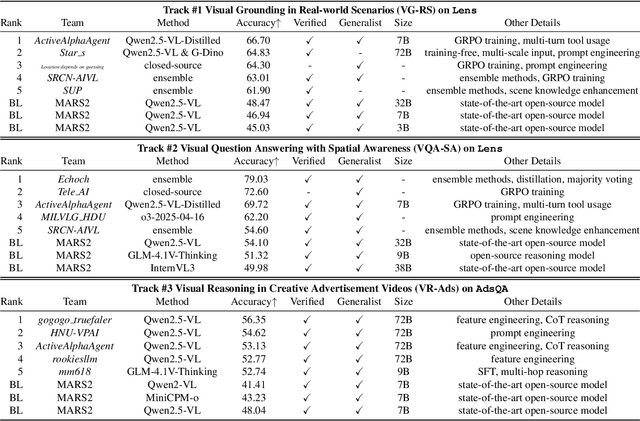
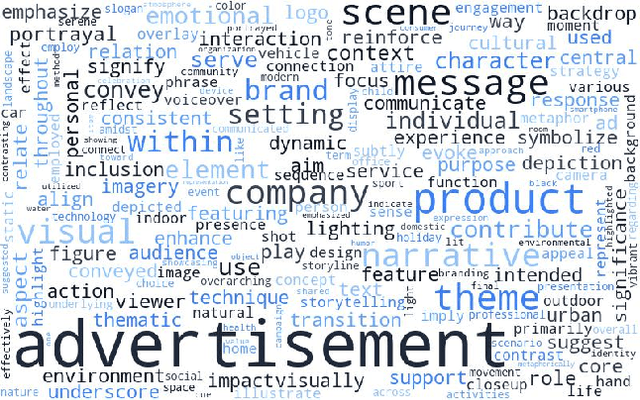
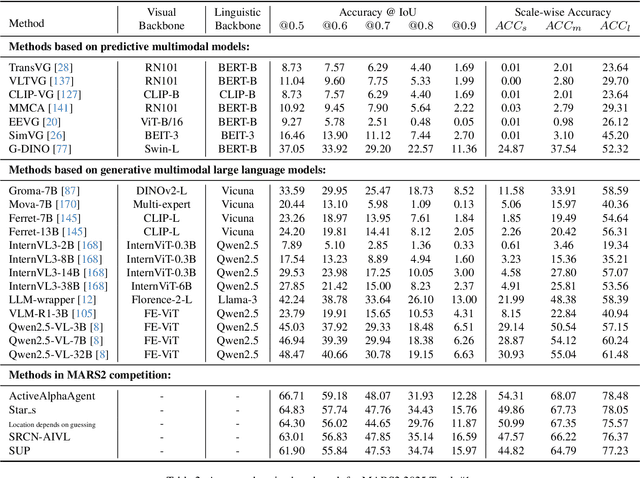
This paper reviews the MARS2 2025 Challenge on Multimodal Reasoning. We aim to bring together different approaches in multimodal machine learning and LLMs via a large benchmark. We hope it better allows researchers to follow the state-of-the-art in this very dynamic area. Meanwhile, a growing number of testbeds have boosted the evolution of general-purpose large language models. Thus, this year's MARS2 focuses on real-world and specialized scenarios to broaden the multimodal reasoning applications of MLLMs. Our organizing team released two tailored datasets Lens and AdsQA as test sets, which support general reasoning in 12 daily scenarios and domain-specific reasoning in advertisement videos, respectively. We evaluated 40+ baselines that include both generalist MLLMs and task-specific models, and opened up three competition tracks, i.e., Visual Grounding in Real-world Scenarios (VG-RS), Visual Question Answering with Spatial Awareness (VQA-SA), and Visual Reasoning in Creative Advertisement Videos (VR-Ads). Finally, 76 teams from the renowned academic and industrial institutions have registered and 40+ valid submissions (out of 1200+) have been included in our ranking lists. Our datasets, code sets (40+ baselines and 15+ participants' methods), and rankings are publicly available on the MARS2 workshop website and our GitHub organization page https://github.com/mars2workshop/, where our updates and announcements of upcoming events will be continuously provided.
VeriOS: Query-Driven Proactive Human-Agent-GUI Interaction for Trustworthy OS Agents
Sep 09, 2025With the rapid progress of multimodal large language models, operating system (OS) agents become increasingly capable of automating tasks through on-device graphical user interfaces (GUIs). However, most existing OS agents are designed for idealized settings, whereas real-world environments often present untrustworthy conditions. To mitigate risks of over-execution in such scenarios, we propose a query-driven human-agent-GUI interaction framework that enables OS agents to decide when to query humans for more reliable task completion. Built upon this framework, we introduce VeriOS-Agent, a trustworthy OS agent trained with a two-stage learning paradigm that falicitate the decoupling and utilization of meta-knowledge. Concretely, VeriOS-Agent autonomously executes actions in normal conditions while proactively querying humans in untrustworthy scenarios. Experiments show that VeriOS-Agent improves the average step-wise success rate by 20.64\% in untrustworthy scenarios over the state-of-the-art, without compromising normal performance. Analysis highlights VeriOS-Agent's rationality, generalizability, and scalability. The codes, datasets and models are available at https://github.com/Wuzheng02/VeriOS.
InfoCons: Identifying Interpretable Critical Concepts in Point Clouds via Information Theory
May 26, 2025Interpretability of point cloud (PC) models becomes imperative given their deployment in safety-critical scenarios such as autonomous vehicles. We focus on attributing PC model outputs to interpretable critical concepts, defined as meaningful subsets of the input point cloud. To enable human-understandable diagnostics of model failures, an ideal critical subset should be *faithful* (preserving points that causally influence predictions) and *conceptually coherent* (forming semantically meaningful structures that align with human perception). We propose InfoCons, an explanation framework that applies information-theoretic principles to decompose the point cloud into 3D concepts, enabling the examination of their causal effect on model predictions with learnable priors. We evaluate InfoCons on synthetic datasets for classification, comparing it qualitatively and quantitatively with four baselines. We further demonstrate its scalability and flexibility on two real-world datasets and in two applications that utilize critical scores of PC.
Revisiting Backdoor Attacks on Time Series Classification in the Frequency Domain
Mar 12, 2025Time series classification (TSC) is a cornerstone of modern web applications, powering tasks such as financial data analysis, network traffic monitoring, and user behavior analysis. In recent years, deep neural networks (DNNs) have greatly enhanced the performance of TSC models in these critical domains. However, DNNs are vulnerable to backdoor attacks, where attackers can covertly implant triggers into models to induce malicious outcomes. Existing backdoor attacks targeting DNN-based TSC models remain elementary. In particular, early methods borrow trigger designs from computer vision, which are ineffective for time series data. More recent approaches utilize generative models for trigger generation, but at the cost of significant computational complexity. In this work, we analyze the limitations of existing attacks and introduce an enhanced method, FreqBack. Drawing inspiration from the fact that DNN models inherently capture frequency domain features in time series data, we identify that improper perturbations in the frequency domain are the root cause of ineffective attacks. To address this, we propose to generate triggers both effectively and efficiently, guided by frequency analysis. FreqBack exhibits substantial performance across five models and eight datasets, achieving an impressive attack success rate of over 90%, while maintaining less than a 3% drop in model accuracy on clean data.