 Add to Chrome
 Add to Firefox
 Add to Edge
When Agents "Misremember" Collectively: Exploring the Mandela Effect in LLM-based Multi-Agent Systems
Jan 31, 2026
Recent advancements in large language models (LLMs) have significantly enhanced the capabilities of collaborative multi-agent systems, enabling them to address complex challenges. However, within these multi-agent systems, the susceptibility of agents to collective cognitive biases remains an underexplored issue. A compelling example is the Mandela effect, a phenomenon where groups collectively misremember past events as a result of false details reinforced through social influence and internalized misinformation. This vulnerability limits our understanding of memory bias in multi-agent systems and raises ethical concerns about the potential spread of misinformation. In this paper, we conduct a comprehensive study on the Mandela effect in LLM-based multi-agent systems, focusing on its existence, causing factors, and mitigation strategies. We propose MANBENCH, a novel benchmark designed to evaluate agent behaviors across four common task types that are susceptible to the Mandela effect, using five interaction protocols that vary in agent roles and memory timescales. We evaluate agents powered by several LLMs on MANBENCH to quantify the Mandela effect and analyze how different factors affect it. Moreover, we propose strategies to mitigate this effect, including prompt-level defenses (e.g., cognitive anchoring and source scrutiny) and model-level alignment-based defense, achieving an average 74.40% reduction in the Mandela effect compared to the baseline. Our findings provide valuable insights for developing more resilient and ethically aligned collaborative multi-agent systems.

FraudShield: Knowledge Graph Empowered Defense for LLMs against Fraud Attacks
Jan 30, 2026Large language models (LLMs) have been widely integrated into critical automated workflows, including contract review and job application processes. However, LLMs are susceptible to manipulation by fraudulent information, which can lead to harmful outcomes. Although advanced defense methods have been developed to address this issue, they often exhibit limitations in effectiveness, interpretability, and generalizability, particularly when applied to LLM-based applications. To address these challenges, we introduce FraudShield, a novel framework designed to protect LLMs from fraudulent content by leveraging a comprehensive analysis of fraud tactics. Specifically, FraudShield constructs and refines a fraud tactic-keyword knowledge graph to capture high-confidence associations between suspicious text and fraud techniques. The structured knowledge graph augments the original input by highlighting keywords and providing supporting evidence, guiding the LLM toward more secure responses. Extensive experiments show that FraudShield consistently outperforms state-of-the-art defenses across four mainstream LLMs and five representative fraud types, while also offering interpretable clues for the model's generations.
Bridging the Copyright Gap: Do Large Vision-Language Models Recognize and Respect Copyrighted Content?
Dec 26, 2025Large vision-language models (LVLMs) have achieved remarkable advancements in multimodal reasoning tasks. However, their widespread accessibility raises critical concerns about potential copyright infringement. Will LVLMs accurately recognize and comply with copyright regulations when encountering copyrighted content (i.e., user input, retrieved documents) in the context? Failure to comply with copyright regulations may lead to serious legal and ethical consequences, particularly when LVLMs generate responses based on copyrighted materials (e.g., retrieved book experts, news reports). In this paper, we present a comprehensive evaluation of various LVLMs, examining how they handle copyrighted content -- such as book excerpts, news articles, music lyrics, and code documentation when they are presented as visual inputs. To systematically measure copyright compliance, we introduce a large-scale benchmark dataset comprising 50,000 multimodal query-content pairs designed to evaluate how effectively LVLMs handle queries that could lead to copyright infringement. Given that real-world copyrighted content may or may not include a copyright notice, the dataset includes query-content pairs in two distinct scenarios: with and without a copyright notice. For the former, we extensively cover four types of copyright notices to account for different cases. Our evaluation reveals that even state-of-the-art closed-source LVLMs exhibit significant deficiencies in recognizing and respecting the copyrighted content, even when presented with the copyright notice. To solve this limitation, we introduce a novel tool-augmented defense framework for copyright compliance, which reduces infringement risks in all scenarios. Our findings underscore the importance of developing copyright-aware LVLMs to ensure the responsible and lawful use of copyrighted content.
CopyrightMeter: Revisiting Copyright Protection in Text-to-image Models
Nov 20, 2024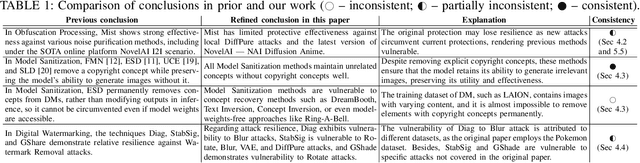
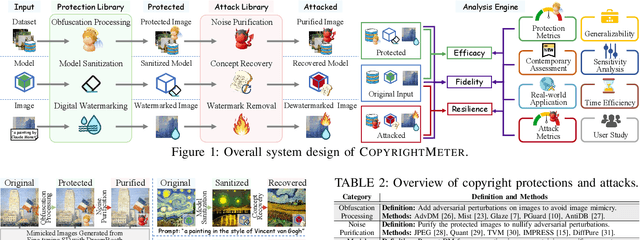
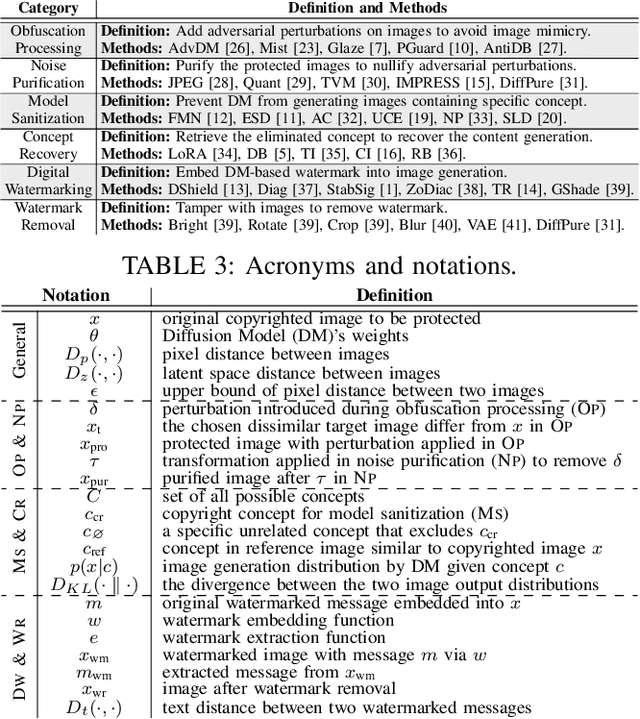
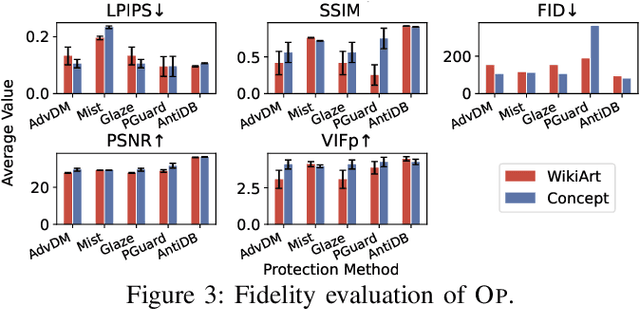
Text-to-image diffusion models have emerged as powerful tools for generating high-quality images from textual descriptions. However, their increasing popularity has raised significant copyright concerns, as these models can be misused to reproduce copyrighted content without authorization. In response, recent studies have proposed various copyright protection methods, including adversarial perturbation, concept erasure, and watermarking techniques. However, their effectiveness and robustness against advanced attacks remain largely unexplored. Moreover, the lack of unified evaluation frameworks has hindered systematic comparison and fair assessment of different approaches. To bridge this gap, we systematize existing copyright protection methods and attacks, providing a unified taxonomy of their design spaces. We then develop CopyrightMeter, a unified evaluation framework that incorporates 17 state-of-the-art protections and 16 representative attacks. Leveraging CopyrightMeter, we comprehensively evaluate protection methods across multiple dimensions, thereby uncovering how different design choices impact fidelity, efficacy, and resilience under attacks. Our analysis reveals several key findings: (i) most protections (16/17) are not resilient against attacks; (ii) the "best" protection varies depending on the target priority; (iii) more advanced attacks significantly promote the upgrading of protections. These insights provide concrete guidance for developing more robust protection methods, while its unified evaluation protocol establishes a standard benchmark for future copyright protection research in text-to-image generation.