 Add to Chrome
 Add to Firefox
 Add to Edge
ECHO-2: A Large-Scale Distributed Rollout Framework for Cost-Efficient Reinforcement Learning
Feb 03, 2026
Reinforcement learning (RL) is a critical stage in post-training large language models (LLMs), involving repeated interaction between rollout generation, reward evaluation, and centralized learning. Distributing rollout execution offers opportunities to leverage more cost-efficient inference resources, but introduces challenges in wide-area coordination and policy dissemination. We present ECHO-2, a distributed RL framework for post-training with remote inference workers and non-negligible dissemination latency. ECHO-2 combines centralized learning with distributed rollouts and treats bounded policy staleness as a user-controlled parameter, enabling rollout generation, dissemination, and training to overlap. We introduce an overlap-based capacity model that relates training time, dissemination latency, and rollout throughput, yielding a practical provisioning rule for sustaining learner utilization. To mitigate dissemination bottlenecks and lower cost, ECHO-2 employs peer-assisted pipelined broadcast and cost-aware activation of heterogeneous workers. Experiments on GRPO post-training of 4B and 8B models under real wide-area bandwidth regimes show that ECHO-2 significantly improves cost efficiency while preserving RL reward comparable to strong baselines.

Controlled LLM Training on Spectral Sphere
Jan 13, 2026Scaling large models requires optimization strategies that ensure rapid convergence grounded in stability. Maximal Update Parametrization ($\boldsymbolμ$P) provides a theoretical safeguard for width-invariant $Θ(1)$ activation control, whereas emerging optimizers like Muon are only ``half-aligned'' with these constraints: they control updates but allow weights to drift. To address this limitation, we introduce the \textbf{Spectral Sphere Optimizer (SSO)}, which enforces strict module-wise spectral constraints on both weights and their updates. By deriving the steepest descent direction on the spectral sphere, SSO realizes a fully $\boldsymbolμ$P-aligned optimization process. To enable large-scale training, we implement SSO as an efficient parallel algorithm within Megatron. Through extensive pretraining on diverse architectures, including Dense 1.7B, MoE 8B-A1B, and 200-layer DeepNet models, SSO consistently outperforms AdamW and Muon. Furthermore, we observe significant practical stability benefits, including improved MoE router load balancing, suppressed outliers, and strictly bounded activations.
Echo: Decoupling Inference and Training for Large-Scale RL Alignment on Heterogeneous Swarms
Aug 07, 2025Modern RL-based post-training for large language models (LLMs) co-locate trajectory sampling and policy optimisation on the same GPU cluster, forcing the system to switch between inference and training workloads. This serial context switching violates the single-program-multiple-data (SPMD) assumption underlying today's distributed training systems. We present Echo, the RL system that cleanly decouples these two phases across heterogeneous "inference" and "training" swarms while preserving statistical efficiency. Echo introduces two lightweight synchronization protocols: a sequential pull mode that refreshes sampler weights on every API call for minimal bias, and an asynchronous push-pull mode that streams version-tagged rollouts through a replay buffer to maximise hardware utilisation. Training three representative RL workloads with Qwen3-4B, Qwen2.5-7B and Qwen3-32B on a geographically distributed cluster, Echo matches a fully co-located Verl baseline in convergence speed and final reward while off-loading trajectory generation to commodity edge hardware. These promising results demonstrate that large-scale RL for LLMs could achieve datacentre-grade performance using decentralised, heterogeneous resources.
SafeWork-R1: Coevolving Safety and Intelligence under the AI-45$^{\circ}$ Law
Jul 24, 2025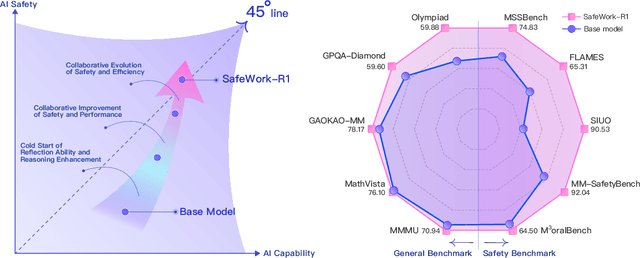
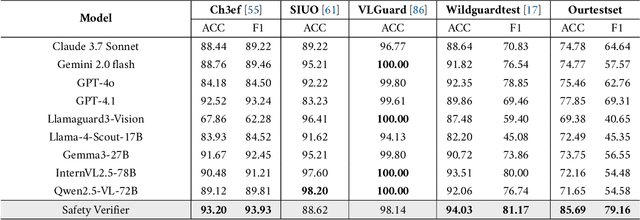
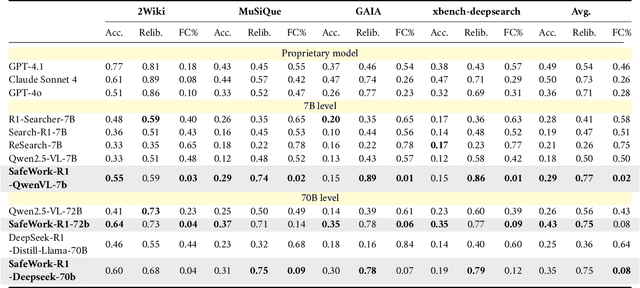
We introduce SafeWork-R1, a cutting-edge multimodal reasoning model that demonstrates the coevolution of capabilities and safety. It is developed by our proposed SafeLadder framework, which incorporates large-scale, progressive, safety-oriented reinforcement learning post-training, supported by a suite of multi-principled verifiers. Unlike previous alignment methods such as RLHF that simply learn human preferences, SafeLadder enables SafeWork-R1 to develop intrinsic safety reasoning and self-reflection abilities, giving rise to safety `aha' moments. Notably, SafeWork-R1 achieves an average improvement of $46.54\%$ over its base model Qwen2.5-VL-72B on safety-related benchmarks without compromising general capabilities, and delivers state-of-the-art safety performance compared to leading proprietary models such as GPT-4.1 and Claude Opus 4. To further bolster its reliability, we implement two distinct inference-time intervention methods and a deliberative search mechanism, enforcing step-level verification. Finally, we further develop SafeWork-R1-InternVL3-78B, SafeWork-R1-DeepSeek-70B, and SafeWork-R1-Qwen2.5VL-7B. All resulting models demonstrate that safety and capability can co-evolve synergistically, highlighting the generalizability of our framework in building robust, reliable, and trustworthy general-purpose AI.
Logic-RL: Unleashing LLM Reasoning with Rule-Based Reinforcement Learning
Feb 20, 2025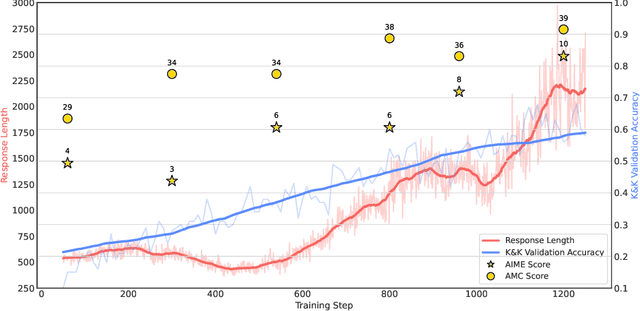

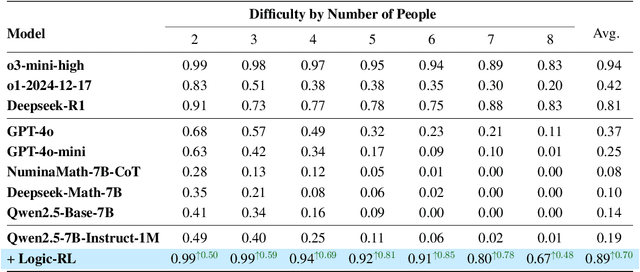
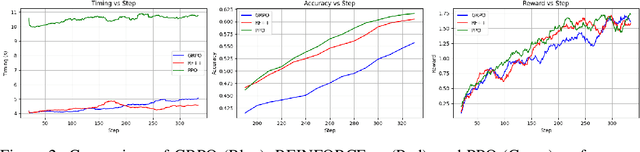
Inspired by the success of DeepSeek-R1, we explore the potential of rule-based reinforcement learning (RL) in large reasoning models. To analyze reasoning dynamics, we use synthetic logic puzzles as training data due to their controllable complexity and straightforward answer verification. We make some key technical contributions that lead to effective and stable RL training: a system prompt that emphasizes the thinking and answering process, a stringent format reward function that penalizes outputs for taking shortcuts, and a straightforward training recipe that achieves stable convergence. Our 7B model develops advanced reasoning skills-such as reflection, verification, and summarization-that are absent from the logic corpus. Remarkably, after training on just 5K logic problems, it demonstrates generalization abilities to the challenging math benchmarks AIME and AMC.