 Add to Chrome
 Add to Firefox
 Add to Edge
Clothing Detection
Clothing detection is the process of identifying and categorizing different types of clothing in images or videos.
Papers and Code
Physical Adversarial Clothing Evades Visible-Thermal Detectors via Non-Overlapping RGB-T Pattern
May 06, 2026
Visible-thermal (RGB-T) object detection is a crucial technology for applications such as autonomous driving, where multimodal fusion enhances performance in challenging conditions like low light. However, the security of RGB-T detectors, particularly in the physical world, has been largely overlooked. This paper proposes a novel approach to RGB-T physical attacks using adversarial clothing with a non-overlapping RGB-T pattern (NORP). To simulate full-view (0$^{\circ}$--360$^{\circ}$) RGB-T attacks, we construct 3D RGB-T models for human and adversarial clothing. NORP is a new adversarial pattern design using distinct visible and thermal materials without overlap, avoiding the light reduction in overlapping RGB-T patterns (ORP). To optimize the NORP on adversarial clothing, we propose a spatial discrete-continuous optimization (SDCO) method. We systematically evaluated our method on RGB-T detectors with different fusion architectures, demonstrating high attack success rates both in the digital and physical worlds. Additionally, we introduce a fusion-stage ensemble method that enhances the transferability of adversarial attacks across unseen RGB-T detectors with different fusion architectures.

mmAnomaly: Leveraging Visual Context for Robust Anomaly Detection in the Non-Visual World with mmWave Radar
Apr 01, 2026mmWave radar enables human sensing in non-visual scenarios-e.g., through clothing or certain types of walls-where traditional cameras fail due to occlusion or privacy limitations. However, robust anomaly detection with mmWave remains challenging, as signal reflections are influenced by material properties, clutter, and multipath interference, producing complex, non-Gaussian distortions. Existing methods lack contextual awareness and misclassify benign signal variations as anomalies. We present mmAnomaly, a multi-modal anomaly detection framework that combines mmWave radar with RGBD input to incorporate visual context. Our system extracts semantic cues-such as scene geometry and material properties-using a fast ResNet-based classifier, and uses a conditional latent diffusion model to synthesize the expected mmWave spectrum for the given visual context. A dual-input comparison module then identifies spatial deviations between real and generated spectra to localize anomalies. We evaluate mmAnomaly on two multi-modal datasets across three applications: concealed weapon localization, through-wall intruder localization, and through-wall fall localization. The system achieves up to 94% F1 score and sub-meter localization error, demonstrating robust generalization across clothing, occlusions, and cluttered environments. These results establish mmAnomaly as an accurate and interpretable framework for context-aware anomaly detection in mmWave sensing.
Physical Adversarial Attacks on AI Surveillance Systems:Detection, Tracking, and Visible--Infrared Evasion
Apr 08, 2026Physical adversarial attacks are increasingly studied in settings that resemble deployed surveillance systems rather than isolated image benchmarks. In these settings, person detection, multi-object tracking, visible--infrared sensing, and the practical form of the attack carrier all matter at once. This changes how the literature should be read. A perturbation that suppresses a detector in one frame may have limited practical effect if identity is recovered over time; an RGB-only result may say little about night-time systems that rely on visible and thermal inputs together; and a conspicuous patch can imply a different threat model from a wearable or selectively activated carrier. This paper reviews physical attacks from that surveillance-oriented viewpoint. Rather than attempting a complete catalogue of all physical attacks in computer vision, we focus on the technical questions that become central in surveillance: temporal persistence, sensing modality, carrier realism, and system-level objective. We organize prior work through a four-part taxonomy and discuss how recent results on multi-object tracking, dual-modal visible--infrared evasion, and controllable clothing reflect a broader change in the field. We also summarize evaluation practices and unresolved gaps, including distance robustness, camera-pipeline variation, identity-level metrics, and activation-aware testing. The resulting picture is that surveillance robustness cannot be judged reliably from isolated per-frame benchmarks alone; it has to be examined as a system problem unfolding over time, across sensors, and under realistic physical deployment constraints.
The Missing Memory Hierarchy: Demand Paging for LLM Context Windows
Mar 09, 2026The context window of a large language model is not memory. It is L1 cache: a small, fast, expensive resource that the field treats as the entire memory system. There is no L2, no virtual memory, no paging. Every tool definition, every system prompt, and every stale tool result occupies context for the lifetime of the session. The result is measurable: across 857 production sessions and 4.45 million effective input tokens, 21.8% is structural waste. We present Pichay, a demand paging system for LLM context windows. Implemented as a transparent proxy between client and inference API, Pichay interposes on the message stream to evict stale content, detect page faults when the model re-requests evicted material, and pin working-set pages identified by fault history. In offline replay across 1.4 million simulated evictions, the fault rate is 0.0254%. In live production deployment over 681turns, the system reduces context consumption by up to 93% (5,038KB to 339KB); under extreme sustained pressure, the system remains operational but exhibits the expected thrashing pathology, with repeated fault-in of evicted content. The key observation is that the problems the field faces, such as context limits, attention degradation, cost scaling, lost state across sessions, are virtual memory problems wearing different clothes. The solutions exist: working set theory (Denning, 1968), demand paging, fault-driven replacement policies, and memory hierarchies with multiple eviction-managed levels. We describe the architecture of a full memory hierarchy for LLM systems (L1 through persistent storage), report on the first three levels deployed in production use (L1 eviction, L2 fault-driven pinning, L3 model-initiated conversation compaction), and identify cross-session memory as the remaining frontier.
The Garbage Dataset (GD): A Multi-Class Image Benchmark for Automated Waste Segregation
Feb 11, 2026This study introduces the Garbage Dataset (GD), a publicly available image dataset designed to advance automated waste segregation through machine learning and computer vision. It's a diverse dataset covering 10 common household waste categories: metal, glass, biological, paper, battery, trash, cardboard, shoes, clothes, and plastic. The dataset comprises 13,348 labeled images collected through multiple methods, including DWaste mobile app and curated web sources. Methods included rigorous validation through checksums and outlier detection, analysis of class imbalance and visual separability via PCA/t-SNE, and assessment of background complexity using entropy and saliency measures. The dataset was benchmarked using state-of-the-art deep learning models (EfficientNetV2M, EfficientNetV2S, MobileNet, ResNet50, ResNet101) evaluated on performance metrics and operational carbon emissions. Experiment results indicate EfficientNetV2S achieved the highest performance with 96.19% accuracy and a 0.96 F1-score, though with a moderate carbon cost. Analysis revealed inherent dataset characteristics including class imbalance, a skew toward high-outlier classes (plastic, cardboard, paper), and brightness variations that require consideration. The main conclusion is that GD provides a valuable, real-world benchmark for waste classification research while highlighting important challenges such as class imbalance, background complexity, and environmental trade-offs in model selection that must be addressed for practical deployment. The dataset is publicly released to support further research in environmental sustainability applications.
Zero-Shot Distracted Driver Detection via Vision Language Models with Double Decoupling
Jan 13, 2026Distracted driving is a major cause of traffic collisions, calling for robust and scalable detection methods. Vision-language models (VLMs) enable strong zero-shot image classification, but existing VLM-based distracted driver detectors often underperform in real-world conditions. We identify subject-specific appearance variations (e.g., clothing, age, and gender) as a key bottleneck: VLMs entangle these factors with behavior cues, leading to decisions driven by who the driver is rather than what the driver is doing. To address this, we propose a subject decoupling framework that extracts a driver appearance embedding and removes its influence from the image embedding prior to zero-shot classification, thereby emphasizing distraction-relevant evidence. We further orthogonalize text embeddings via metric projection onto Stiefel manifold to improve separability while staying close to the original semantics. Experiments demonstrate consistent gains over prior baselines, indicating the promise of our approach for practical road-safety applications.
HitoMi-Cam: A Shape-Agnostic Person Detection Method Using the Spectral Characteristics of Clothing
Nov 12, 2025While convolutional neural network (CNN)-based object detection is widely used, it exhibits a shape dependency that degrades performance for postures not included in the training data. Building upon our previous simulation study published in this journal, this study implements and evaluates the spectral-based approach on physical hardware to address this limitation. Specifically, this paper introduces HitoMi-Cam, a lightweight and shape-agnostic person detection method that uses the spectral reflectance properties of clothing. The author implemented the system on a resource-constrained edge device without a GPU to assess its practical viability. The results indicate that a processing speed of 23.2 frames per second (fps) (253x190 pixels) is achievable, suggesting that the method can be used for real-time applications. In a simulated search and rescue scenario where the performance of CNNs declines, HitoMi-Cam achieved an average precision (AP) of 93.5%, surpassing that of the compared CNN models (best AP of 53.8%). Throughout all evaluation scenarios, the occurrence of false positives remained minimal. This study positions the HitoMi-Cam method not as a replacement for CNN-based detectors but as a complementary tool under specific conditions. The results indicate that spectral-based person detection can be a viable option for real-time operation on edge devices in real-world environments where shapes are unpredictable, such as disaster rescue.
* 37 pages, 21 figures, 9 tables. Published in MDPI Journal of Imaging. Includes 1 supplementary video file (ancillary file)
Thermally Activated Dual-Modal Adversarial Clothing against AI Surveillance Systems
Nov 17, 2025Adversarial patches have emerged as a popular privacy-preserving approach for resisting AI-driven surveillance systems. However, their conspicuous appearance makes them difficult to deploy in real-world scenarios. In this paper, we propose a thermally activated adversarial wearable designed to ensure adaptability and effectiveness in complex real-world environments. The system integrates thermochromic dyes with flexible heating units to induce visually dynamic adversarial patterns on clothing surfaces. In its default state, the clothing appears as an ordinary black T-shirt. Upon heating via an embedded thermal unit, hidden adversarial patterns on the fabric are activated, allowing the wearer to effectively evade detection across both visible and infrared modalities. Physical experiments demonstrate that the adversarial wearable achieves rapid texture activation within 50 seconds and maintains an adversarial success rate above 80\% across diverse real-world surveillance environments. This work demonstrates a new pathway toward physically grounded, user-controllable anti-AI systems, highlighting the growing importance of proactive adversarial techniques for privacy protection in the age of ubiquitous AI surveillance.
Privacy Beyond Pixels: Latent Anonymization for Privacy-Preserving Video Understanding
Nov 11, 2025We introduce a novel formulation of visual privacy preservation for video foundation models that operates entirely in the latent space. While spatio-temporal features learned by foundation models have deepened general understanding of video content, sharing or storing these extracted visual features for downstream tasks inadvertently reveals sensitive personal information like skin color, gender, or clothing. Current privacy preservation methods focus on input-pixel-level anonymization, which requires retraining the entire utility video model and results in task-specific anonymization, making them unsuitable for recent video foundational models. To address these challenges, we introduce a lightweight Anonymizing Adapter Module (AAM) that removes private information from video features while retaining general task utility. AAM can be applied in a plug-and-play fashion to frozen video encoders, minimizing the computational burden of finetuning and re-extracting features. Our framework employs three newly designed training objectives: (1) a clip-level self-supervised privacy objective to reduce mutual information between static clips, (2) a co-training objective to retain utility across seen tasks, and (3) a latent consistency loss for generalization on unseen tasks. Our extensive evaluations demonstrate a significant 35% reduction in privacy leakage while maintaining near-baseline utility performance across various downstream tasks: Action Recognition (Kinetics400, UCF101, HMDB51), Temporal Action Detection (THUMOS14), and Anomaly Detection (UCF-Crime). We also provide an analysis on anonymization for sensitive temporal attribute recognition. Additionally, we propose new protocols for assessing gender bias in action recognition models, showing that our method effectively mitigates such biases and promotes more equitable video understanding.
Investigation of Using Non-Contact Electrodes for Fetal ECG Monitoring
Oct 01, 2025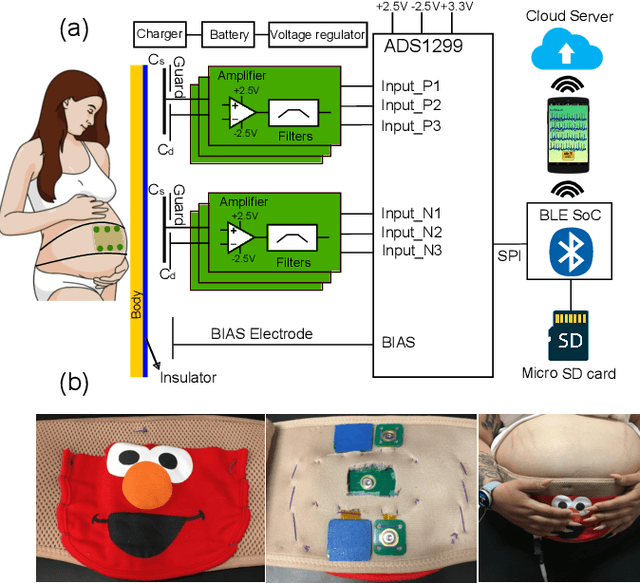
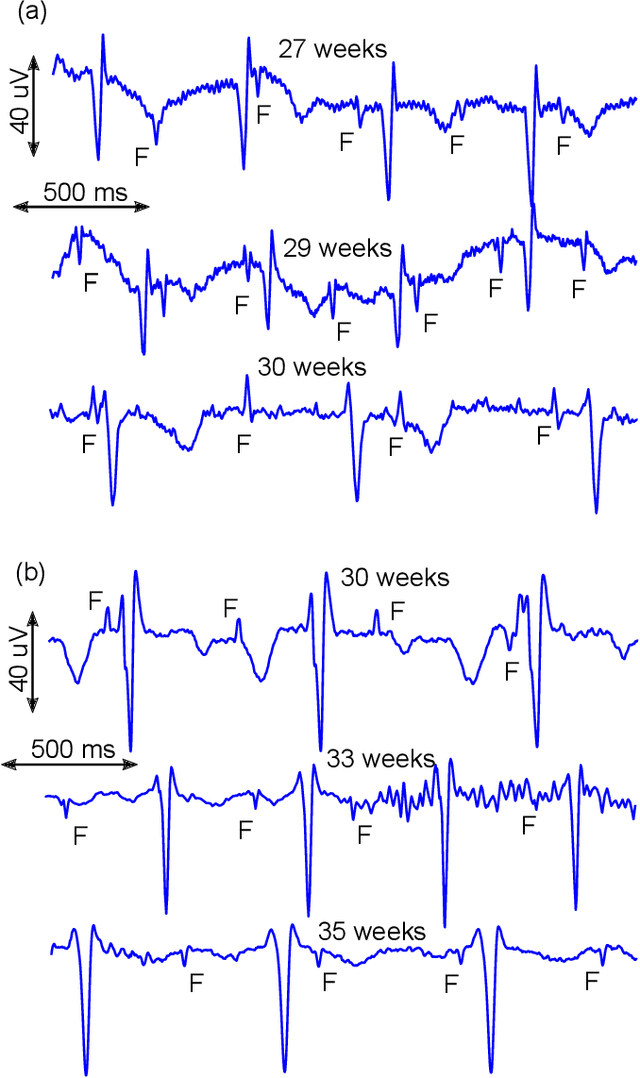
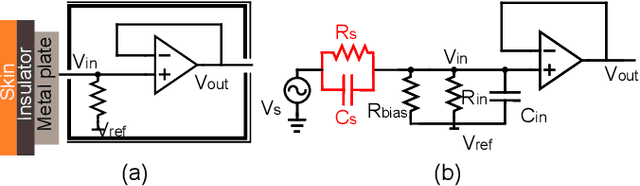
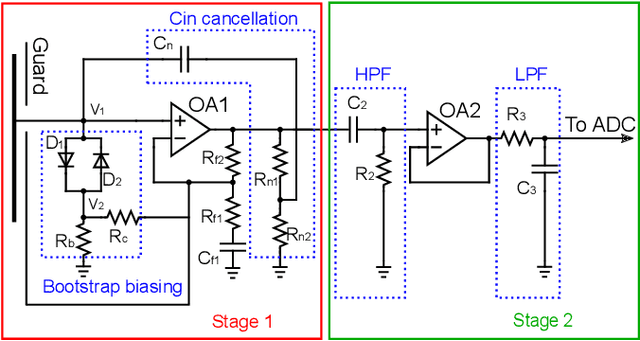
Regular physiological monitoring of maternal and fetal parameters is indispensable for ensuring safe outcomes during pregnancy and parturition. Fetal electrocardiogram (fECG) assessment is crucial to detect fetal distress and developmental anomalies. Given challenges of prenatal care due to the lack of medical professionals and the limit of accessibility, especially in remote and resource-poor areas, we develop a fECG monitoring system using novel non-contact electrodes (NCE) to record the fetal/maternal ECG (f/mECG) signals through clothes, thereby improving the comfort during measurement. The system is designed to be incorporated inside a maternity belt with data acquisition, data transmission module as well as novel NCEs. Thorough characterizations were carried out to evaluate the novel NCE against traditional wet electrodes (i.e., Ag/AgCl electrodes), showing comparable performance. A successful {preliminary pilot feasibility study} conducted with pregnant women (n = 10) between 25 and 32 weeks of gestation demonstrates the system's performance, usability and safety.