 Add to Chrome
 Add to Firefox
 Add to Edge
LongVPO: From Anchored Cues to Self-Reasoning for Long-Form Video Preference Optimization
Feb 02, 2026
We present LongVPO, a novel two-stage Direct Preference Optimization framework that enables short-context vision-language models to robustly understand ultra-long videos without any long-video annotations. In Stage 1, we synthesize preference triples by anchoring questions to individual short clips, interleaving them with distractors, and applying visual-similarity and question-specificity filtering to mitigate positional bias and ensure unambiguous supervision. We also approximate the reference model's scoring over long contexts by evaluating only the anchor clip, reducing computational overhead. In Stage 2, we employ a recursive captioning pipeline on long videos to generate scene-level metadata, then use a large language model to craft multi-segment reasoning queries and dispreferred responses, aligning the model's preferences through multi-segment reasoning tasks. With only 16K synthetic examples and no costly human labels, LongVPO outperforms the state-of-the-art open-source models on multiple long-video benchmarks, while maintaining strong short-video performance (e.g., on MVBench), offering a scalable paradigm for efficient long-form video understanding.

Accurate Network Traffic Matrix Prediction via LEAD: an LLM-Enhanced Adapter-Based Conditional Diffusion Model
Jan 29, 2026Driven by the evolution toward 6G and AI-native edge intelligence, network operations increasingly require predictive and risk-aware adaptation under stringent computation and latency constraints. Network Traffic Matrix (TM), which characterizes flow volumes between nodes, is a fundamental signal for proactive traffic engineering. However, accurate TM forecasting remains challenging due to the stochastic, non-linear, and bursty nature of network dynamics. Existing discriminative models often suffer from over-smoothing and provide limited uncertainty awareness, leading to poor fidelity under extreme bursts. To address these limitations, we propose LEAD, a Large Language Model (LLM)-Enhanced Adapter-based conditional Diffusion model. First, LEAD adopts a "Traffic-to-Image" paradigm to transform traffic matrices into RGB images, enabling global dependency modeling via vision backbones. Then, we design a "Frozen LLM with Trainable Adapter" model, which efficiently captures temporal semantics with limited computational cost. Moreover, we propose a Dual-Conditioning Strategy to precisely guide a diffusion model to generate complex, dynamic network traffic matrices. Experiments on the Abilene and GEANT datasets demonstrate that LEAD outperforms all baselines. On the Abilene dataset, LEAD attains a remarkable 45.2% reduction in RMSE against the best baseline, with the error margin rising only marginally from 0.1098 at one-step to 0.1134 at 20-step predictions. Meanwhile, on the GEANT dataset, LEAD achieves a 0.0258 RMSE at 20-step prediction horizon which is 27.3% lower than the best baseline.
Digital Twin AI: Opportunities and Challenges from Large Language Models to World Models
Jan 04, 2026Digital twins, as precise digital representations of physical systems, have evolved from passive simulation tools into intelligent and autonomous entities through the integration of artificial intelligence technologies. This paper presents a unified four-stage framework that systematically characterizes AI integration across the digital twin lifecycle, spanning modeling, mirroring, intervention, and autonomous management. By synthesizing existing technologies and practices, we distill a unified four-stage framework that systematically characterizes how AI methodologies are embedded across the digital twin lifecycle: (1) modeling the physical twin through physics-based and physics-informed AI approaches, (2) mirroring the physical system into a digital twin with real-time synchronization, (3) intervening in the physical twin through predictive modeling, anomaly detection, and optimization strategies, and (4) achieving autonomous management through large language models, foundation models, and intelligent agents. We analyze the synergy between physics-based modeling and data-driven learning, highlighting the shift from traditional numerical solvers to physics-informed and foundation models for physical systems. Furthermore, we examine how generative AI technologies, including large language models and generative world models, transform digital twins into proactive and self-improving cognitive systems capable of reasoning, communication, and creative scenario generation. Through a cross-domain review spanning eleven application domains, including healthcare, aerospace, smart manufacturing, robotics, and smart cities, we identify common challenges related to scalability, explainability, and trustworthiness, and outline directions for responsible AI-driven digital twin systems.
MobileViCLIP: An Efficient Video-Text Model for Mobile Devices
Aug 10, 2025Efficient lightweight neural networks are with increasing attention due to their faster reasoning speed and easier deployment on mobile devices. However, existing video pre-trained models still focus on the common ViT architecture with high latency, and few works attempt to build efficient architecture on mobile devices. This paper bridges this gap by introducing temporal structural reparameterization into an efficient image-text model and training it on a large-scale high-quality video-text dataset, resulting in an efficient video-text model that can run on mobile devices with strong zero-shot classification and retrieval capabilities, termed as MobileViCLIP. In particular, in terms of inference speed on mobile devices, our MobileViCLIP-Small is 55.4x times faster than InternVideo2-L14 and 6.7x faster than InternVideo2-S14. In terms of zero-shot retrieval performance, our MobileViCLIP-Small obtains similar performance as InternVideo2-L14 and obtains 6.9\% better than InternVideo2-S14 on MSR-VTT. The code is available at https://github.com/MCG-NJU/MobileViCLIP.
SeFAR: Semi-supervised Fine-grained Action Recognition with Temporal Perturbation and Learning Stabilization
Jan 02, 2025
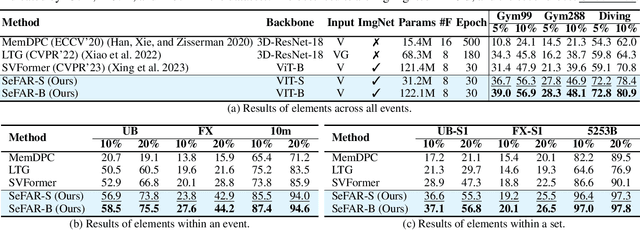
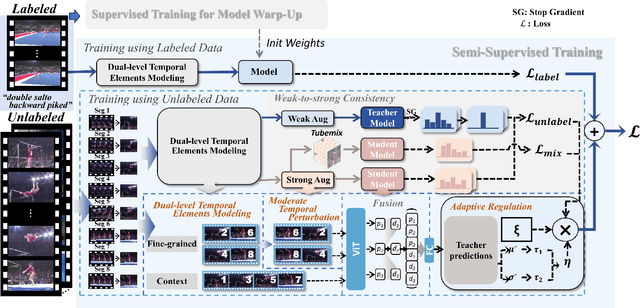
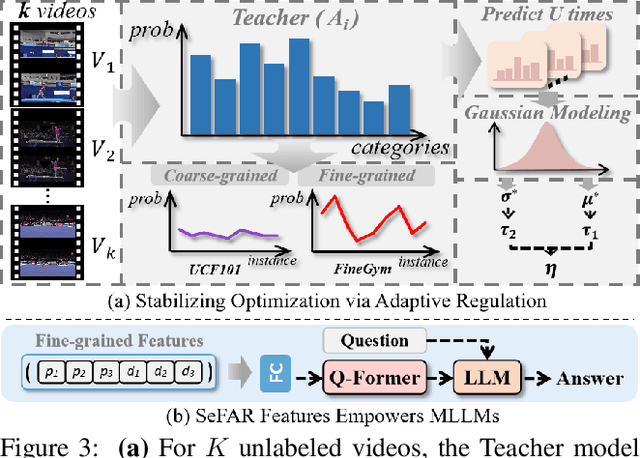
Human action understanding is crucial for the advancement of multimodal systems. While recent developments, driven by powerful large language models (LLMs), aim to be general enough to cover a wide range of categories, they often overlook the need for more specific capabilities. In this work, we address the more challenging task of Fine-grained Action Recognition (FAR), which focuses on detailed semantic labels within shorter temporal duration (e.g., "salto backward tucked with 1 turn"). Given the high costs of annotating fine-grained labels and the substantial data needed for fine-tuning LLMs, we propose to adopt semi-supervised learning (SSL). Our framework, SeFAR, incorporates several innovative designs to tackle these challenges. Specifically, to capture sufficient visual details, we construct Dual-level temporal elements as more effective representations, based on which we design a new strong augmentation strategy for the Teacher-Student learning paradigm through involving moderate temporal perturbation. Furthermore, to handle the high uncertainty within the teacher model's predictions for FAR, we propose the Adaptive Regulation to stabilize the learning process. Experiments show that SeFAR achieves state-of-the-art performance on two FAR datasets, FineGym and FineDiving, across various data scopes. It also outperforms other semi-supervised methods on two classical coarse-grained datasets, UCF101 and HMDB51. Further analysis and ablation studies validate the effectiveness of our designs. Additionally, we show that the features extracted by our SeFAR could largely promote the ability of multimodal foundation models to understand fine-grained and domain-specific semantics.
Chain-of-Jailbreak Attack for Image Generation Models via Editing Step by Step
Oct 04, 2024Text-based image generation models, such as Stable Diffusion and DALL-E 3, hold significant potential in content creation and publishing workflows, making them the focus in recent years. Despite their remarkable capability to generate diverse and vivid images, considerable efforts are being made to prevent the generation of harmful content, such as abusive, violent, or pornographic material. To assess the safety of existing models, we introduce a novel jailbreaking method called Chain-of-Jailbreak (CoJ) attack, which compromises image generation models through a step-by-step editing process. Specifically, for malicious queries that cannot bypass the safeguards with a single prompt, we intentionally decompose the query into multiple sub-queries. The image generation models are then prompted to generate and iteratively edit images based on these sub-queries. To evaluate the effectiveness of our CoJ attack method, we constructed a comprehensive dataset, CoJ-Bench, encompassing nine safety scenarios, three types of editing operations, and three editing elements. Experiments on four widely-used image generation services provided by GPT-4V, GPT-4o, Gemini 1.5 and Gemini 1.5 Pro, demonstrate that our CoJ attack method can successfully bypass the safeguards of models for over 60% cases, which significantly outperforms other jailbreaking methods (i.e., 14%). Further, to enhance these models' safety against our CoJ attack method, we also propose an effective prompting-based method, Think Twice Prompting, that can successfully defend over 95% of CoJ attack. We release our dataset and code to facilitate the AI safety research.