 Add to Chrome
 Add to Firefox
 Add to Edge
MedGround: Bridging the Evidence Gap in Medical Vision-Language Models with Verified Grounding Data
Jan 11, 2026
Vision-Language Models (VLMs) can generate convincing clinical narratives, yet frequently struggle to visually ground their statements. We posit this limitation arises from the scarcity of high-quality, large-scale clinical referring-localization pairs. To address this, we introduce MedGround, an automated pipeline that transforms segmentation resources into high-quality medical referring grounding data. Leveraging expert masks as spatial anchors, MedGround precisely derives localization targets, extracts shape and spatial cues, and guides VLMs to synthesize natural, clinically grounded queries that reflect morphology and location. To ensure data rigor, a multi-stage verification system integrates strict formatting checks, geometry- and medical-prior rules, and image-based visual judging to filter out ambiguous or visually unsupported samples. Finally, we present MedGround-35K, a novel multimodal medical dataset. Extensive experiments demonstrate that VLMs trained with MedGround-35K consistently achieve improved referring grounding performance, enhance multi-object semantic disambiguation, and exhibit strong generalization to unseen grounding settings. This work highlights MedGround as a scalable, data-driven approach to anchor medical language to verifiable visual evidence. Dataset and code will be released publicly upon acceptance.

HY-Motion 1.0: Scaling Flow Matching Models for Text-To-Motion Generation
Dec 29, 2025We present HY-Motion 1.0, a series of state-of-the-art, large-scale, motion generation models capable of generating 3D human motions from textual descriptions. HY-Motion 1.0 represents the first successful attempt to scale up Diffusion Transformer (DiT)-based flow matching models to the billion-parameter scale within the motion generation domain, delivering instruction-following capabilities that significantly outperform current open-source benchmarks. Uniquely, we introduce a comprehensive, full-stage training paradigm -- including large-scale pretraining on over 3,000 hours of motion data, high-quality fine-tuning on 400 hours of curated data, and reinforcement learning from both human feedback and reward models -- to ensure precise alignment with the text instruction and high motion quality. This framework is supported by our meticulous data processing pipeline, which performs rigorous motion cleaning and captioning. Consequently, our model achieves the most extensive coverage, spanning over 200 motion categories across 6 major classes. We release HY-Motion 1.0 to the open-source community to foster future research and accelerate the transition of 3D human motion generation models towards commercial maturity.
Kangaroo: A Powerful Video-Language Model Supporting Long-context Video Input
Aug 28, 2024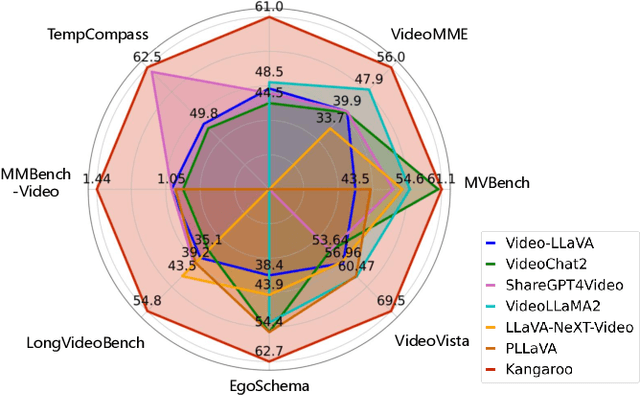
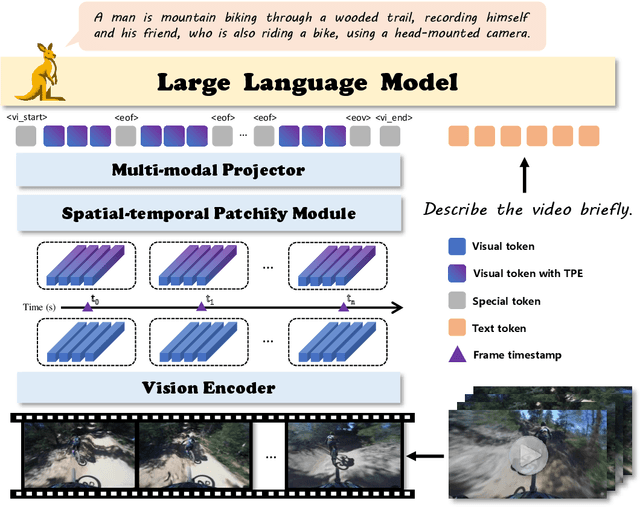
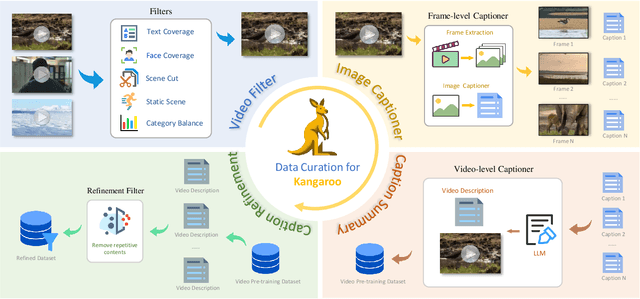
Rapid advancements have been made in extending Large Language Models (LLMs) to Large Multi-modal Models (LMMs). However, extending input modality of LLMs to video data remains a challenging endeavor, especially for long videos. Due to insufficient access to large-scale high-quality video data and the excessive compression of visual features, current methods exhibit limitations in effectively processing long videos. In this paper, we introduce Kangaroo, a powerful Video LMM aimed at addressing these challenges. Confronted with issue of inadequate training data, we develop a data curation system to build a large-scale dataset with high-quality annotations for vision-language pre-training and instruction tuning. In addition, we design a curriculum training pipeline with gradually increasing resolution and number of input frames to accommodate long videos. Evaluation results demonstrate that, with 8B parameters, Kangaroo achieves state-of-the-art performance across a variety of video understanding benchmarks while exhibiting competitive results on others. Particularly, on benchmarks specialized for long videos, Kangaroo excels some larger models with over 10B parameters and proprietary models.