 Add to Chrome
 Add to Firefox
 Add to Edge
Decoupling Return-to-Go for Efficient Decision Transformer
Jan 22, 2026
The Decision Transformer (DT) has established a powerful sequence modeling approach to offline reinforcement learning. It conditions its action predictions on Return-to-Go (RTG), using it both to distinguish trajectory quality during training and to guide action generation at inference. In this work, we identify a critical redundancy in this design: feeding the entire sequence of RTGs into the Transformer is theoretically unnecessary, as only the most recent RTG affects action prediction. We show that this redundancy can impair DT's performance through experiments. To resolve this, we propose the Decoupled DT (DDT). DDT simplifies the architecture by processing only observation and action sequences through the Transformer, using the latest RTG to guide the action prediction. This streamlined approach not only improves performance but also reduces computational cost. Our experiments show that DDT significantly outperforms DT and establishes competitive performance against state-of-the-art DT variants across multiple offline RL tasks.

InterMT: Multi-Turn Interleaved Preference Alignment with Human Feedback
May 29, 2025As multimodal large models (MLLMs) continue to advance across challenging tasks, a key question emerges: What essential capabilities are still missing? A critical aspect of human learning is continuous interaction with the environment -- not limited to language, but also involving multimodal understanding and generation. To move closer to human-level intelligence, models must similarly support multi-turn, multimodal interaction. In particular, they should comprehend interleaved multimodal contexts and respond coherently in ongoing exchanges. In this work, we present an initial exploration through the InterMT -- the first preference dataset for multi-turn multimodal interaction, grounded in real human feedback. In this exploration, we particularly emphasize the importance of human oversight, introducing expert annotations to guide the process, motivated by the fact that current MLLMs lack such complex interactive capabilities. InterMT captures human preferences at both global and local levels into nine sub-dimensions, consists of 15.6k prompts, 52.6k multi-turn dialogue instances, and 32.4k human-labeled preference pairs. To compensate for the lack of capability for multi-modal understanding and generation, we introduce an agentic workflow that leverages tool-augmented MLLMs to construct multi-turn QA instances. To further this goal, we introduce InterMT-Bench to assess the ability of MLLMs in assisting judges with multi-turn, multimodal tasks. We demonstrate the utility of \InterMT through applications such as judge moderation and further reveal the multi-turn scaling law of judge model. We hope the open-source of our data can help facilitate further research on aligning current MLLMs to the next step. Our project website can be found at https://pku-intermt.github.io .
Single-Pass Document Scanning for Question Answering
Apr 04, 2025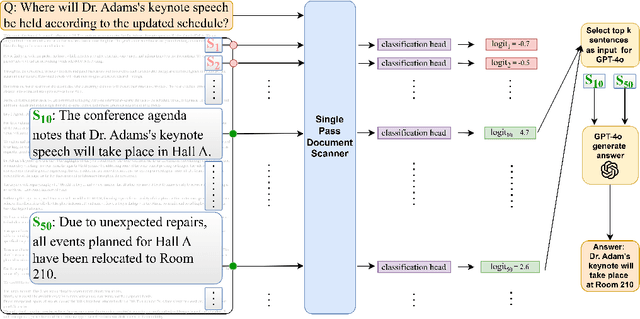
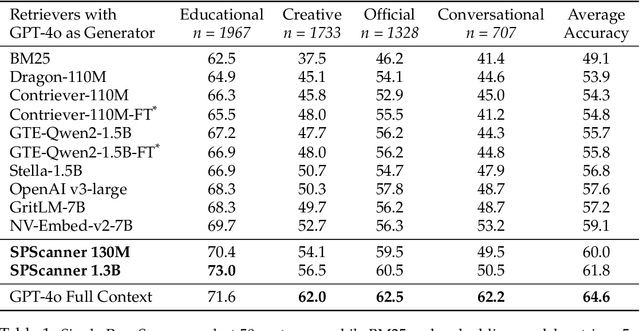
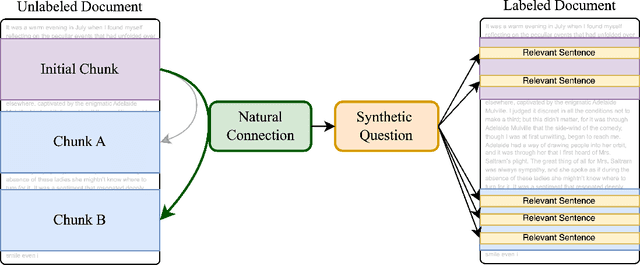
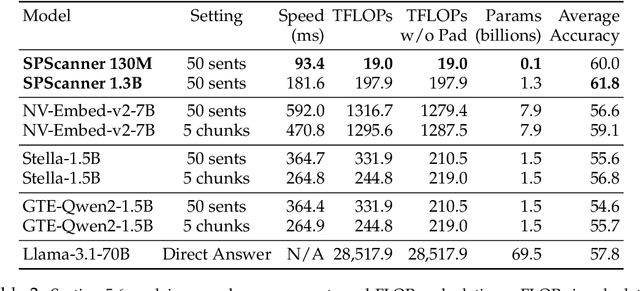
Handling extremely large documents for question answering is challenging: chunk-based embedding methods often lose track of important global context, while full-context transformers can be prohibitively expensive for hundreds of thousands of tokens. We propose a single-pass document scanning approach that processes the entire text in linear time, preserving global coherence while deciding which sentences are most relevant to the query. On 41 QA benchmarks, our single-pass scanner consistently outperforms chunk-based embedding methods and competes with large language models at a fraction of the computational cost. By conditioning on the entire preceding context without chunk breaks, the method preserves global coherence, which is especially important for long documents. Overall, single-pass document scanning offers a simple solution for question answering over massive text. All code, datasets, and model checkpoints are available at https://github.com/MambaRetriever/MambaRetriever