 Add to Chrome
 Add to Firefox
 Add to Edge
TRIP-Bench: A Benchmark for Long-Horizon Interactive Agents in Real-World Scenarios
Feb 02, 2026
As LLM-based agents are deployed in increasingly complex real-world settings, existing benchmarks underrepresent key challenges such as enforcing global constraints, coordinating multi-tool reasoning, and adapting to evolving user behavior over long, multi-turn interactions. To bridge this gap, we introduce \textbf{TRIP-Bench}, a long-horizon benchmark grounded in realistic travel-planning scenarios. TRIP-Bench leverages real-world data, offers 18 curated tools and 40+ travel requirements, and supports automated evaluation. It includes splits of varying difficulty; the hard split emphasizes long and ambiguous interactions, style shifts, feasibility changes, and iterative version revision. Dialogues span up to 15 user turns, can involve 150+ tool calls, and may exceed 200k tokens of context. Experiments show that even advanced models achieve at most 50\% success on the easy split, with performance dropping below 10\% on hard subsets. We further propose \textbf{GTPO}, an online multi-turn reinforcement learning method with specialized reward normalization and reward differencing. Applied to Qwen2.5-32B-Instruct, GTPO improves constraint satisfaction and interaction robustness, outperforming Gemini-3-Pro in our evaluation. We expect TRIP-Bench to advance practical long-horizon interactive agents, and GTPO to provide an effective online RL recipe for robust long-horizon training.

SWE-Compass: Towards Unified Evaluation of Agentic Coding Abilities for Large Language Models
Nov 07, 2025Evaluating large language models (LLMs) for software engineering has been limited by narrow task coverage, language bias, and insufficient alignment with real-world developer workflows. Existing benchmarks often focus on algorithmic problems or Python-centric bug fixing, leaving critical dimensions of software engineering underexplored. To address these gaps, we introduce SWE-Compass1, a comprehensive benchmark that unifies heterogeneous code-related evaluations into a structured and production-aligned framework. SWE-Compass spans 8 task types, 8 programming scenarios, and 10 programming languages, with 2000 high-quality instances curated from authentic GitHub pull requests and refined through systematic filtering and validation. We benchmark ten state-of-the-art LLMs under two agentic frameworks, SWE-Agent and Claude Code, revealing a clear hierarchy of difficulty across task types, languages, and scenarios. Moreover, by aligning evaluation with real-world developer practices, SWE-Compass provides a rigorous and reproducible foundation for diagnosing and advancing agentic coding capabilities in large language models.
MARS2 2025 Challenge on Multimodal Reasoning: Datasets, Methods, Results, Discussion, and Outlook
Sep 17, 2025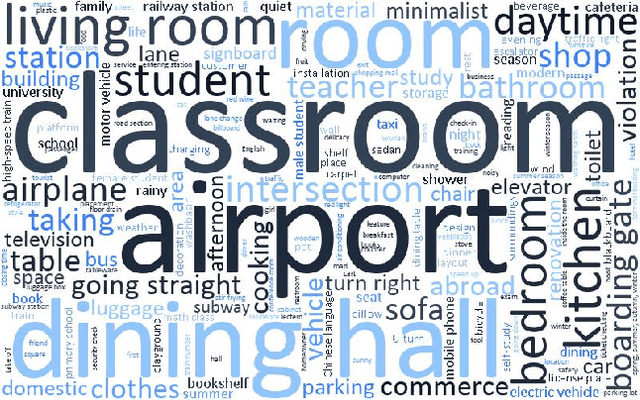
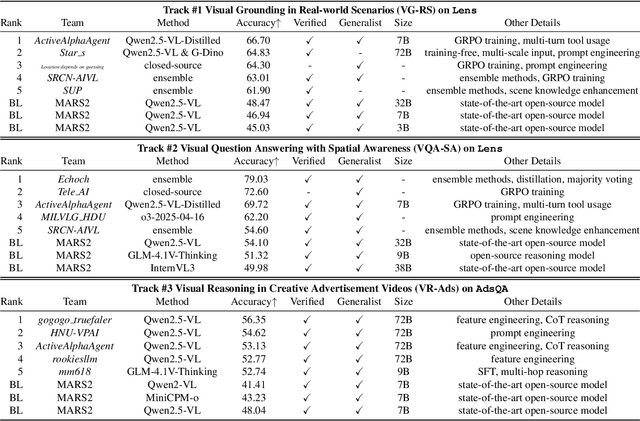
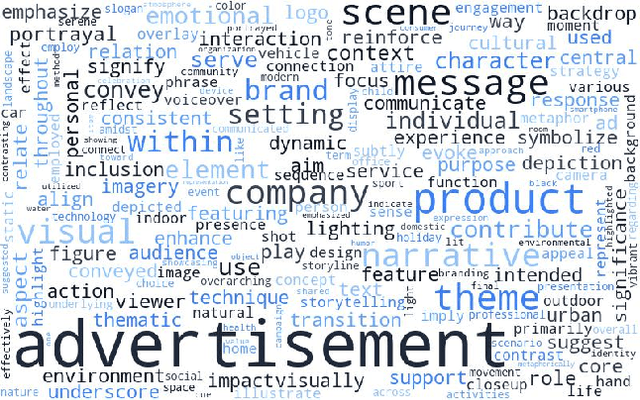
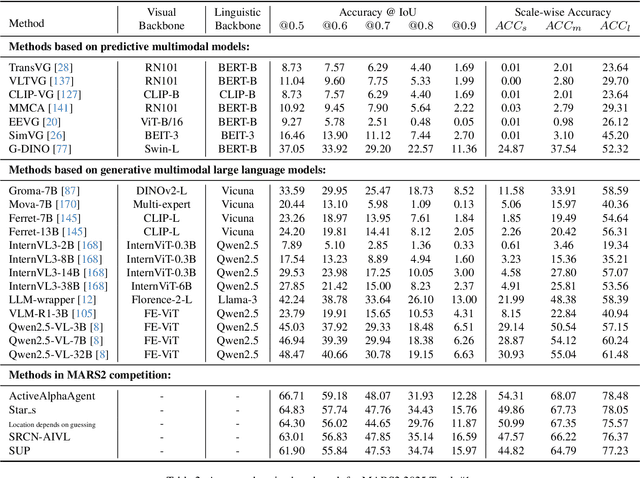
This paper reviews the MARS2 2025 Challenge on Multimodal Reasoning. We aim to bring together different approaches in multimodal machine learning and LLMs via a large benchmark. We hope it better allows researchers to follow the state-of-the-art in this very dynamic area. Meanwhile, a growing number of testbeds have boosted the evolution of general-purpose large language models. Thus, this year's MARS2 focuses on real-world and specialized scenarios to broaden the multimodal reasoning applications of MLLMs. Our organizing team released two tailored datasets Lens and AdsQA as test sets, which support general reasoning in 12 daily scenarios and domain-specific reasoning in advertisement videos, respectively. We evaluated 40+ baselines that include both generalist MLLMs and task-specific models, and opened up three competition tracks, i.e., Visual Grounding in Real-world Scenarios (VG-RS), Visual Question Answering with Spatial Awareness (VQA-SA), and Visual Reasoning in Creative Advertisement Videos (VR-Ads). Finally, 76 teams from the renowned academic and industrial institutions have registered and 40+ valid submissions (out of 1200+) have been included in our ranking lists. Our datasets, code sets (40+ baselines and 15+ participants' methods), and rankings are publicly available on the MARS2 workshop website and our GitHub organization page https://github.com/mars2workshop/, where our updates and announcements of upcoming events will be continuously provided.
Efficient Tuning of Large Language Models for Knowledge-Grounded Dialogue Generation
Apr 10, 2025Large language models (LLMs) demonstrate remarkable text comprehension and generation capabilities but often lack the ability to utilize up-to-date or domain-specific knowledge not included in their training data. To address this gap, we introduce KEDiT, an efficient method for fine-tuning LLMs for knowledge-grounded dialogue generation. KEDiT operates in two main phases: first, it employs an information bottleneck to compress retrieved knowledge into learnable parameters, retaining essential information while minimizing computational overhead. Second, a lightweight knowledge-aware adapter integrates these compressed knowledge vectors into the LLM during fine-tuning, updating less than 2\% of the model parameters. The experimental results on the Wizard of Wikipedia and a newly constructed PubMed-Dialog dataset demonstrate that KEDiT excels in generating contextually relevant and informative responses, outperforming competitive baselines in automatic, LLM-based, and human evaluations. This approach effectively combines the strengths of pretrained LLMs with the adaptability needed for incorporating dynamic knowledge, presenting a scalable solution for fields such as medicine.