 Add to Chrome
 Add to Firefox
 Add to Edge
TRIP-Bench: A Benchmark for Long-Horizon Interactive Agents in Real-World Scenarios
Feb 02, 2026
As LLM-based agents are deployed in increasingly complex real-world settings, existing benchmarks underrepresent key challenges such as enforcing global constraints, coordinating multi-tool reasoning, and adapting to evolving user behavior over long, multi-turn interactions. To bridge this gap, we introduce \textbf{TRIP-Bench}, a long-horizon benchmark grounded in realistic travel-planning scenarios. TRIP-Bench leverages real-world data, offers 18 curated tools and 40+ travel requirements, and supports automated evaluation. It includes splits of varying difficulty; the hard split emphasizes long and ambiguous interactions, style shifts, feasibility changes, and iterative version revision. Dialogues span up to 15 user turns, can involve 150+ tool calls, and may exceed 200k tokens of context. Experiments show that even advanced models achieve at most 50\% success on the easy split, with performance dropping below 10\% on hard subsets. We further propose \textbf{GTPO}, an online multi-turn reinforcement learning method with specialized reward normalization and reward differencing. Applied to Qwen2.5-32B-Instruct, GTPO improves constraint satisfaction and interaction robustness, outperforming Gemini-3-Pro in our evaluation. We expect TRIP-Bench to advance practical long-horizon interactive agents, and GTPO to provide an effective online RL recipe for robust long-horizon training.

BatCoder: Self-Supervised Bidirectional Code-Documentation Learning via Back-Translation
Jan 30, 2026Training LLMs for code-related tasks typically depends on high-quality code-documentation pairs, which are costly to curate and often scarce for niche programming languages. We introduce BatCoder, a self-supervised reinforcement learning framework designed to jointly optimize code generation and documentation production. BatCoder employs a back-translation strategy: a documentation is first generated from code, and then the generated documentation is used to reconstruct the original code. The semantic similarity between the original and reconstructed code serves as an implicit reward, enabling reinforcement learning to improve the model's performance both in generating code from documentation and vice versa. This approach allows models to be trained using only code, substantially increasing the available training examples. Evaluated on HumanEval and MBPP with a 7B model, BatCoder achieved 83.5% and 81.0% pass@1, outperforming strong open-source baselines. Moreover, the framework demonstrates consistent scaling with respect to both training corpus size and model capacity.
CSSG: Measuring Code Similarity with Semantic Graphs
Jan 07, 2026Existing code similarity metrics, such as BLEU, CodeBLEU, and TSED, largely rely on surface-level string overlap or abstract syntax tree structures, and often fail to capture deeper semantic relationships between programs.We propose CSSG (Code Similarity using Semantic Graphs), a novel metric that leverages program dependence graphs to explicitly model control dependencies and variable interactions, providing a semantics-aware representation of code.Experiments on the CodeContests+ dataset show that CSSG consistently outperforms existing metrics in distinguishing more similar code from less similar code under both monolingual and cross-lingual settings, demonstrating that dependency-aware graph representations offer a more effective alternative to surface-level or syntax-based similarity measures.
Searching for Best Practices in Retrieval-Augmented Generation
Jul 01, 2024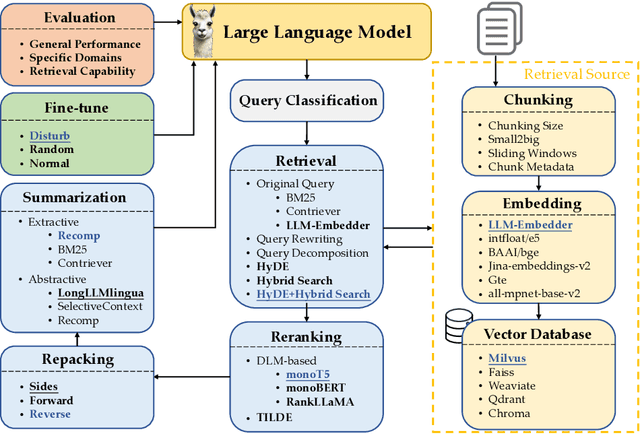
Retrieval-augmented generation (RAG) techniques have proven to be effective in integrating up-to-date information, mitigating hallucinations, and enhancing response quality, particularly in specialized domains. While many RAG approaches have been proposed to enhance large language models through query-dependent retrievals, these approaches still suffer from their complex implementation and prolonged response times. Typically, a RAG workflow involves multiple processing steps, each of which can be executed in various ways. Here, we investigate existing RAG approaches and their potential combinations to identify optimal RAG practices. Through extensive experiments, we suggest several strategies for deploying RAG that balance both performance and efficiency. Moreover, we demonstrate that multimodal retrieval techniques can significantly enhance question-answering capabilities about visual inputs and accelerate the generation of multimodal content using a "retrieval as generation" strategy.