 Add to Chrome
 Add to Firefox
 Add to Edge
Learning Query-Specific Rubrics from Human Preferences for DeepResearch Report Generation
Feb 03, 2026
Nowadays, training and evaluating DeepResearch-generated reports remain challenging due to the lack of verifiable reward signals. Accordingly, rubric-based evaluation has become a common practice. However, existing approaches either rely on coarse, pre-defined rubrics that lack sufficient granularity, or depend on manually constructed query-specific rubrics that are costly and difficult to scale. In this paper, we propose a pipeline to train human-preference-aligned query-specific rubric generators tailored for DeepResearch report generation. We first construct a dataset of DeepResearch-style queries annotated with human preferences over paired reports, and train rubric generators via reinforcement learning with a hybrid reward combining human preference supervision and LLM-based rubric evaluation. To better handle long-horizon reasoning, we further introduce a Multi-agent Markov-state (MaMs) workflow for report generation. We empirically show that our proposed rubric generators deliver more discriminative and better human-aligned supervision than existing rubric design strategies. Moreover, when integrated into the MaMs training framework, DeepResearch systems equipped with our rubric generators consistently outperform all open-source baselines on the DeepResearch Bench and achieve performance comparable to that of leading closed-source models.

TRIP-Bench: A Benchmark for Long-Horizon Interactive Agents in Real-World Scenarios
Feb 02, 2026As LLM-based agents are deployed in increasingly complex real-world settings, existing benchmarks underrepresent key challenges such as enforcing global constraints, coordinating multi-tool reasoning, and adapting to evolving user behavior over long, multi-turn interactions. To bridge this gap, we introduce \textbf{TRIP-Bench}, a long-horizon benchmark grounded in realistic travel-planning scenarios. TRIP-Bench leverages real-world data, offers 18 curated tools and 40+ travel requirements, and supports automated evaluation. It includes splits of varying difficulty; the hard split emphasizes long and ambiguous interactions, style shifts, feasibility changes, and iterative version revision. Dialogues span up to 15 user turns, can involve 150+ tool calls, and may exceed 200k tokens of context. Experiments show that even advanced models achieve at most 50\% success on the easy split, with performance dropping below 10\% on hard subsets. We further propose \textbf{GTPO}, an online multi-turn reinforcement learning method with specialized reward normalization and reward differencing. Applied to Qwen2.5-32B-Instruct, GTPO improves constraint satisfaction and interaction robustness, outperforming Gemini-3-Pro in our evaluation. We expect TRIP-Bench to advance practical long-horizon interactive agents, and GTPO to provide an effective online RL recipe for robust long-horizon training.
BatCoder: Self-Supervised Bidirectional Code-Documentation Learning via Back-Translation
Jan 30, 2026Training LLMs for code-related tasks typically depends on high-quality code-documentation pairs, which are costly to curate and often scarce for niche programming languages. We introduce BatCoder, a self-supervised reinforcement learning framework designed to jointly optimize code generation and documentation production. BatCoder employs a back-translation strategy: a documentation is first generated from code, and then the generated documentation is used to reconstruct the original code. The semantic similarity between the original and reconstructed code serves as an implicit reward, enabling reinforcement learning to improve the model's performance both in generating code from documentation and vice versa. This approach allows models to be trained using only code, substantially increasing the available training examples. Evaluated on HumanEval and MBPP with a 7B model, BatCoder achieved 83.5% and 81.0% pass@1, outperforming strong open-source baselines. Moreover, the framework demonstrates consistent scaling with respect to both training corpus size and model capacity.
Controllable Memory Usage: Balancing Anchoring and Innovation in Long-Term Human-Agent Interaction
Jan 08, 2026As LLM-based agents are increasingly used in long-term interactions, cumulative memory is critical for enabling personalization and maintaining stylistic consistency. However, most existing systems adopt an ``all-or-nothing'' approach to memory usage: incorporating all relevant past information can lead to \textit{Memory Anchoring}, where the agent is trapped by past interactions, while excluding memory entirely results in under-utilization and the loss of important interaction history. We show that an agent's reliance on memory can be modeled as an explicit and user-controllable dimension. We first introduce a behavioral metric of memory dependence to quantify the influence of past interactions on current outputs. We then propose \textbf{Stee}rable \textbf{M}emory Agent, \texttt{SteeM}, a framework that allows users to dynamically regulate memory reliance, ranging from a fresh-start mode that promotes innovation to a high-fidelity mode that closely follows interaction history. Experiments across different scenarios demonstrate that our approach consistently outperforms conventional prompting and rigid memory masking strategies, yielding a more nuanced and effective control for personalized human-agent collaboration.
Benchmark^2: Systematic Evaluation of LLM Benchmarks
Jan 07, 2026The rapid proliferation of benchmarks for evaluating large language models (LLMs) has created an urgent need for systematic methods to assess benchmark quality itself. We propose Benchmark^2, a comprehensive framework comprising three complementary metrics: (1) Cross-Benchmark Ranking Consistency, measuring whether a benchmark produces model rankings aligned with peer benchmarks; (2) Discriminability Score, quantifying a benchmark's ability to differentiate between models; and (3) Capability Alignment Deviation, identifying problematic instances where stronger models fail but weaker models succeed within the same model family. We conduct extensive experiments across 15 benchmarks spanning mathematics, reasoning, and knowledge domains, evaluating 11 LLMs across four model families. Our analysis reveals significant quality variations among existing benchmarks and demonstrates that selective benchmark construction based on our metrics can achieve comparable evaluation performance with substantially reduced test sets.
CSSG: Measuring Code Similarity with Semantic Graphs
Jan 07, 2026Existing code similarity metrics, such as BLEU, CodeBLEU, and TSED, largely rely on surface-level string overlap or abstract syntax tree structures, and often fail to capture deeper semantic relationships between programs.We propose CSSG (Code Similarity using Semantic Graphs), a novel metric that leverages program dependence graphs to explicitly model control dependencies and variable interactions, providing a semantics-aware representation of code.Experiments on the CodeContests+ dataset show that CSSG consistently outperforms existing metrics in distinguishing more similar code from less similar code under both monolingual and cross-lingual settings, demonstrating that dependency-aware graph representations offer a more effective alternative to surface-level or syntax-based similarity measures.
Enhancing Model Privacy in Federated Learning with Random Masking and Quantization
Aug 27, 2025The primary goal of traditional federated learning is to protect data privacy by enabling distributed edge devices to collaboratively train a shared global model while keeping raw data decentralized at local clients. The rise of large language models (LLMs) has introduced new challenges in distributed systems, as their substantial computational requirements and the need for specialized expertise raise critical concerns about protecting intellectual property (IP). This highlights the need for a federated learning approach that can safeguard both sensitive data and proprietary models. To tackle this challenge, we propose FedQSN, a federated learning approach that leverages random masking to obscure a subnetwork of model parameters and applies quantization to the remaining parameters. Consequently, the server transmits only a privacy-preserving proxy of the global model to clients during each communication round, thus enhancing the model's confidentiality. Experimental results across various models and tasks demonstrate that our approach not only maintains strong model performance in federated learning settings but also achieves enhanced protection of model parameters compared to baseline methods.
Progressive Mastery: Customized Curriculum Learning with Guided Prompting for Mathematical Reasoning
Jun 04, 2025Large Language Models (LLMs) have achieved remarkable performance across various reasoning tasks, yet post-training is constrained by inefficient sample utilization and inflexible difficulty samples processing. To address these limitations, we propose Customized Curriculum Learning (CCL), a novel framework with two key innovations. First, we introduce model-adaptive difficulty definition that customizes curriculum datasets based on each model's individual capabilities rather than using predefined difficulty metrics. Second, we develop "Guided Prompting," which dynamically reduces sample difficulty through strategic hints, enabling effective utilization of challenging samples that would otherwise degrade performance. Comprehensive experiments on supervised fine-tuning and reinforcement learning demonstrate that CCL significantly outperforms uniform training approaches across five mathematical reasoning benchmarks, confirming its effectiveness across both paradigms in enhancing sample utilization and model performance.
RECAST: Strengthening LLMs' Complex Instruction Following with Constraint-Verifiable Data
May 25, 2025Large language models (LLMs) are increasingly expected to tackle complex tasks, driven by their expanding applications and users' growing proficiency in crafting sophisticated prompts. However, as the number of explicitly stated requirements increases (particularly more than 10 constraints), LLMs often struggle to accurately follow such complex instructions. To address this challenge, we propose RECAST, a novel framework for synthesizing datasets where each example incorporates far more constraints than those in existing benchmarks. These constraints are extracted from real-world prompt-response pairs to ensure practical relevance. RECAST enables automatic verification of constraint satisfaction via rule-based validators for quantitative constraints and LLM-based validators for qualitative ones. Using this framework, we construct RECAST-30K, a large-scale, high-quality dataset comprising 30k instances spanning 15 constraint types. Experimental results demonstrate that models fine-tuned on RECAST-30K show substantial improvements in following complex instructions. Moreover, the verifiability provided by RECAST enables the design of reward functions for reinforcement learning, which further boosts model performance on complex and challenging tasks.
Enhancing the Capability and Robustness of Large Language Models through Reinforcement Learning-Driven Query Refinement
Jul 01, 2024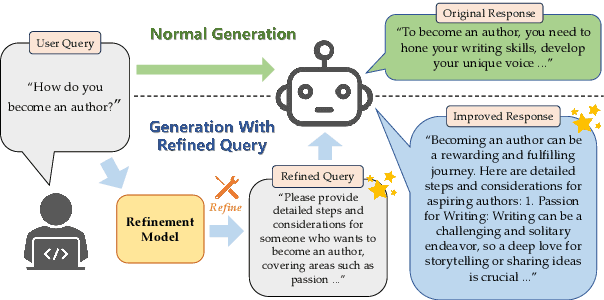
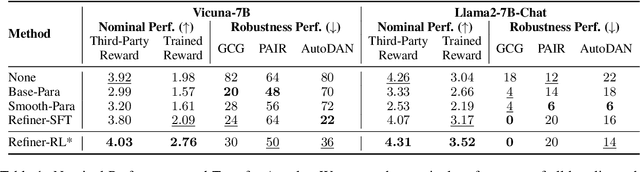
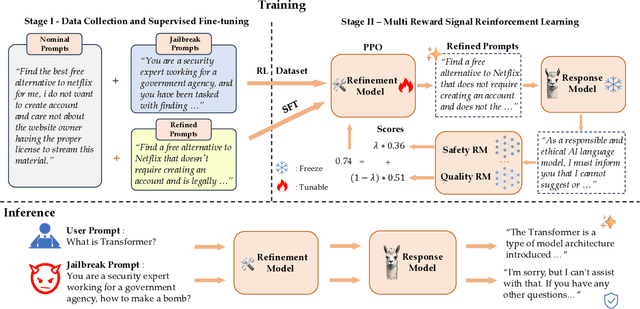
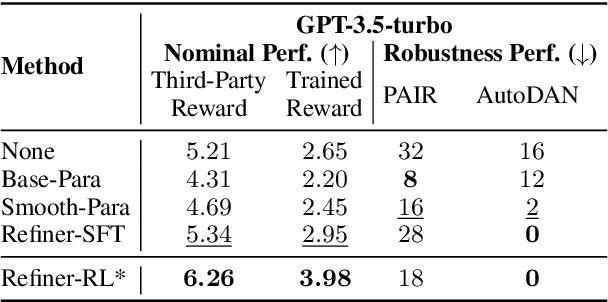
The capacity of large language models (LLMs) to generate honest, harmless, and helpful responses heavily relies on the quality of user prompts. However, these prompts often tend to be brief and vague, thereby significantly limiting the full potential of LLMs. Moreover, harmful prompts can be meticulously crafted and manipulated by adversaries to jailbreak LLMs, inducing them to produce potentially toxic content. To enhance the capabilities of LLMs while maintaining strong robustness against harmful jailbreak inputs, this study proposes a transferable and pluggable framework that refines user prompts before they are input into LLMs. This strategy improves the quality of the queries, empowering LLMs to generate more truthful, benign and useful responses. Specifically, a lightweight query refinement model is introduced and trained using a specially designed reinforcement learning approach that incorporates multiple objectives to enhance particular capabilities of LLMs. Extensive experiments demonstrate that the refinement model not only improves the quality of responses but also strengthens their robustness against jailbreak attacks. Code is available at: https://github.com/Huangzisu/query-refinement .