 Add to Chrome
 Add to Firefox
 Add to Edge
VILTA: A VLM-in-the-Loop Adversary for Enhancing Driving Policy Robustness
Jan 19, 2026
The safe deployment of autonomous driving (AD) systems is fundamentally hindered by the long-tail problem, where rare yet critical driving scenarios are severely underrepresented in real-world data. Existing solutions including safety-critical scenario generation and closed-loop learning often rely on rule-based heuristics, resampling methods and generative models learned from offline datasets, limiting their ability to produce diverse and novel challenges. While recent works leverage Vision Language Models (VLMs) to produce scene descriptions that guide a separate, downstream model in generating hazardous trajectories for agents, such two-stage framework constrains the generative potential of VLMs, as the diversity of the final trajectories is ultimately limited by the generalization ceiling of the downstream algorithm. To overcome these limitations, we introduce VILTA (VLM-In-the-Loop Trajectory Adversary), a novel framework that integrates a VLM into the closed-loop training of AD agents. Unlike prior works, VILTA actively participates in the training loop by comprehending the dynamic driving environment and strategically generating challenging scenarios through direct, fine-grained editing of surrounding agents' future trajectories. This direct-editing approach fully leverages the VLM's powerful generalization capabilities to create a diverse curriculum of plausible yet challenging scenarios that extend beyond the scope of traditional methods. We demonstrate that our approach substantially enhances the safety and robustness of the resulting AD policy, particularly in its ability to navigate critical long-tail events.

SWE-Compass: Towards Unified Evaluation of Agentic Coding Abilities for Large Language Models
Nov 07, 2025Evaluating large language models (LLMs) for software engineering has been limited by narrow task coverage, language bias, and insufficient alignment with real-world developer workflows. Existing benchmarks often focus on algorithmic problems or Python-centric bug fixing, leaving critical dimensions of software engineering underexplored. To address these gaps, we introduce SWE-Compass1, a comprehensive benchmark that unifies heterogeneous code-related evaluations into a structured and production-aligned framework. SWE-Compass spans 8 task types, 8 programming scenarios, and 10 programming languages, with 2000 high-quality instances curated from authentic GitHub pull requests and refined through systematic filtering and validation. We benchmark ten state-of-the-art LLMs under two agentic frameworks, SWE-Agent and Claude Code, revealing a clear hierarchy of difficulty across task types, languages, and scenarios. Moreover, by aligning evaluation with real-world developer practices, SWE-Compass provides a rigorous and reproducible foundation for diagnosing and advancing agentic coding capabilities in large language models.
UniOcc: Unifying Vision-Centric 3D Occupancy Prediction with Geometric and Semantic Rendering
Jun 15, 2023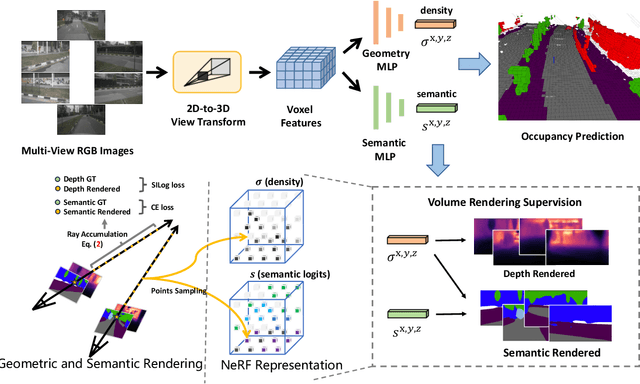
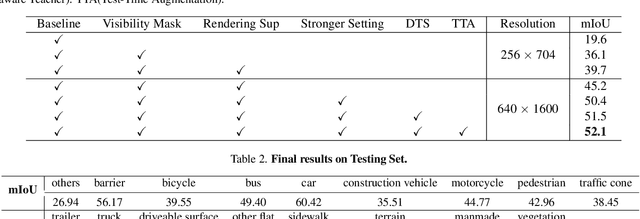
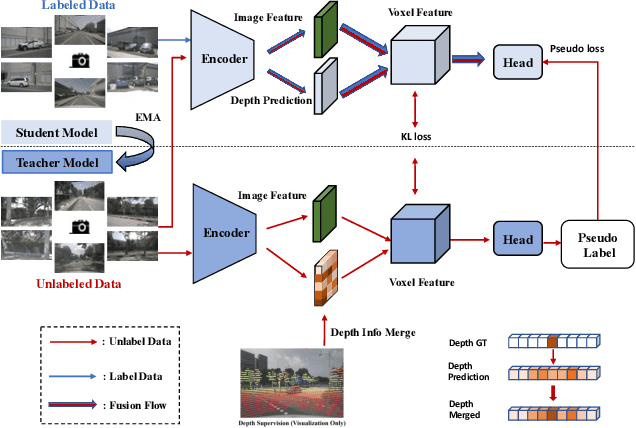

In this technical report, we present our solution, named UniOCC, for the Vision-Centric 3D occupancy prediction track in the nuScenes Open Dataset Challenge at CVPR 2023. Existing methods for occupancy prediction primarily focus on optimizing projected features on 3D volume space using 3D occupancy labels. However, the generation process of these labels is complex and expensive (relying on 3D semantic annotations), and limited by voxel resolution, they cannot provide fine-grained spatial semantics. To address this limitation, we propose a novel Unifying Occupancy (UniOcc) prediction method, explicitly imposing spatial geometry constraint and complementing fine-grained semantic supervision through volume ray rendering. Our method significantly enhances model performance and demonstrates promising potential in reducing human annotation costs. Given the laborious nature of annotating 3D occupancy, we further introduce a Depth-aware Teacher Student (DTS) framework to enhance prediction accuracy using unlabeled data. Our solution achieves 51.27\% mIoU on the official leaderboard with single model, placing 3rd in this challenge.