 Add to Chrome
 Add to Firefox
 Add to Edge
Guided by the Plan: Enhancing Faithful Autoregressive Text-to-Audio Generation with Guided Decoding
Jan 18, 2026
Autoregressive (AR) models excel at generating temporally coherent audio by producing tokens sequentially, yet they often falter in faithfully following complex textual prompts, especially those describing complex sound events. We uncover a surprising capability in AR audio generators: their early prefix tokens implicitly encode global semantic attributes of the final output, such as event count and sound-object category, revealing a form of implicit planning. Building on this insight, we propose Plan-Critic, a lightweight auxiliary model trained with a Generalized Advantage Estimation (GAE)-inspired objective to predict final instruction-following quality from partial generations. At inference time, Plan-Critic enables guided exploration: it evaluates candidate prefixes early, prunes low-fidelity trajectories, and reallocates computation to high-potential planning seeds. Our Plan-Critic-guided sampling achieves up to a 10-point improvement in CLAP score over the AR baseline-establishing a new state of the art in AR text-to-audio generation-while maintaining computational parity with standard best-of-N decoding. This work bridges the gap between causal generation and global semantic alignment, demonstrating that even strictly autoregressive models can plan ahead.

PerPilot: Personalizing VLM-based Mobile Agents via Memory and Exploration
Aug 25, 2025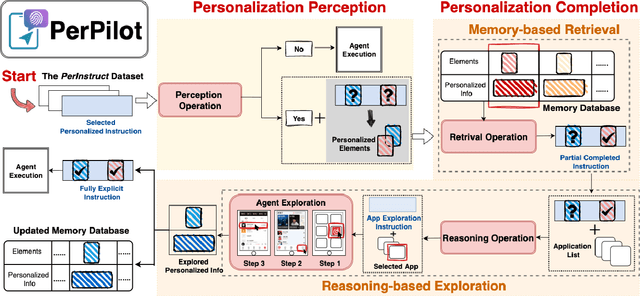

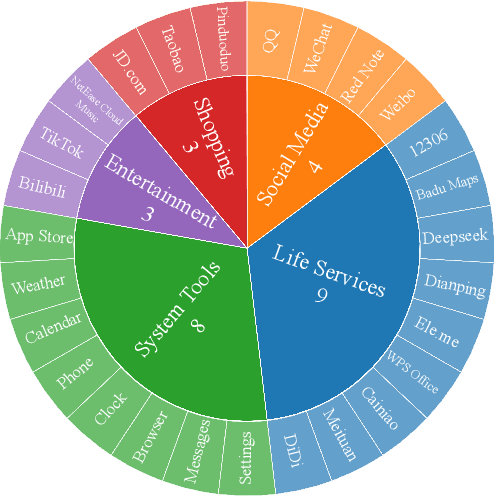
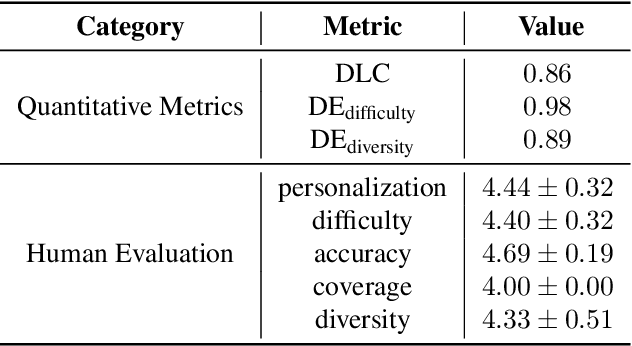
Vision language model (VLM)-based mobile agents show great potential for assisting users in performing instruction-driven tasks. However, these agents typically struggle with personalized instructions -- those containing ambiguous, user-specific context -- a challenge that has been largely overlooked in previous research. In this paper, we define personalized instructions and introduce PerInstruct, a novel human-annotated dataset covering diverse personalized instructions across various mobile scenarios. Furthermore, given the limited personalization capabilities of existing mobile agents, we propose PerPilot, a plug-and-play framework powered by large language models (LLMs) that enables mobile agents to autonomously perceive, understand, and execute personalized user instructions. PerPilot identifies personalized elements and autonomously completes instructions via two complementary approaches: memory-based retrieval and reasoning-based exploration. Experimental results demonstrate that PerPilot effectively handles personalized tasks with minimal user intervention and progressively improves its performance with continued use, underscoring the importance of personalization-aware reasoning for next-generation mobile agents. The dataset and code are available at: https://github.com/xinwang-nwpu/PerPilot
A Reputation System for Large Language Model-based Multi-agent Systems to Avoid the Tragedy of the Commons
May 08, 2025The tragedy of the commons, where individual self-interest leads to collectively disastrous outcomes, is a pervasive challenge in human society. Recent studies have demonstrated that similar phenomena can arise in generative multi-agent systems (MASs). To address this challenge, this paper explores the use of reputation systems as a remedy. We propose RepuNet, a dynamic, dual-level reputation framework that models both agent-level reputation dynamics and system-level network evolution. Specifically, driven by direct interactions and indirect gossip, agents form reputations for both themselves and their peers, and decide whether to connect or disconnect other agents for future interactions. Through two distinct scenarios, we show that RepuNet effectively mitigates the 'tragedy of the commons', promoting and sustaining cooperation in generative MASs. Moreover, we find that reputation systems can give rise to rich emergent behaviors in generative MASs, such as the formation of cooperative clusters, the social isolation of exploitative agents, and the preference for sharing positive gossip rather than negative ones.
Emergence of Social Norms in Large Language Model-based Agent Societies
Mar 13, 2024The emergence of social norms has attracted much interest in a wide array of disciplines, ranging from social science and cognitive science to artificial intelligence. In this paper, we propose the first generative agent architecture that empowers the emergence of social norms within a population of large language model-based agents. Our architecture, named CRSEC, consists of four modules: Creation & Representation, Spreading, Evaluation, and Compliance. Our architecture addresses several important aspects of the emergent processes all in one: (i) where social norms come from, (ii) how they are formally represented, (iii) how they spread through agents' communications and observations, (iv) how they are examined with a sanity check and synthesized in the long term, and (v) how they are incorporated into agents' planning and actions. Our experiments deployed in the Smallville sandbox game environment demonstrate the capability of our architecture to establish social norms and reduce social conflicts within large language model-based multi-agent systems. The positive outcomes of our human evaluation, conducted with 30 evaluators, further affirm the effectiveness of our approach.