 Add to Chrome
 Add to Firefox
 Add to Edge
ERNIE 5.0 Technical Report
Feb 04, 2026
In this report, we introduce ERNIE 5.0, a natively autoregressive foundation model desinged for unified multimodal understanding and generation across text, image, video, and audio. All modalities are trained from scratch under a unified next-group-of-tokens prediction objective, based on an ultra-sparse mixture-of-experts (MoE) architecture with modality-agnostic expert routing. To address practical challenges in large-scale deployment under diverse resource constraints, ERNIE 5.0 adopts a novel elastic training paradigm. Within a single pre-training run, the model learns a family of sub-models with varying depths, expert capacities, and routing sparsity, enabling flexible trade-offs among performance, model size, and inference latency in memory- or time-constrained scenarios. Moreover, we systematically address the challenges of scaling reinforcement learning to unified foundation models, thereby guaranteeing efficient and stable post-training under ultra-sparse MoE architectures and diverse multimodal settings. Extensive experiments demonstrate that ERNIE 5.0 achieves strong and balanced performance across multiple modalities. To the best of our knowledge, among publicly disclosed models, ERNIE 5.0 represents the first production-scale realization of a trillion-parameter unified autoregressive model that supports both multimodal understanding and generation. To facilitate further research, we present detailed visualizations of modality-agnostic expert routing in the unified model, alongside comprehensive empirical analysis of elastic training, aiming to offer profound insights to the community.

SuperGPQA: Scaling LLM Evaluation across 285 Graduate Disciplines
Feb 20, 2025Large language models (LLMs) have demonstrated remarkable proficiency in mainstream academic disciplines such as mathematics, physics, and computer science. However, human knowledge encompasses over 200 specialized disciplines, far exceeding the scope of existing benchmarks. The capabilities of LLMs in many of these specialized fields-particularly in light industry, agriculture, and service-oriented disciplines-remain inadequately evaluated. To address this gap, we present SuperGPQA, a comprehensive benchmark that evaluates graduate-level knowledge and reasoning capabilities across 285 disciplines. Our benchmark employs a novel Human-LLM collaborative filtering mechanism to eliminate trivial or ambiguous questions through iterative refinement based on both LLM responses and expert feedback. Our experimental results reveal significant room for improvement in the performance of current state-of-the-art LLMs across diverse knowledge domains (e.g., the reasoning-focused model DeepSeek-R1 achieved the highest accuracy of 61.82% on SuperGPQA), highlighting the considerable gap between current model capabilities and artificial general intelligence. Additionally, we present comprehensive insights from our management of a large-scale annotation process, involving over 80 expert annotators and an interactive Human-LLM collaborative system, offering valuable methodological guidance for future research initiatives of comparable scope.
Can MLLMs Understand the Deep Implication Behind Chinese Images?
Oct 17, 2024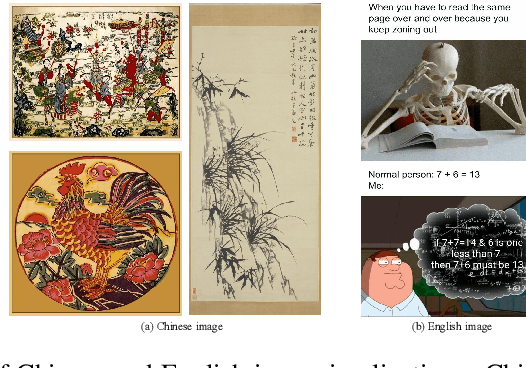
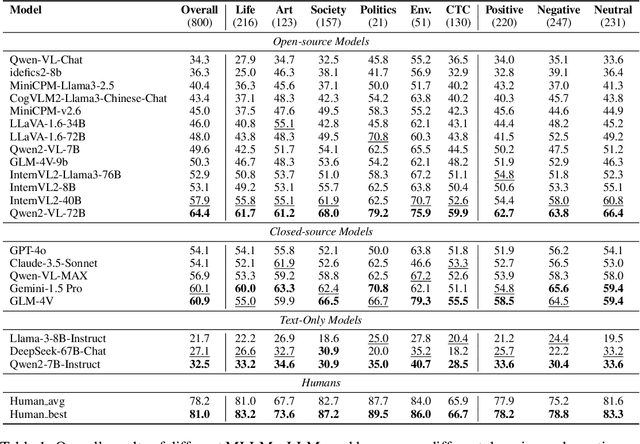
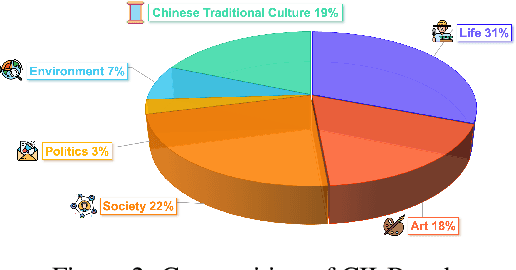
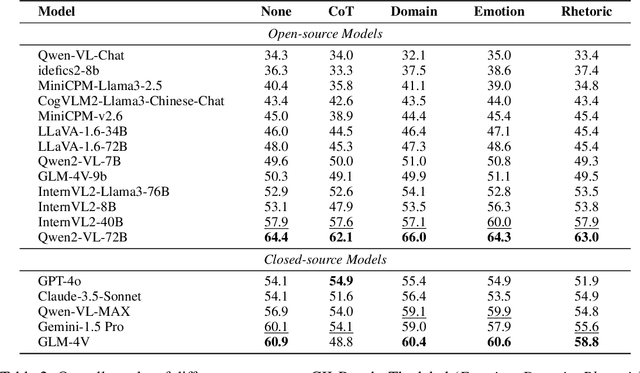
As the capabilities of Multimodal Large Language Models (MLLMs) continue to improve, the need for higher-order capability evaluation of MLLMs is increasing. However, there is a lack of work evaluating MLLM for higher-order perception and understanding of Chinese visual content. To fill the gap, we introduce the **C**hinese **I**mage **I**mplication understanding **Bench**mark, **CII-Bench**, which aims to assess the higher-order perception and understanding capabilities of MLLMs for Chinese images. CII-Bench stands out in several ways compared to existing benchmarks. Firstly, to ensure the authenticity of the Chinese context, images in CII-Bench are sourced from the Chinese Internet and manually reviewed, with corresponding answers also manually crafted. Additionally, CII-Bench incorporates images that represent Chinese traditional culture, such as famous Chinese traditional paintings, which can deeply reflect the model's understanding of Chinese traditional culture. Through extensive experiments on CII-Bench across multiple MLLMs, we have made significant findings. Initially, a substantial gap is observed between the performance of MLLMs and humans on CII-Bench. The highest accuracy of MLLMs attains 64.4%, where as human accuracy averages 78.2%, peaking at an impressive 81.0%. Subsequently, MLLMs perform worse on Chinese traditional culture images, suggesting limitations in their ability to understand high-level semantics and lack a deep knowledge base of Chinese traditional culture. Finally, it is observed that most models exhibit enhanced accuracy when image emotion hints are incorporated into the prompts. We believe that CII-Bench will enable MLLMs to gain a better understanding of Chinese semantics and Chinese-specific images, advancing the journey towards expert artificial general intelligence (AGI). Our project is publicly available at https://cii-bench.github.io/.