 Add to Chrome
 Add to Firefox
 Add to Edge
The LLM Data Auditor: A Metric-oriented Survey on Quality and Trustworthiness in Evaluating Synthetic Data
Jan 27, 2026
Large Language Models (LLMs) have emerged as powerful tools for generating data across various modalities. By transforming data from a scarce resource into a controllable asset, LLMs mitigate the bottlenecks imposed by the acquisition costs of real-world data for model training, evaluation, and system iteration. However, ensuring the high quality of LLM-generated synthetic data remains a critical challenge. Existing research primarily focuses on generation methodologies, with limited direct attention to the quality of the resulting data. Furthermore, most studies are restricted to single modalities, lacking a unified perspective across different data types. To bridge this gap, we propose the \textbf{LLM Data Auditor framework}. In this framework, we first describe how LLMs are utilized to generate data across six distinct modalities. More importantly, we systematically categorize intrinsic metrics for evaluating synthetic data from two dimensions: quality and trustworthiness. This approach shifts the focus from extrinsic evaluation, which relies on downstream task performance, to the inherent properties of the data itself. Using this evaluation system, we analyze the experimental evaluations of representative generation methods for each modality and identify substantial deficiencies in current evaluation practices. Based on these findings, we offer concrete recommendations for the community to improve the evaluation of data generation. Finally, the framework outlines methodologies for the practical application of synthetic data across different modalities.

TransactionGPT
Nov 12, 2025We present TransactionGPT (TGPT), a foundation model for consumer transaction data within one of world's largest payment networks. TGPT is designed to understand and generate transaction trajectories while simultaneously supporting a variety of downstream prediction and classification tasks. We introduce a novel 3D-Transformer architecture specifically tailored for capturing the complex dynamics in payment transaction data. This architecture incorporates design innovations that enhance modality fusion and computational efficiency, while seamlessly enabling joint optimization with downstream objectives. Trained on billion-scale real-world transactions, TGPT significantly improves downstream classification performance against a competitive production model and exhibits advantages over baselines in generating future transactions. We conduct extensive empirical evaluations utilizing a diverse collection of company transaction datasets spanning multiple downstream tasks, thereby enabling a thorough assessment of TGPT's effectiveness and efficiency in comparison to established methodologies. Furthermore, we examine the incorporation of LLM-derived embeddings within TGPT and benchmark its performance against fine-tuned LLMs, demonstrating that TGPT achieves superior predictive accuracy as well as faster training and inference. We anticipate that the architectural innovations and practical guidelines from this work will advance foundation models for transaction-like data and catalyze future research in this emerging field.
MAIN-RAG: Multi-Agent Filtering Retrieval-Augmented Generation
Dec 31, 2024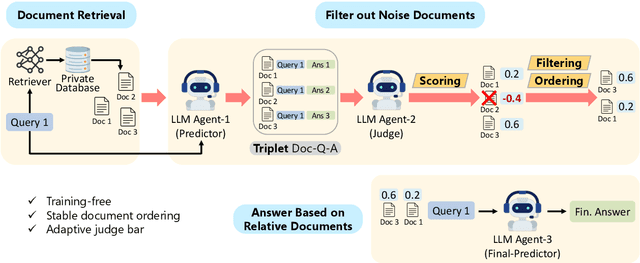
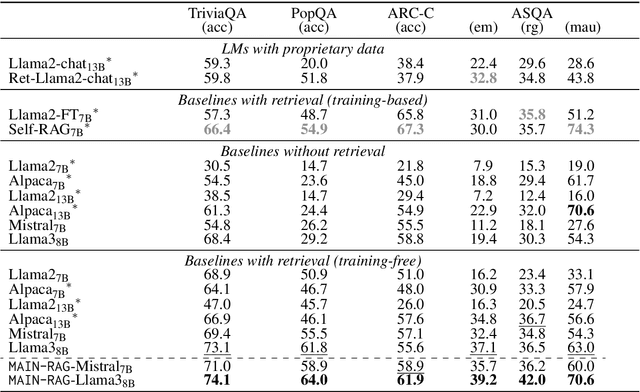
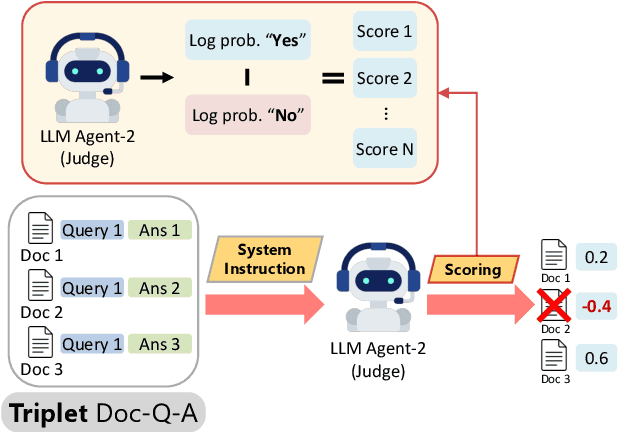
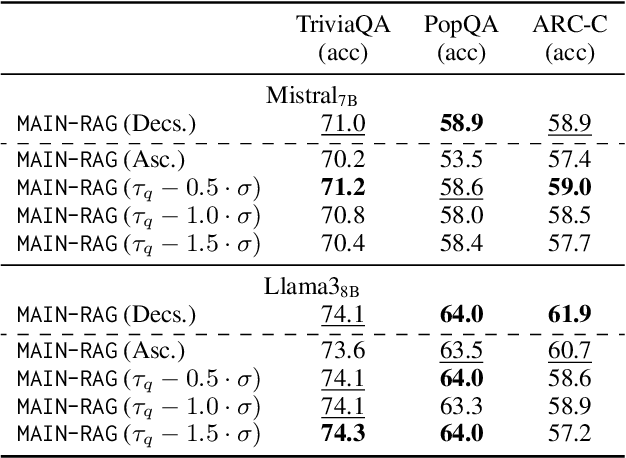
Large Language Models (LLMs) are becoming essential tools for various natural language processing tasks but often suffer from generating outdated or incorrect information. Retrieval-Augmented Generation (RAG) addresses this issue by incorporating external, real-time information retrieval to ground LLM responses. However, the existing RAG systems frequently struggle with the quality of retrieval documents, as irrelevant or noisy documents degrade performance, increase computational overhead, and undermine response reliability. To tackle this problem, we propose Multi-Agent Filtering Retrieval-Augmented Generation (MAIN-RAG), a training-free RAG framework that leverages multiple LLM agents to collaboratively filter and score retrieved documents. Specifically, MAIN-RAG introduces an adaptive filtering mechanism that dynamically adjusts the relevance filtering threshold based on score distributions, effectively minimizing noise while maintaining high recall of relevant documents. The proposed approach leverages inter-agent consensus to ensure robust document selection without requiring additional training data or fine-tuning. Experimental results across four QA benchmarks demonstrate that MAIN-RAG consistently outperforms traditional RAG approaches, achieving a 2-11% improvement in answer accuracy while reducing the number of irrelevant retrieved documents. Quantitative analysis further reveals that our approach achieves superior response consistency and answer accuracy over baseline methods, offering a competitive and practical alternative to training-based solutions.