 Add to Chrome
 Add to Firefox
 Add to Edge
Deep Layer Aggregation
Papers and Code
HSSDCT: Factorized Spatial-Spectral Correlation for Hyperspectral Image Fusion
Jan 31, 2026
Hyperspectral image (HSI) fusion aims to reconstruct a high-resolution HSI (HR-HSI) by combining the rich spectral information of a low-resolution HSI (LR-HSI) with the fine spatial details of a high-resolution multispectral image (HR-MSI). Although recent deep learning methods have achieved notable progress, they still suffer from limited receptive fields, redundant spectral bands, and the quadratic complexity of self-attention, which restrict both efficiency and robustness. To overcome these challenges, we propose the Hierarchical Spatial-Spectral Dense Correlation Network (HSSDCT). The framework introduces two key modules: (i) a Hierarchical Dense-Residue Transformer Block (HDRTB) that progressively enlarges windows and employs dense-residue connections for multi-scale feature aggregation, and (ii) a Spatial-Spectral Correlation Layer (SSCL) that explicitly factorizes spatial and spectral dependencies, reducing self-attention to linear complexity while mitigating spectral redundancy. Extensive experiments on benchmark datasets demonstrate that HSSDCT delivers superior reconstruction quality with significantly lower computational costs, achieving new state-of-the-art performance in HSI fusion. Our code is available at https://github.com/jemmyleee/HSSDCT.

GRIP2: A Robust and Powerful Deep Knockoff Method for Feature Selection
Jan 30, 2026Identifying truly predictive covariates while strictly controlling false discoveries remains a fundamental challenge in nonlinear, highly correlated, and low signal-to-noise regimes, where deep learning based feature selection methods are most attractive. We propose Group Regularization Importance Persistence in 2 Dimensions (GRIP2), a deep knockoff feature importance statistic that integrates first-layer feature activity over a two-dimensional regularization surface controlling both sparsity strength and sparsification geometry. To approximate this surface integral in a single training run, we introduce efficient block-stochastic sampling, which aggregates feature activity magnitudes across diverse regularization regimes along the optimization trajectory. The resulting statistics are antisymmetric by construction, ensuring finite-sample FDR control. In extensive experiments on synthetic and semi-real data, GRIP2 demonstrates improved robustness to feature correlation and noise level: in high correlation and low signal-to-noise ratio regimes where standard deep learning based feature selectors may struggle, our method retains high power and stability. Finally, on real-world HIV drug resistance data, GRIP2 recovers known resistance-associated mutations with power better than established linear baselines, confirming its reliability in practice.
SpanNorm: Reconciling Training Stability and Performance in Deep Transformers
Jan 30, 2026The success of Large Language Models (LLMs) hinges on the stable training of deep Transformer architectures. A critical design choice is the placement of normalization layers, leading to a fundamental trade-off: the ``PreNorm'' architecture ensures training stability at the cost of potential performance degradation in deep models, while the ``PostNorm'' architecture offers strong performance but suffers from severe training instability. In this work, we propose SpanNorm, a novel technique designed to resolve this dilemma by integrating the strengths of both paradigms. Structurally, SpanNorm establishes a clean residual connection that spans the entire transformer block to stabilize signal propagation, while employing a PostNorm-style computation that normalizes the aggregated output to enhance model performance. We provide a theoretical analysis demonstrating that SpanNorm, combined with a principled scaling strategy, maintains bounded signal variance throughout the network, preventing the gradient issues that plague PostNorm models, and also alleviating the representation collapse of PreNorm. Empirically, SpanNorm consistently outperforms standard normalization schemes in both dense and Mixture-of-Experts (MoE) scenarios, paving the way for more powerful and stable Transformer architectures.
ReflexSplit: Single Image Reflection Separation via Layer Fusion-Separation
Jan 24, 2026Single Image Reflection Separation (SIRS) disentangles mixed images into transmission and reflection layers. Existing methods suffer from transmission-reflection confusion under nonlinear mixing, particularly in deep decoder layers, due to implicit fusion mechanisms and inadequate multi-scale coordination. We propose ReflexSplit, a dual-stream framework with three key innovations. (1) Cross-scale Gated Fusion (CrGF) adaptively aggregates semantic priors, texture details, and decoder context across hierarchical depths, stabilizing gradient flow and maintaining feature consistency. (2) Layer Fusion-Separation Blocks (LFSB) alternate between fusion for shared structure extraction and differential separation for layer-specific disentanglement. Inspired by Differential Transformer, we extend attention cancellation to dual-stream separation via cross-stream subtraction. (3) Curriculum training progressively strengthens differential separation through depth-dependent initialization and epoch-wise warmup. Extensive experiments on synthetic and real-world benchmarks demonstrate state-of-the-art performance with superior perceptual quality and robust generalization. Our code is available at https://github.com/wuw2135/ReflexSplit.
Efficient reformulations of ReLU deep neural networks for surrogate modelling in power system optimisation
Jan 21, 2026The ongoing decarbonisation of power systems is driving an increasing reliance on distributed energy resources, which introduces complex and nonlinear interactions that are difficult to capture in conventional optimisation models. As a result, machine learning based surrogate modelling has emerged as a promising approach, but integrating machine learning models such as ReLU deep neural networks (DNNs) directly into optimisation often results in nonconvex and computationally intractable formulations. This paper proposes a linear programming (LP) reformulation for a class of convexified ReLU DNNs with non-negative weight matrices beyond the first layer, enabling a tight and tractable embedding of learned surrogate models in optimisation. We evaluate the method using a case study on learning the prosumer's responsiveness within an aggregator bidding problem in the Danish tertiary capacity market. The proposed reformulation is benchmarked against state-of-the-art alternatives, including piecewise linearisation (PWL), MIP-based embedding, and other LP relaxations. Across multiple neural network architectures and market scenarios, the convexified ReLU DNN achieves solution quality comparable to PWL and MIP-based reformulations while significantly improving computational performance and preserving model fidelity, unlike penalty-based reformulations. The results demonstrate that convexified ReLU DNNs offer a scalable and reliable methodology for integrating learned surrogate models in optimisation, with applicability to a wide range of emerging power system applications.
Federated Transformer-GNN for Privacy-Preserving Brain Tumor Localization with Modality-Level Explainability
Jan 21, 2026Deep learning models for brain tumor analysis require large and diverse datasets that are often siloed across healthcare institutions due to privacy regulations. We present a federated learning framework for brain tumor localization that enables multi-institutional collaboration without sharing sensitive patient data. Our method extends a hybrid Transformer-Graph Neural Network architecture derived from prior decoder-free supervoxel GNNs and is deployed within CAFEIN\textsuperscript{\textregistered}, CERN's federated learning platform designed for healthcare environments. We provide an explainability analysis through Transformer attention mechanisms that reveals which MRI modalities drive the model predictions. Experiments on the BraTS dataset demonstrate a key finding: while isolated training on individual client data triggers early stopping well before reaching full training capacity, federated learning enables continued model improvement by leveraging distributed data, ultimately matching centralized performance. This result provides strong justification for federated learning when dealing with complex tasks and high-dimensional input data, as aggregating knowledge from multiple institutions significantly benefits the learning process. Our explainability analysis, validated through rigorous statistical testing on the full test set (paired t-tests with Bonferroni correction), reveals that deeper network layers significantly increase attention to T2 and FLAIR modalities ($p<0.001$, Cohen's $d$=1.50), aligning with clinical practice.
Learning from Historical Activations in Graph Neural Networks
Jan 03, 2026Graph Neural Networks (GNNs) have demonstrated remarkable success in various domains such as social networks, molecular chemistry, and more. A crucial component of GNNs is the pooling procedure, in which the node features calculated by the model are combined to form an informative final descriptor to be used for the downstream task. However, previous graph pooling schemes rely on the last GNN layer features as an input to the pooling or classifier layers, potentially under-utilizing important activations of previous layers produced during the forward pass of the model, which we regard as historical graph activations. This gap is particularly pronounced in cases where a node's representation can shift significantly over the course of many graph neural layers, and worsened by graph-specific challenges such as over-smoothing in deep architectures. To bridge this gap, we introduce HISTOGRAPH, a novel two-stage attention-based final aggregation layer that first applies a unified layer-wise attention over intermediate activations, followed by node-wise attention. By modeling the evolution of node representations across layers, our HISTOGRAPH leverages both the activation history of nodes and the graph structure to refine features used for final prediction. Empirical results on multiple graph classification benchmarks demonstrate that HISTOGRAPH offers strong performance that consistently improves traditional techniques, with particularly strong robustness in deep GNNs.
WAY: Estimation of Vessel Destination in Worldwide AIS Trajectory
Dec 15, 2025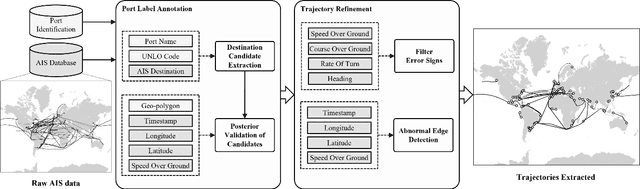
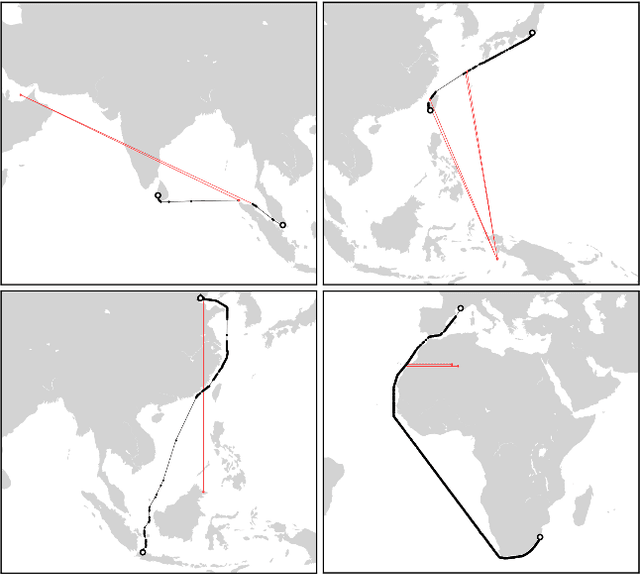
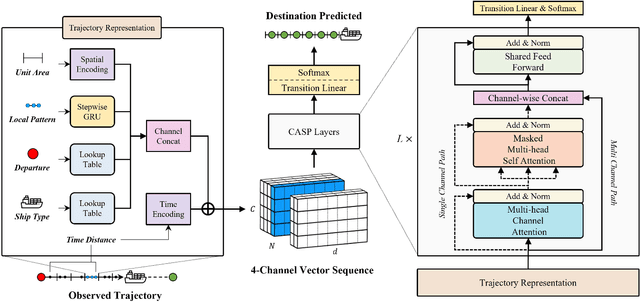
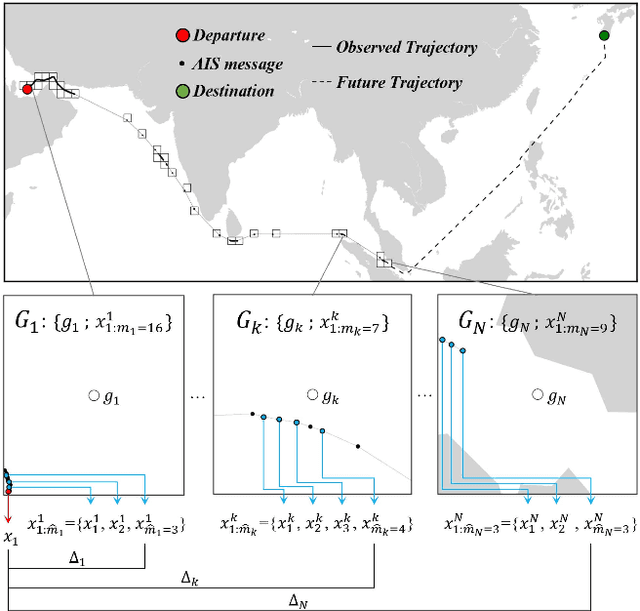
The Automatic Identification System (AIS) enables data-driven maritime surveillance but suffers from reliability issues and irregular intervals. We address vessel destination estimation using global-scope AIS data by proposing a differentiated approach that recasts long port-to-port trajectories as a nested sequence structure. Using spatial grids, this method mitigates spatio-temporal bias while preserving detailed resolution. We introduce a novel deep learning architecture, WAY, designed to process these reformulated trajectories for long-term destination estimation days to weeks in advance. WAY comprises a trajectory representation layer and Channel-Aggregative Sequential Processing (CASP) blocks. The representation layer generates multi-channel vector sequences from kinematic and non-kinematic features. CASP blocks utilize multi-headed channel- and self-attention for aggregation and sequential information delivery. Additionally, we propose a task-specialized Gradient Dropout (GD) technique to enable many-to-many training on single labels, preventing biased feedback surges by stochastically blocking gradient flow based on sample length. Experiments on 5-year AIS data demonstrate WAY's superiority over conventional spatial grid-based approaches regardless of trajectory progression. Results further confirm that adopting GD leads to performance gains. Finally, we explore WAY's potential for real-world application through multitask learning for ETA estimation.
* Accepted to IEEE Transactions on Aerospace and Electronic Systems (TAES)
Hetero-SplitEE: Split Learning of Neural Networks with Early Exits for Heterogeneous IoT Devices
Dec 10, 2025The continuous scaling of deep neural networks has fundamentally transformed machine learning, with larger models demonstrating improved performance across diverse tasks. This growth in model size has dramatically increased the computational resources required for the training process. Consequently, distributed approaches, such as Federated Learning and Split Learning, have become essential paradigms for scalable deployment. However, existing Split Learning approaches assume client homogeneity and uniform split points across all participants. This critically limits their applicability to real-world IoT systems where devices exhibit heterogeneity in computational resources. To address this limitation, this paper proposes Hetero-SplitEE, a novel method that enables heterogeneous IoT devices to train a shared deep neural network in parallel collaboratively. By integrating heterogeneous early exits into hierarchical training, our approach allows each client to select distinct split points (cut layers) tailored to its computational capacity. In addition, we propose two cooperative training strategies, the Sequential strategy and the Averaging strategy, to facilitate this collaboration among clients with different split points. The Sequential strategy trains clients sequentially with a shared server model to reduce computational overhead. The Averaging strategy enables parallel client training with periodic cross-layer aggregation. Extensive experiments on CIFAR-10, CIFAR-100, and STL-10 datasets using ResNet-18 demonstrate that our method maintains competitive accuracy while efficiently supporting diverse computational constraints, enabling practical deployment of collaborative deep learning in heterogeneous IoT ecosystems.
Advancing Text Classification with Large Language Models and Neural Attention Mechanisms
Dec 10, 2025This study proposes a text classification algorithm based on large language models, aiming to address the limitations of traditional methods in capturing long-range dependencies, understanding contextual semantics, and handling class imbalance. The framework includes text encoding, contextual representation modeling, attention-based enhancement, feature aggregation, and classification prediction. In the representation stage, deep semantic embeddings are obtained through large-scale pretrained language models, and attention mechanisms are applied to enhance the selective representation of key features. In the aggregation stage, global and weighted strategies are combined to generate robust text-level vectors. In the classification stage, a fully connected layer and Softmax output are used to predict class distributions, and cross-entropy loss is employed to optimize model parameters. Comparative experiments introduce multiple baseline models, including recurrent neural networks, graph neural networks, and Transformers, and evaluate them on Precision, Recall, F1-Score, and AUC. Results show that the proposed method outperforms existing models on all metrics, with especially strong improvements in Recall and AUC. In addition, sensitivity experiments are conducted on hyperparameters and data conditions, covering the impact of hidden dimensions on AUC and the impact of class imbalance ratios on Recall. The findings demonstrate that proper model configuration has a significant effect on performance and reveal the adaptability and stability of the model under different conditions. Overall, the proposed text classification method not only achieves effective performance improvement but also verifies its robustness and applicability in complex data environments through systematic analysis.