 Add to Chrome
 Add to Firefox
 Add to Edge
Elign: Equivariant Diffusion Model Alignment from Foundational Machine Learning Force Fields
Jan 29, 2026
Generative models for 3D molecular conformations must respect Euclidean symmetries and concentrate probability mass on thermodynamically favorable, mechanically stable structures. However, E(3)-equivariant diffusion models often reproduce biases from semi-empirical training data rather than capturing the equilibrium distribution of a high-fidelity Hamiltonian. While physics-based guidance can correct this, it faces two computational bottlenecks: expensive quantum-chemical evaluations (e.g., DFT) and the need to repeat such queries at every sampling step. We present Elign, a post-training framework that amortizes both costs. First, we replace expensive DFT evaluations with a faster, pretrained foundational machine-learning force field (MLFF) to provide physical signals. Second, we eliminate repeated run-time queries by shifting physical steering to the training phase. To achieve the second amortization, we formulate reverse diffusion as a reinforcement learning problem and introduce Force--Energy Disentangled Group Relative Policy Optimization (FED-GRPO) to fine-tune the denoising policy. FED-GRPO includes a potential-based energy reward and a force-based stability reward, which are optimized and group-normalized independently. Experiments show that Elign generates conformations with lower gold-standard DFT energies and forces, while improving stability. Crucially, inference remains as fast as unguided sampling, since no energy evaluations are required during generation.

E2Former-V2: On-the-Fly Equivariant Attention with Linear Activation Memory
Jan 23, 2026Equivariant Graph Neural Networks (EGNNs) have become a widely used approach for modeling 3D atomistic systems. However, mainstream architectures face critical scalability bottlenecks due to the explicit construction of geometric features or dense tensor products on \textit{every} edge. To overcome this, we introduce \textbf{E2Former-V2}, a scalable architecture that integrates algebraic sparsity with hardware-aware execution. We first propose \textbf{E}quivariant \textbf{A}xis-\textbf{A}ligned \textbf{S}parsification (EAAS). EAAS builds on Wigner-$6j$ convolution by exploiting an $\mathrm{SO}(3) \rightarrow \mathrm{SO}(2)$ change of basis to transform computationally expensive dense tensor contractions into efficient, sparse parity re-indexing operations. Building on this representation, we introduce \textbf{On-the-Fly Equivariant Attention}, a fully node-centric mechanism implemented via a custom fused Triton kernel. By eliminating materialized edge tensors and maximizing SRAM utilization, our kernel achieves a \textbf{20$\times$ improvement in TFLOPS} compared to standard implementations. Extensive experiments on the SPICE and OMol25 datasets demonstrate that E2Former-V2 maintains comparable predictive performance while notably accelerating inference. This work demonstrates that large equivariant transformers can be trained efficiently using widely accessible GPU platforms. The code is avalible at https://github.com/IQuestLab/UBio-MolFM/tree/e2formerv2.
Enhancing the Scalability and Applicability of Kohn-Sham Hamiltonians for Molecular Systems
Feb 26, 2025Density Functional Theory (DFT) is a pivotal method within quantum chemistry and materials science, with its core involving the construction and solution of the Kohn-Sham Hamiltonian. Despite its importance, the application of DFT is frequently limited by the substantial computational resources required to construct the Kohn-Sham Hamiltonian. In response to these limitations, current research has employed deep-learning models to efficiently predict molecular and solid Hamiltonians, with roto-translational symmetries encoded in their neural networks. However, the scalability of prior models may be problematic when applied to large molecules, resulting in non-physical predictions of ground-state properties. In this study, we generate a substantially larger training set (PubChemQH) than used previously and use it to create a scalable model for DFT calculations with physical accuracy. For our model, we introduce a loss function derived from physical principles, which we call Wavefunction Alignment Loss (WALoss). WALoss involves performing a basis change on the predicted Hamiltonian to align it with the observed one; thus, the resulting differences can serve as a surrogate for orbital energy differences, allowing models to make better predictions for molecular orbitals and total energies than previously possible. WALoss also substantially accelerates self-consistent-field (SCF) DFT calculations. Here, we show it achieves a reduction in total energy prediction error by a factor of 1347 and an SCF calculation speed-up by a factor of 18%. These substantial improvements set new benchmarks for achieving accurate and applicable predictions in larger molecular systems.
Efficient and Scalable Density Functional Theory Hamiltonian Prediction through Adaptive Sparsity
Feb 03, 2025Hamiltonian matrix prediction is pivotal in computational chemistry, serving as the foundation for determining a wide range of molecular properties. While SE(3) equivariant graph neural networks have achieved remarkable success in this domain, their substantial computational cost-driven by high-order tensor product (TP) operations-restricts their scalability to large molecular systems with extensive basis sets. To address this challenge, we introduce SPHNet, an efficient and scalable equivariant network that incorporates adaptive sparsity into Hamiltonian prediction. SPHNet employs two innovative sparse gates to selectively constrain non-critical interaction combinations, significantly reducing tensor product computations while maintaining accuracy. To optimize the sparse representation, we develop a Three-phase Sparsity Scheduler, ensuring stable convergence and achieving high performance at sparsity rates of up to 70 percent. Extensive evaluations on QH9 and PubchemQH datasets demonstrate that SPHNet achieves state-of-the-art accuracy while providing up to a 7x speedup over existing models. Beyond Hamiltonian prediction, the proposed sparsification techniques also hold significant potential for improving the efficiency and scalability of other SE(3) equivariant networks, further broadening their applicability and impact.
\underline{E2}Former: A Linear-time \underline{E}fficient and \underline{E}quivariant Trans\underline{former} for Scalable Molecular Modeling
Jan 31, 2025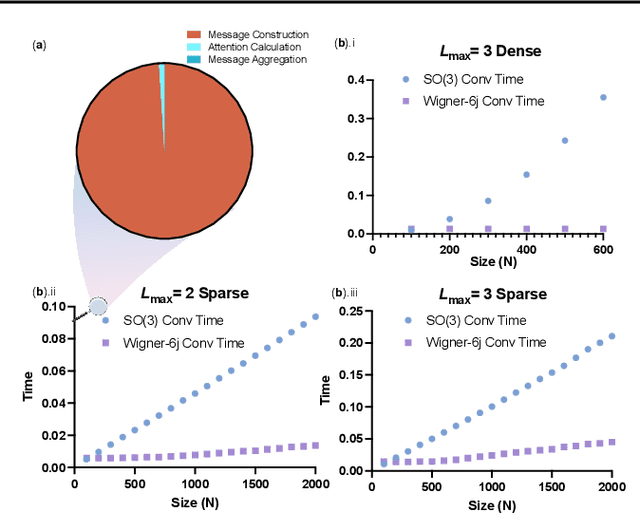
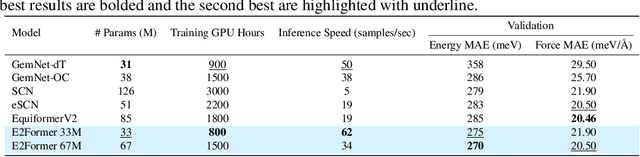
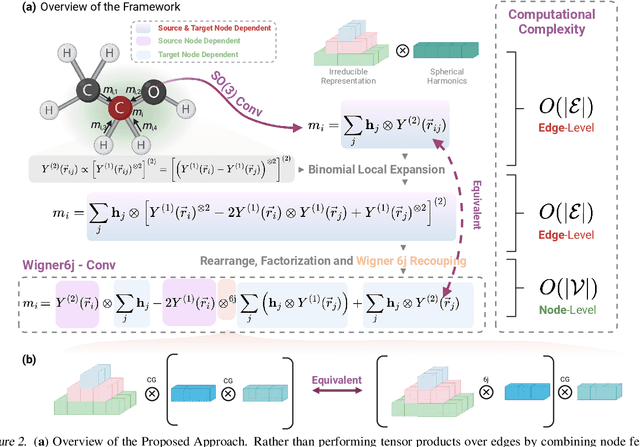

Equivariant Graph Neural Networks (EGNNs) have demonstrated significant success in modeling microscale systems, including those in chemistry, biology and materials science. However, EGNNs face substantial computational challenges due to the high cost of constructing edge features via spherical tensor products, making them impractical for large-scale systems. To address this limitation, we introduce E2Former, an equivariant and efficient transformer architecture that incorporates the Wigner $6j$ convolution (Wigner $6j$ Conv). By shifting the computational burden from edges to nodes, the Wigner $6j$ Conv reduces the complexity from $O(|\mathcal{E}|)$ to $ O(| \mathcal{V}|)$ while preserving both the model's expressive power and rotational equivariance. We show that this approach achieves a 7x-30x speedup compared to conventional $\mathrm{SO}(3)$ convolutions. Furthermore, our empirical results demonstrate that the derived E2Former mitigates the computational challenges of existing approaches without compromising the ability to capture detailed geometric information. This development could suggest a promising direction for scalable and efficient molecular modeling.
A Survey of Generative AI for De Novo Drug Design: New Frontiers in Molecule and Protein Generation
Feb 13, 2024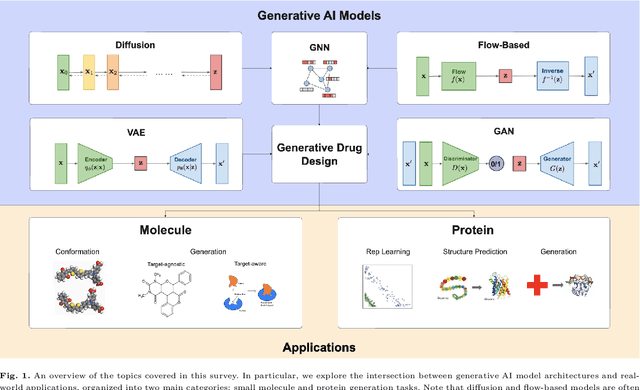
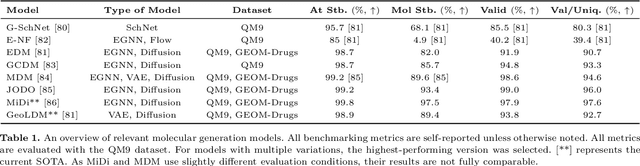
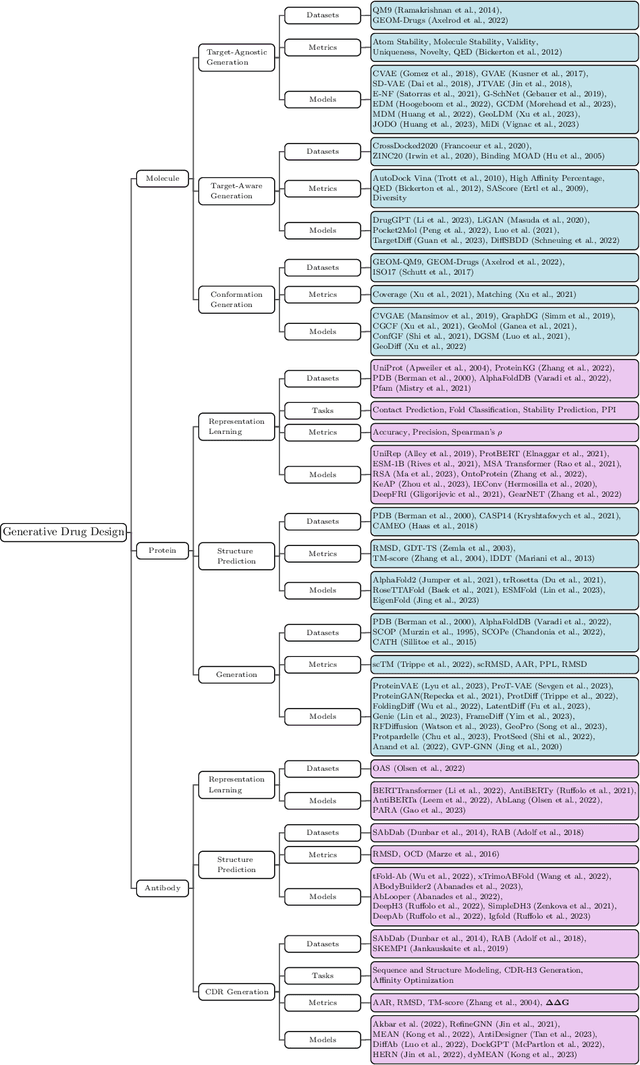

Artificial intelligence (AI)-driven methods can vastly improve the historically costly drug design process, with various generative models already in widespread use. Generative models for de novo drug design, in particular, focus on the creation of novel biological compounds entirely from scratch, representing a promising future direction. Rapid development in the field, combined with the inherent complexity of the drug design process, creates a difficult landscape for new researchers to enter. In this survey, we organize de novo drug design into two overarching themes: small molecule and protein generation. Within each theme, we identify a variety of subtasks and applications, highlighting important datasets, benchmarks, and model architectures and comparing the performance of top models. We take a broad approach to AI-driven drug design, allowing for both micro-level comparisons of various methods within each subtask and macro-level observations across different fields. We discuss parallel challenges and approaches between the two applications and highlight future directions for AI-driven de novo drug design as a whole. An organized repository of all covered sources is available at https://github.com/gersteinlab/GenAI4Drug.