 Add to Chrome
 Add to Firefox
 Add to Edge
ERNIE 5.0 Technical Report
Feb 04, 2026
In this report, we introduce ERNIE 5.0, a natively autoregressive foundation model desinged for unified multimodal understanding and generation across text, image, video, and audio. All modalities are trained from scratch under a unified next-group-of-tokens prediction objective, based on an ultra-sparse mixture-of-experts (MoE) architecture with modality-agnostic expert routing. To address practical challenges in large-scale deployment under diverse resource constraints, ERNIE 5.0 adopts a novel elastic training paradigm. Within a single pre-training run, the model learns a family of sub-models with varying depths, expert capacities, and routing sparsity, enabling flexible trade-offs among performance, model size, and inference latency in memory- or time-constrained scenarios. Moreover, we systematically address the challenges of scaling reinforcement learning to unified foundation models, thereby guaranteeing efficient and stable post-training under ultra-sparse MoE architectures and diverse multimodal settings. Extensive experiments demonstrate that ERNIE 5.0 achieves strong and balanced performance across multiple modalities. To the best of our knowledge, among publicly disclosed models, ERNIE 5.0 represents the first production-scale realization of a trillion-parameter unified autoregressive model that supports both multimodal understanding and generation. To facilitate further research, we present detailed visualizations of modality-agnostic expert routing in the unified model, alongside comprehensive empirical analysis of elastic training, aiming to offer profound insights to the community.

PP-OCRv2: Bag of Tricks for Ultra Lightweight OCR System
Sep 07, 2021

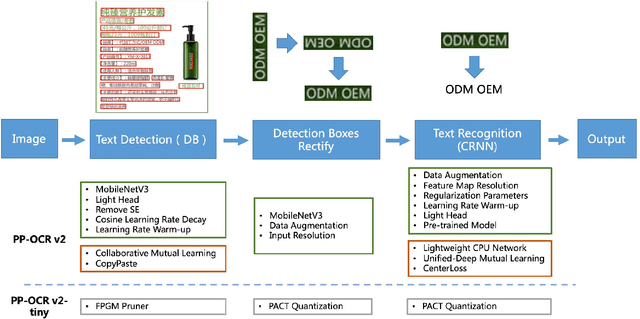
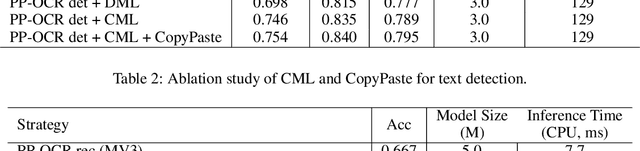
Optical Character Recognition (OCR) systems have been widely used in various of application scenarios. Designing an OCR system is still a challenging task. In previous work, we proposed a practical ultra lightweight OCR system (PP-OCR) to balance the accuracy against the efficiency. In order to improve the accuracy of PP-OCR and keep high efficiency, in this paper, we propose a more robust OCR system, i.e. PP-OCRv2. We introduce bag of tricks to train a better text detector and a better text recognizer, which include Collaborative Mutual Learning (CML), CopyPaste, Lightweight CPUNetwork (LCNet), Unified-Deep Mutual Learning (U-DML) and Enhanced CTCLoss. Experiments on real data show that the precision of PP-OCRv2 is 7% higher than PP-OCR under the same inference cost. It is also comparable to the server models of the PP-OCR which uses ResNet series as backbones. All of the above mentioned models are open-sourced and the code is available in the GitHub repository PaddleOCR which is powered by PaddlePaddle.
PP-OCR: A Practical Ultra Lightweight OCR System
Oct 15, 2020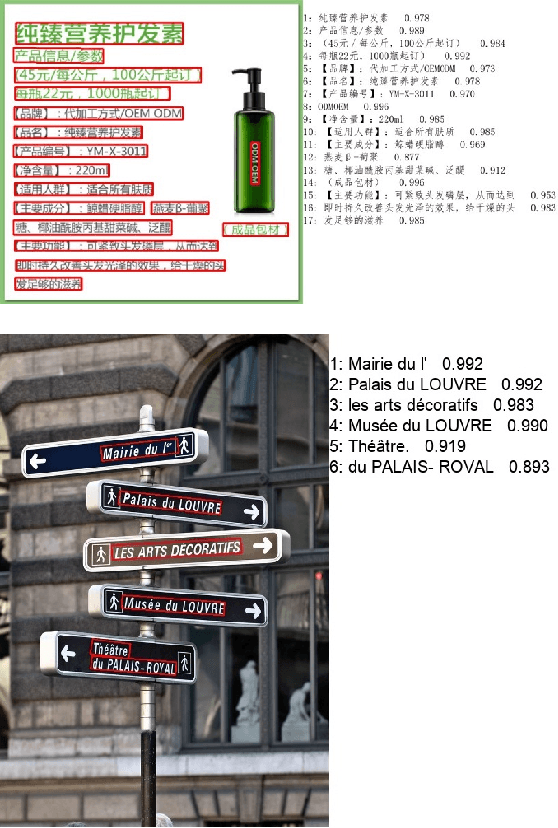

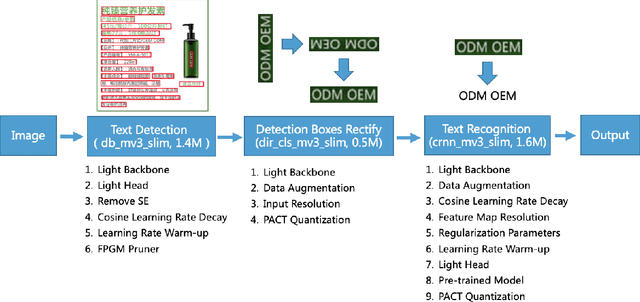
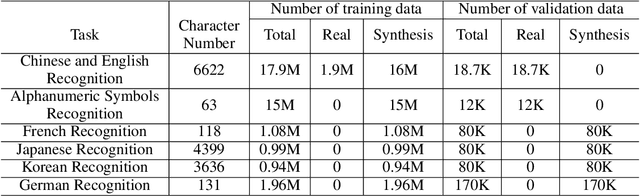
The Optical Character Recognition (OCR) systems have been widely used in various of application scenarios, such as office automation (OA) systems, factory automations, online educations, map productions etc. However, OCR is still a challenging task due to the various of text appearances and the demand of computational efficiency. In this paper, we propose a practical ultra lightweight OCR system, i.e., PP-OCR. The overall model size of the PP-OCR is only 3.5M for recognizing 6622 Chinese characters and 2.8M for recognizing 63 alphanumeric symbols, respectively. We introduce a bag of strategies to either enhance the model ability or reduce the model size. The corresponding ablation experiments with the real data are also provided. Meanwhile, several pre-trained models for the Chinese and English recognition are released, including a text detector (97K images are used), a direction classifier (600K images are used) as well as a text recognizer (17.9M images are used). Besides, the proposed PP-OCR are also verified in several other language recognition tasks, including French, Korean, Japanese and German. All of the above mentioned models are open-sourced and the codes are available in the GitHub repository, i.e., https://github.com/PaddlePaddle/PaddleOCR.