 Add to Chrome
 Add to Firefox
 Add to Edge
Advancing Opinion Dynamics Modeling with Neural Diffusion-Convection-Reaction Equation
Feb 05, 2026
Advanced opinion dynamics modeling is vital for deciphering social behavior, emphasizing its role in mitigating polarization and securing cyberspace. To synergize mechanistic interpretability with data-driven flexibility, recent studies have explored the integration of Physics-Informed Neural Networks (PINNs) for opinion modeling. Despite this promise, existing methods are tailored to incomplete priors, lacking a comprehensive physical system to integrate dynamics from local, global, and endogenous levels. Moreover, penalty-based constraints adopted in existing methods struggle to deeply encode physical priors, leading to optimization pathologies and discrepancy between latent representations and physical transparency. To this end, we offer a physical view to interpret opinion dynamics via Diffusion-Convection-Reaction (DCR) system inspired by interacting particle theory. Building upon the Neural ODEs, we define the neural opinion dynamics to coordinate neural networks with physical priors, and further present the OPINN, a physics-informed neural framework for opinion dynamics modeling. Evaluated on real-world and synthetic datasets, OPINN achieves state-of-the-art performance in opinion evolution forecasting, offering a promising paradigm for the nexus of cyber, physical, and social systems.

TopoDIM: One-shot Topology Generation of Diverse Interaction Modes for Multi-Agent Systems
Jan 15, 2026Optimizing communication topology in LLM-based multi-agent system is critical for enabling collective intelligence. Existing methods mainly rely on spatio-temporal interaction paradigms, where the sequential execution of multi-round dialogues incurs high latency and computation. Motivated by the recent insights that evaluation and debate mechanisms can improve problem-solving in multi-agent systems, we propose TopoDIM, a framework for one-shot Topology generation with Diverse Interaction Modes. Designed for decentralized execution to enhance adaptability and privacy, TopoDIM enables agents to autonomously construct heterogeneous communication without iterative coordination, achieving token efficiency and improved task performance. Experiments demonstrate that TopoDIM reduces total token consumption by 46.41% while improving average performance by 1.50% over state-of-the-art methods. Moreover, the framework exhibits strong adaptability in organizing communication among heterogeneous agents. Code is available at: https://anonymous.4open.science/r/TopoDIM-8D35/
EscherVerse: An Open World Benchmark and Dataset for Teleo-Spatial Intelligence with Physical-Dynamic and Intent-Driven Understanding
Jan 04, 2026The ability to reason about spatial dynamics is a cornerstone of intelligence, yet current research overlooks the human intent behind spatial changes. To address these limitations, we introduce Teleo-Spatial Intelligence (TSI), a new paradigm that unifies two critical pillars: Physical-Dynamic Reasoning--understanding the physical principles of object interactions--and Intent-Driven Reasoning--inferring the human goals behind these actions. To catalyze research in TSI, we present EscherVerse, consisting of a large-scale, open-world benchmark (Escher-Bench), a dataset (Escher-35k), and models (Escher series). Derived from real-world videos, EscherVerse moves beyond constrained settings to explicitly evaluate an agent's ability to reason about object permanence, state transitions, and trajectory prediction in dynamic, human-centric scenarios. Crucially, it is the first benchmark to systematically assess Intent-Driven Reasoning, challenging models to connect physical events to their underlying human purposes. Our work, including a novel data curation pipeline, provides a foundational resource to advance spatial intelligence from passive scene description toward a holistic, purpose-driven understanding of the world.
DORAEMON: Decentralized Ontology-aware Reliable Agent with Enhanced Memory Oriented Navigation
May 29, 2025Adaptive navigation in unfamiliar environments is crucial for household service robots but remains challenging due to the need for both low-level path planning and high-level scene understanding. While recent vision-language model (VLM) based zero-shot approaches reduce dependence on prior maps and scene-specific training data, they face significant limitations: spatiotemporal discontinuity from discrete observations, unstructured memory representations, and insufficient task understanding leading to navigation failures. We propose DORAEMON (Decentralized Ontology-aware Reliable Agent with Enhanced Memory Oriented Navigation), a novel cognitive-inspired framework consisting of Ventral and Dorsal Streams that mimics human navigation capabilities. The Dorsal Stream implements the Hierarchical Semantic-Spatial Fusion and Topology Map to handle spatiotemporal discontinuities, while the Ventral Stream combines RAG-VLM and Policy-VLM to improve decision-making. Our approach also develops Nav-Ensurance to ensure navigation safety and efficiency. We evaluate DORAEMON on the HM3D, MP3D, and GOAT datasets, where it achieves state-of-the-art performance on both success rate (SR) and success weighted by path length (SPL) metrics, significantly outperforming existing methods. We also introduce a new evaluation metric (AORI) to assess navigation intelligence better. Comprehensive experiments demonstrate DORAEMON's effectiveness in zero-shot autonomous navigation without requiring prior map building or pre-training.
EpiLLM: Unlocking the Potential of Large Language Models in Epidemic Forecasting
May 19, 2025Advanced epidemic forecasting is critical for enabling precision containment strategies, highlighting its strategic importance for public health security. While recent advances in Large Language Models (LLMs) have demonstrated effectiveness as foundation models for domain-specific tasks, their potential for epidemic forecasting remains largely unexplored. In this paper, we introduce EpiLLM, a novel LLM-based framework tailored for spatio-temporal epidemic forecasting. Considering the key factors in real-world epidemic transmission: infection cases and human mobility, we introduce a dual-branch architecture to achieve fine-grained token-level alignment between such complex epidemic patterns and language tokens for LLM adaptation. To unleash the multi-step forecasting and generalization potential of LLM architectures, we propose an autoregressive modeling paradigm that reformulates the epidemic forecasting task into next-token prediction. To further enhance LLM perception of epidemics, we introduce spatio-temporal prompt learning techniques, which strengthen forecasting capabilities from a data-driven perspective. Extensive experiments show that EpiLLM significantly outperforms existing baselines on real-world COVID-19 datasets and exhibits scaling behavior characteristic of LLMs.
Efficient Multimodal Large Language Models: A Survey
May 17, 2024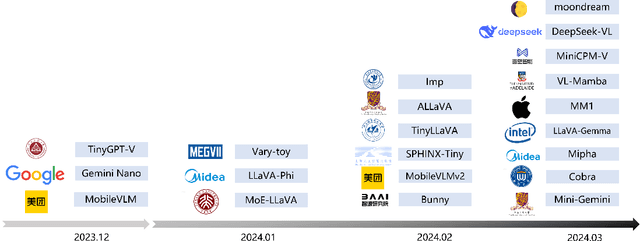
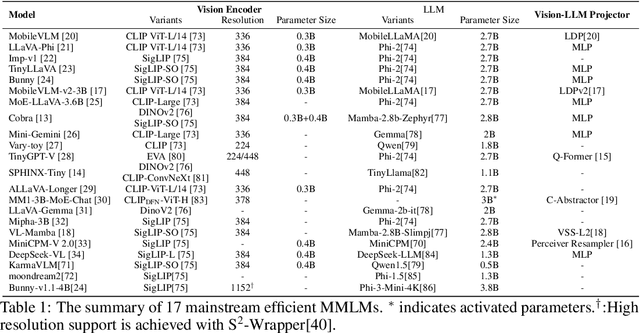
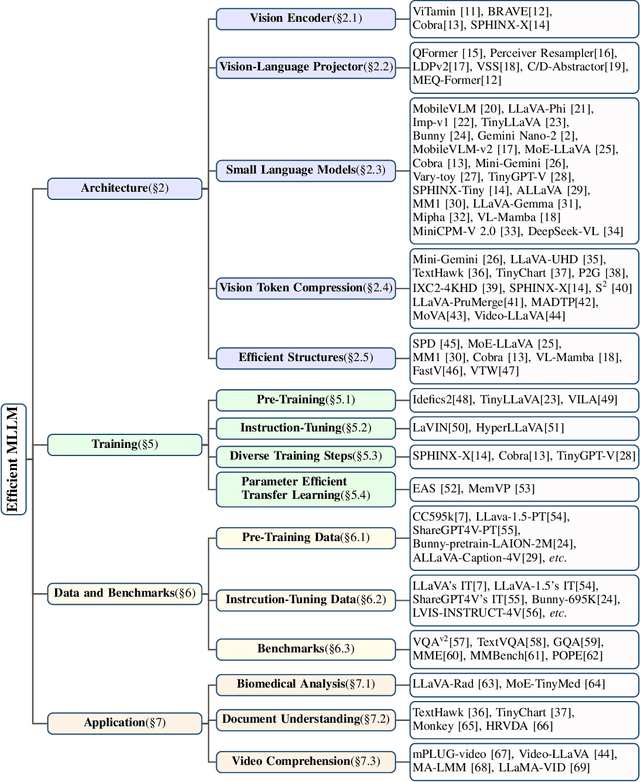
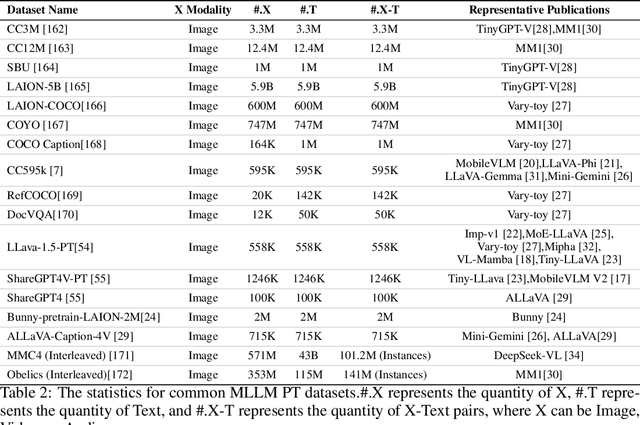
In the past year, Multimodal Large Language Models (MLLMs) have demonstrated remarkable performance in tasks such as visual question answering, visual understanding and reasoning. However, the extensive model size and high training and inference costs have hindered the widespread application of MLLMs in academia and industry. Thus, studying efficient and lightweight MLLMs has enormous potential, especially in edge computing scenarios. In this survey, we provide a comprehensive and systematic review of the current state of efficient MLLMs. Specifically, we summarize the timeline of representative efficient MLLMs, research state of efficient structures and strategies, and the applications. Finally, we discuss the limitations of current efficient MLLM research and promising future directions. Please refer to our GitHub repository for more details: https://github.com/lijiannuist/Efficient-Multimodal-LLMs-Survey.