 Add to Chrome
 Add to Firefox
 Add to Edge
Advancing Opinion Dynamics Modeling with Neural Diffusion-Convection-Reaction Equation
Feb 05, 2026
Advanced opinion dynamics modeling is vital for deciphering social behavior, emphasizing its role in mitigating polarization and securing cyberspace. To synergize mechanistic interpretability with data-driven flexibility, recent studies have explored the integration of Physics-Informed Neural Networks (PINNs) for opinion modeling. Despite this promise, existing methods are tailored to incomplete priors, lacking a comprehensive physical system to integrate dynamics from local, global, and endogenous levels. Moreover, penalty-based constraints adopted in existing methods struggle to deeply encode physical priors, leading to optimization pathologies and discrepancy between latent representations and physical transparency. To this end, we offer a physical view to interpret opinion dynamics via Diffusion-Convection-Reaction (DCR) system inspired by interacting particle theory. Building upon the Neural ODEs, we define the neural opinion dynamics to coordinate neural networks with physical priors, and further present the OPINN, a physics-informed neural framework for opinion dynamics modeling. Evaluated on real-world and synthetic datasets, OPINN achieves state-of-the-art performance in opinion evolution forecasting, offering a promising paradigm for the nexus of cyber, physical, and social systems.

TopoDIM: One-shot Topology Generation of Diverse Interaction Modes for Multi-Agent Systems
Jan 15, 2026Optimizing communication topology in LLM-based multi-agent system is critical for enabling collective intelligence. Existing methods mainly rely on spatio-temporal interaction paradigms, where the sequential execution of multi-round dialogues incurs high latency and computation. Motivated by the recent insights that evaluation and debate mechanisms can improve problem-solving in multi-agent systems, we propose TopoDIM, a framework for one-shot Topology generation with Diverse Interaction Modes. Designed for decentralized execution to enhance adaptability and privacy, TopoDIM enables agents to autonomously construct heterogeneous communication without iterative coordination, achieving token efficiency and improved task performance. Experiments demonstrate that TopoDIM reduces total token consumption by 46.41% while improving average performance by 1.50% over state-of-the-art methods. Moreover, the framework exhibits strong adaptability in organizing communication among heterogeneous agents. Code is available at: https://anonymous.4open.science/r/TopoDIM-8D35/
Beamforming Design for RIS-Aided THz Wideband Communication Systems
Sep 21, 2023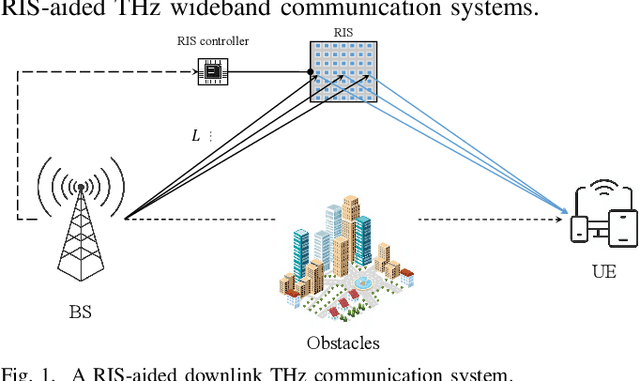
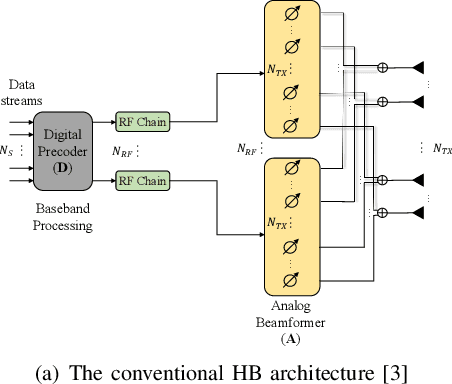
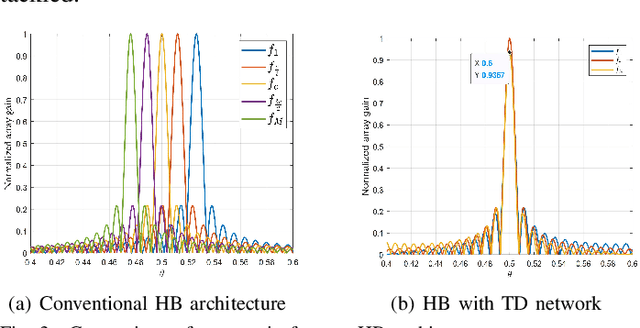
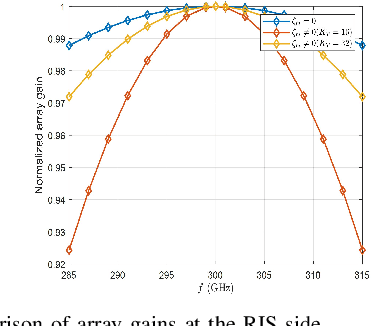
Benefiting from tens of GHz of bandwidth, terahertz (THz) communications has become a promising technology for future 6G networks. However, the conventional hybrid beamforming architecture based on frequency-independent phase-shifters is not able to cope with the beam split effect (BSE) in THz massive multiple-input multiple-output (MIMO) systems. Despite some work introducing the frequency-dependent phase shifts via the time delay network to mitigate the beam splitting in THz wideband communications, the corresponding issue in reconfigurable intelligent surface (RIS)-aided communications has not been well investigated. In this paper, the BSE in THz massive MIMO is quantified by analyzing the array gain loss. A new beamforming architecture has been proposed to mitigate this effect under RIS-aided communications scenarios. Simulations are performed to evaluate the effectiveness of the proposed system architecture in combating the array gain loss.