 Add to Chrome
 Add to Firefox
 Add to Edge
VideoGPA: Distilling Geometry Priors for 3D-Consistent Video Generation
Jan 30, 2026
While recent video diffusion models (VDMs) produce visually impressive results, they fundamentally struggle to maintain 3D structural consistency, often resulting in object deformation or spatial drift. We hypothesize that these failures arise because standard denoising objectives lack explicit incentives for geometric coherence. To address this, we introduce VideoGPA (Video Geometric Preference Alignment), a data-efficient self-supervised framework that leverages a geometry foundation model to automatically derive dense preference signals that guide VDMs via Direct Preference Optimization (DPO). This approach effectively steers the generative distribution toward inherent 3D consistency without requiring human annotations. VideoGPA significantly enhances temporal stability, physical plausibility, and motion coherence using minimal preference pairs, consistently outperforming state-of-the-art baselines in extensive experiments.

UniHash: Unifying Pointwise and Pairwise Hashing Paradigms for Seen and Unseen Category Retrieval
Jan 14, 2026Effective retrieval across both seen and unseen categories is crucial for modern image retrieval systems. Retrieval on seen categories ensures precise recognition of known classes, while retrieval on unseen categories promotes generalization to novel classes with limited supervision. However, most existing deep hashing methods are confined to a single training paradigm, either pointwise or pairwise, where the former excels on seen categories and the latter generalizes better to unseen ones. To overcome this limitation, we propose Unified Hashing (UniHash), a dual-branch framework that unifies the strengths of both paradigms to achieve balanced retrieval performance across seen and unseen categories. UniHash consists of two complementary branches: a center-based branch following the pointwise paradigm and a pairwise branch following the pairwise paradigm. A novel hash code learning method is introduced to enable bidirectional knowledge transfer between branches, improving hash code discriminability and generalization. It employs a mutual learning loss to align hash representations and introduces a Split-Merge Mixture of Hash Experts (SM-MoH) module to enhance cross-branch exchange of hash representations. Theoretical analysis substantiates the effectiveness of UniHash, and extensive experiments on CIFAR-10, MSCOCO, and ImageNet demonstrate that UniHash consistently achieves state-of-the-art performance in both seen and unseen image retrieval scenarios.
MAP-VLA: Memory-Augmented Prompting for Vision-Language-Action Model in Robotic Manipulation
Nov 12, 2025Pre-trained Vision-Language-Action (VLA) models have achieved remarkable success in improving robustness and generalization for end-to-end robotic manipulation. However, these models struggle with long-horizon tasks due to their lack of memory and reliance solely on immediate sensory inputs. To address this limitation, we propose Memory-Augmented Prompting for Vision-Language-Action model (MAP-VLA), a novel framework that empowers pre-trained VLA models with demonstration-derived memory prompts to augment action generation for long-horizon robotic manipulation tasks. To achieve this, MAP-VLA first constructs a memory library from historical demonstrations, where each memory unit captures information about a specific stage of a task. These memory units are implemented as learnable soft prompts optimized through prompt tuning. Then, during real-time task execution, MAP-VLA retrieves relevant memory through trajectory similarity matching and dynamically integrates it into the VLA model for augmented action generation. Importantly, this prompt tuning and retrieval augmentation approach operates as a plug-and-play module for a frozen VLA model, offering a lightweight and flexible solution to improve task performance. Experimental results show that MAP-VLA delivers up to 7.0% absolute performance gains in the simulation benchmark and 25.0% on real robot evaluations for long-horizon tasks, surpassing the current state-of-the-art methods.
Mutual Learning for Hashing: Unlocking Strong Hash Functions from Weak Supervision
Oct 09, 2025Deep hashing has been widely adopted for large-scale image retrieval, with numerous strategies proposed to optimize hash function learning. Pairwise-based methods are effective in learning hash functions that preserve local similarity relationships, whereas center-based methods typically achieve superior performance by more effectively capturing global data distributions. However, the strength of center-based methods in modeling global structures often comes at the expense of underutilizing important local similarity information. To address this limitation, we propose Mutual Learning for Hashing (MLH), a novel weak-to-strong framework that enhances a center-based hashing branch by transferring knowledge from a weaker pairwise-based branch. MLH consists of two branches: a strong center-based branch and a weaker pairwise-based branch. Through an iterative mutual learning process, the center-based branch leverages local similarity cues learned by the pairwise-based branch. Furthermore, inspired by the mixture-of-experts paradigm, we introduce a novel mixture-of-hash-experts module that enables effective cross-branch interaction, further enhancing the performance of both branches. Extensive experiments demonstrate that MLH consistently outperforms state-of-the-art hashing methods across multiple benchmark datasets.
UniGaussian: Driving Scene Reconstruction from Multiple Camera Models via Unified Gaussian Representations
Nov 22, 2024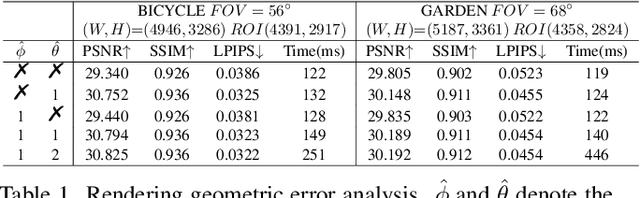
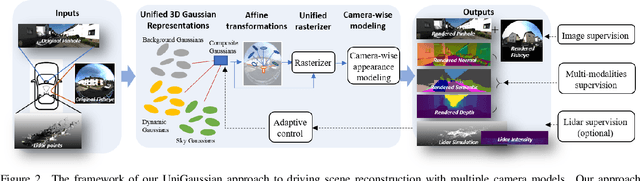
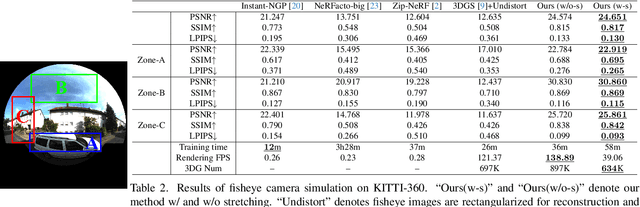
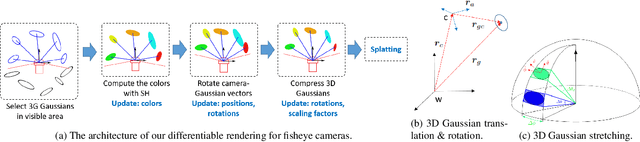
Urban scene reconstruction is crucial for real-world autonomous driving simulators. Although existing methods have achieved photorealistic reconstruction, they mostly focus on pinhole cameras and neglect fisheye cameras. In fact, how to effectively simulate fisheye cameras in driving scene remains an unsolved problem. In this work, we propose UniGaussian, a novel approach that learns a unified 3D Gaussian representation from multiple camera models for urban scene reconstruction in autonomous driving. Our contributions are two-fold. First, we propose a new differentiable rendering method that distorts 3D Gaussians using a series of affine transformations tailored to fisheye camera models. This addresses the compatibility issue of 3D Gaussian splatting with fisheye cameras, which is hindered by light ray distortion caused by lenses or mirrors. Besides, our method maintains real-time rendering while ensuring differentiability. Second, built on the differentiable rendering method, we design a new framework that learns a unified Gaussian representation from multiple camera models. By applying affine transformations to adapt different camera models and regularizing the shared Gaussians with supervision from different modalities, our framework learns a unified 3D Gaussian representation with input data from multiple sources and achieves holistic driving scene understanding. As a result, our approach models multiple sensors (pinhole and fisheye cameras) and modalities (depth, semantic, normal and LiDAR point clouds). Our experiments show that our method achieves superior rendering quality and fast rendering speed for driving scene simulation.