 Add to Chrome
 Add to Firefox
 Add to Edge
Stable and Explainable Personality Trait Evaluation in Large Language Models with Internal Activations
Jan 14, 2026
Evaluating personality traits in Large Language Models (LLMs) is key to model interpretation, comparison, and responsible deployment. However, existing questionnaire-based evaluation methods exhibit limited stability and offer little explainability, as their results are highly sensitive to minor variations in prompt phrasing or role-play configurations. To address these limitations, we propose an internal-activation-based approach, termed Persona-Vector Neutrality Interpolation (PVNI), for stable and explainable personality trait evaluation in LLMs. PVNI extracts a persona vector associated with a target personality trait from the model's internal activations using contrastive prompts. It then estimates the corresponding neutral score by interpolating along the persona vector as an anchor axis, enabling an interpretable comparison between the neutral prompt representation and the persona direction. We provide a theoretical analysis of the effectiveness and generalization properties of PVNI. Extensive experiments across diverse LLMs demonstrate that PVNI yields substantially more stable personality trait evaluations than existing methods, even under questionnaire and role-play variants.

UniHash: Unifying Pointwise and Pairwise Hashing Paradigms for Seen and Unseen Category Retrieval
Jan 14, 2026Effective retrieval across both seen and unseen categories is crucial for modern image retrieval systems. Retrieval on seen categories ensures precise recognition of known classes, while retrieval on unseen categories promotes generalization to novel classes with limited supervision. However, most existing deep hashing methods are confined to a single training paradigm, either pointwise or pairwise, where the former excels on seen categories and the latter generalizes better to unseen ones. To overcome this limitation, we propose Unified Hashing (UniHash), a dual-branch framework that unifies the strengths of both paradigms to achieve balanced retrieval performance across seen and unseen categories. UniHash consists of two complementary branches: a center-based branch following the pointwise paradigm and a pairwise branch following the pairwise paradigm. A novel hash code learning method is introduced to enable bidirectional knowledge transfer between branches, improving hash code discriminability and generalization. It employs a mutual learning loss to align hash representations and introduces a Split-Merge Mixture of Hash Experts (SM-MoH) module to enhance cross-branch exchange of hash representations. Theoretical analysis substantiates the effectiveness of UniHash, and extensive experiments on CIFAR-10, MSCOCO, and ImageNet demonstrate that UniHash consistently achieves state-of-the-art performance in both seen and unseen image retrieval scenarios.
Discrete Wavelet Transform-Based Capsule Network for Hyperspectral Image Classification
Jan 08, 2025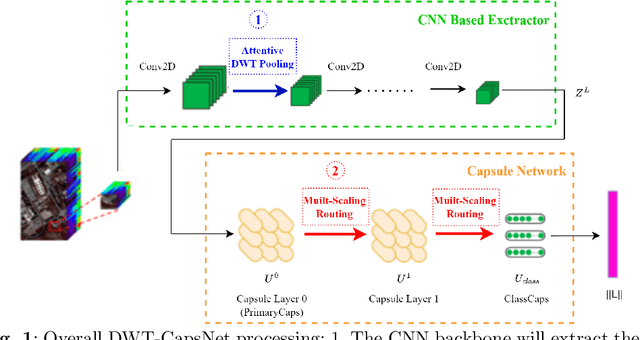
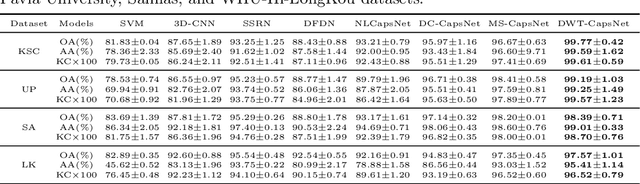

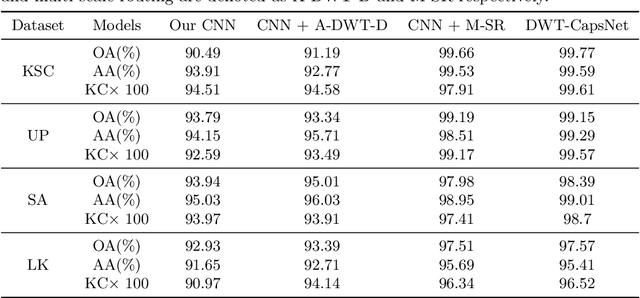
Hyperspectral image (HSI) classification is a crucial technique for remote sensing to build large-scale earth monitoring systems. HSI contains much more information than traditional visual images for identifying the categories of land covers. One recent feasible solution for HSI is to leverage CapsNets for capturing spectral-spatial information. However, these methods require high computational requirements due to the full connection architecture between stacked capsule layers. To solve this problem, a DWT-CapsNet is proposed to identify partial but important connections in CapsNet for a effective and efficient HSI classification. Specifically, we integrate a tailored attention mechanism into a Discrete Wavelet Transform (DWT)-based downsampling layer, alleviating the information loss problem of conventional downsampling operation in feature extractors. Moreover, we propose a novel multi-scale routing algorithm that prunes a large proportion of connections in CapsNet. A capsule pyramid fusion mechanism is designed to aggregate the spectral-spatial relationships in multiple levels of granularity, and then a self-attention mechanism is further conducted in a partially and locally connected architecture to emphasize the meaningful relationships. As shown in the experimental results, our method achieves state-of-the-art accuracy while keeping lower computational demand regarding running time, flops, and the number of parameters, rendering it an appealing choice for practical implementation in HSI classification.