 Add to Chrome
 Add to Firefox
 Add to Edge
Stop Rewarding Hallucinated Steps: Faithfulness-Aware Step-Level Reinforcement Learning for Small Reasoning Models
Feb 05, 2026
As large language models become smaller and more efficient, small reasoning models (SRMs) are crucial for enabling chain-of-thought (CoT) reasoning in resource-constrained settings. However, they are prone to faithfulness hallucinations, especially in intermediate reasoning steps. Existing mitigation methods based on online reinforcement learning rely on outcome-based rewards or coarse-grained CoT evaluation, which can inadvertently reinforce unfaithful reasoning when the final answer is correct. To address these limitations, we propose Faithfulness-Aware Step-Level Reinforcement Learning (FaithRL), introducing step-level supervision via explicit faithfulness rewards from a process reward model, together with an implicit truncated resampling strategy that generates contrastive signals from faithful prefixes. Experiments across multiple SRMs and Open-Book QA benchmarks demonstrate that FaithRL consistently reduces hallucinations in both the CoT and final answers, leading to more faithful and reliable reasoning. Code is available at https://github.com/Easy195/FaithRL.

Training Report of TeleChat3-MoE
Dec 30, 2025TeleChat3-MoE is the latest series of TeleChat large language models, featuring a Mixture-of-Experts (MoE) architecture with parameter counts ranging from 105 billion to over one trillion,trained end-to-end on Ascend NPU cluster. This technical report mainly presents the underlying training infrastructure that enables reliable and efficient scaling to frontier model sizes. We detail systematic methodologies for operator-level and end-to-end numerical accuracy verification, ensuring consistency across hardware platforms and distributed parallelism strategies. Furthermore, we introduce a suite of performance optimizations, including interleaved pipeline scheduling, attention-aware data scheduling for long-sequence training,hierarchical and overlapped communication for expert parallelism, and DVM-based operator fusion. A systematic parallelization framework, leveraging analytical estimation and integer linear programming, is also proposed to optimize multi-dimensional parallelism configurations. Additionally, we present methodological approaches to cluster-level optimizations, addressing host- and device-bound bottlenecks during large-scale training tasks. These infrastructure advancements yield significant throughput improvements and near-linear scaling on clusters comprising thousands of devices, providing a robust foundation for large-scale language model development on hardware ecosystems.
Multi-Intent Spoken Language Understanding: Methods, Trends, and Challenges
Dec 12, 2025Multi-intent spoken language understanding (SLU) involves two tasks: multiple intent detection and slot filling, which jointly handle utterances containing more than one intent. Owing to this characteristic, which closely reflects real-world applications, the task has attracted increasing research attention, and substantial progress has been achieved. However, there remains a lack of a comprehensive and systematic review of existing studies on multi-intent SLU. To this end, this paper presents a survey of recent advances in multi-intent SLU. We provide an in-depth overview of previous research from two perspectives: decoding paradigms and modeling approaches. On this basis, we further compare the performance of representative models and analyze their strengths and limitations. Finally, we discuss the current challenges and outline promising directions for future research. We hope this survey will offer valuable insights and serve as a useful reference for advancing research in multi-intent SLU.
MR-UIE: Multi-Perspective Reasoning with Reinforcement Learning for Universal Information Extraction
Sep 11, 2025Large language models (LLMs) demonstrate robust capabilities across diverse research domains. However, their performance in universal information extraction (UIE) remains insufficient, especially when tackling structured output scenarios that involve complex schema descriptions and require multi-step reasoning. While existing approaches enhance the performance of LLMs through in-context learning and instruction tuning, significant limitations nonetheless persist. To enhance the model's generalization ability, we propose integrating reinforcement learning (RL) with multi-perspective reasoning for information extraction (IE) tasks. Our work transitions LLMs from passive extractors to active reasoners, enabling them to understand not only what to extract but also how to reason. Experiments conducted on multiple IE benchmarks demonstrate that MR-UIE consistently elevates extraction accuracy across domains and surpasses state-of-the-art methods on several datasets. Furthermore, incorporating multi-perspective reasoning into RL notably enhances generalization in complex IE tasks, underscoring the critical role of reasoning in challenging scenarios.
Technical Report of TeleChat2, TeleChat2.5 and T1
Jul 24, 2025
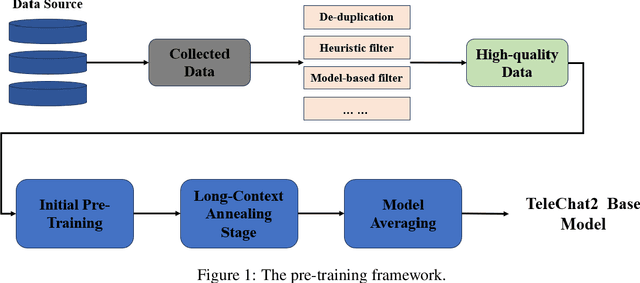
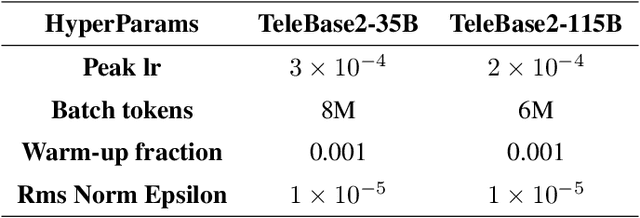
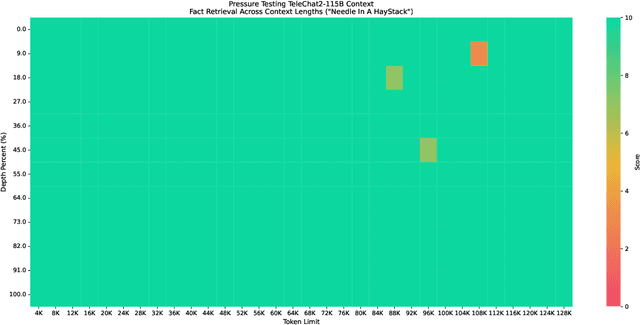
We introduce the latest series of TeleChat models: \textbf{TeleChat2}, \textbf{TeleChat2.5}, and \textbf{T1}, offering a significant upgrade over their predecessor, TeleChat. Despite minimal changes to the model architecture, the new series achieves substantial performance gains through enhanced training strategies in both pre-training and post-training stages. The series begins with \textbf{TeleChat2}, which undergoes pretraining on 10 trillion high-quality and diverse tokens. This is followed by Supervised Fine-Tuning (SFT) and Direct Preference Optimization (DPO) to further enhance its capabilities. \textbf{TeleChat2.5} and \textbf{T1} expand the pipeline by incorporating a continual pretraining phase with domain-specific datasets, combined with reinforcement learning (RL) to improve performance in code generation and mathematical reasoning tasks. The \textbf{T1} variant is designed for complex reasoning, supporting long Chain-of-Thought (CoT) reasoning and demonstrating substantial improvements in mathematics and coding. In contrast, \textbf{TeleChat2.5} prioritizes speed, delivering rapid inference. Both flagship models of \textbf{T1} and \textbf{TeleChat2.5} are dense Transformer-based architectures with 115B parameters, showcasing significant advancements in reasoning and general task performance compared to the original TeleChat. Notably, \textbf{T1-115B} outperform proprietary models such as OpenAI's o1-mini and GPT-4o. We publicly release \textbf{TeleChat2}, \textbf{TeleChat2.5} and \textbf{T1}, including post-trained versions with 35B and 115B parameters, to empower developers and researchers with state-of-the-art language models tailored for diverse applications.
RB-SQL: A Retrieval-based LLM Framework for Text-to-SQL
Jul 11, 2024Large language models (LLMs) with in-context learning have significantly improved the performance of text-to-SQL task. Previous works generally focus on using exclusive SQL generation prompt to improve the LLMs' reasoning ability. However, they are mostly hard to handle large databases with numerous tables and columns, and usually ignore the significance of pre-processing database and extracting valuable information for more efficient prompt engineering. Based on above analysis, we propose RB-SQL, a novel retrieval-based LLM framework for in-context prompt engineering, which consists of three modules that retrieve concise tables and columns as schema, and targeted examples for in-context learning. Experiment results demonstrate that our model achieves better performance than several competitive baselines on public datasets BIRD and Spider.
TeleChat Technical Report
Jan 08, 2024
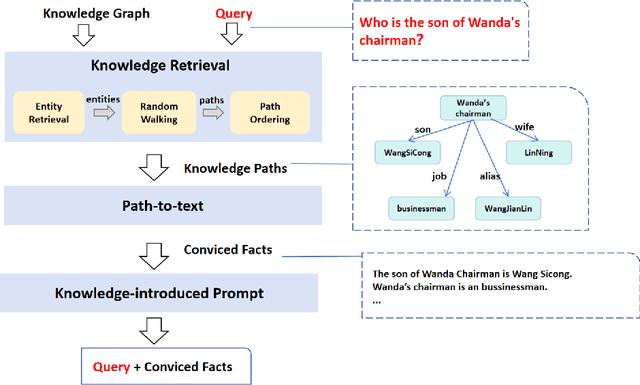
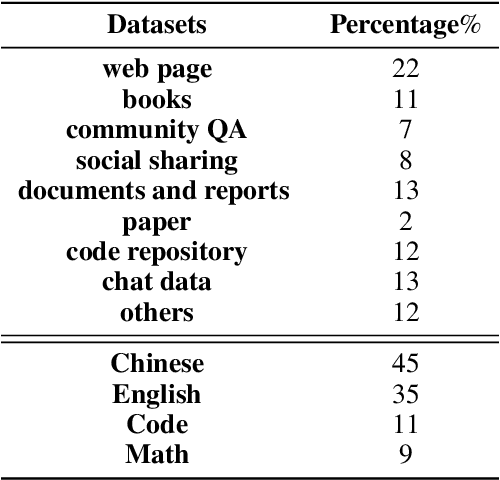
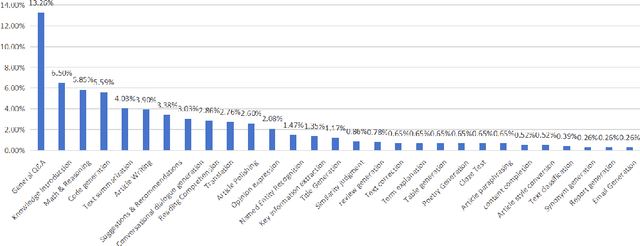
In this technical report, we present TeleChat, a collection of large language models (LLMs) with parameters of 3 billion, 7 billion and 12 billion. It includes pretrained language models as well as fine-tuned chat models that is aligned with human preferences. TeleChat is initially pretrained on an extensive corpus containing a diverse collection of texts from both English and Chinese languages, including trillions of tokens. Subsequently, the model undergoes fine-tuning to align with human preferences, following a detailed methodology that we describe. We evaluate the performance of TeleChat on various tasks, including language understanding, mathematics, reasoning, code generation, and knowledge-based question answering. Our findings indicate that TeleChat achieves comparable performance to other open-source models of similar size across a wide range of public benchmarks. To support future research and applications utilizing LLMs, we release the fine-tuned model checkpoints of TeleChat's 7B and 12B variant, along with code and a portion of our pretraining data, to the public community.