 Add to Chrome
 Add to Firefox
 Add to Edge
Learning Modal-Mixed Chain-of-Thought Reasoning with Latent Embeddings
Jan 31, 2026
We study how to extend chain-of-thought (CoT) beyond language to better handle multimodal reasoning. While CoT helps LLMs and VLMs articulate intermediate steps, its text-only form often fails on vision-intensive problems where key intermediate states are inherently visual. We introduce modal-mixed CoT, which interleaves textual tokens with compact visual sketches represented as latent embeddings. To bridge the modality gap without eroding the original knowledge and capability of the VLM, we use the VLM itself as an encoder and train the language backbone to reconstruct its own intermediate vision embeddings, to guarantee the semantic alignment of the visual latent space. We further attach a diffusion-based latent decoder, invoked by a special control token and conditioned on hidden states from the VLM. In this way, the diffusion head carries fine-grained perceptual details while the VLM specifies high-level intent, which cleanly disentangles roles and reduces the optimization pressure of the VLM. Training proceeds in two stages: supervised fine-tuning on traces that interleave text and latents with a joint next-token and latent-reconstruction objective, followed by reinforcement learning that teaches when to switch modalities and how to compose long reasoning chains. Extensive experiments across 11 diverse multimodal reasoning tasks, demonstrate that our method yields better performance than language-only and other CoT methods. Our code will be publicly released.

Towards General Continuous Memory for Vision-Language Models
May 23, 2025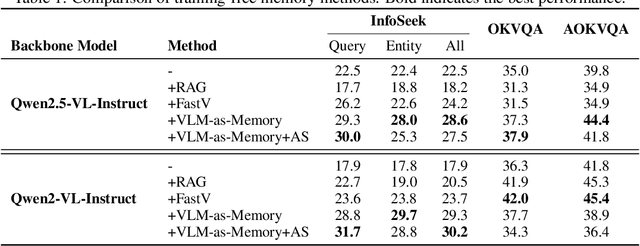
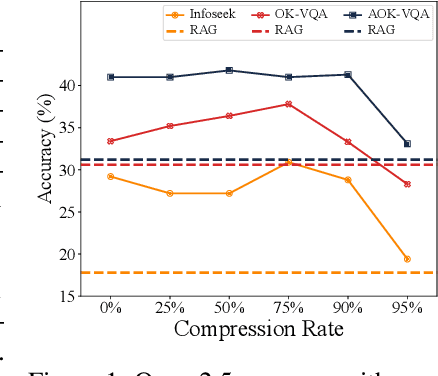
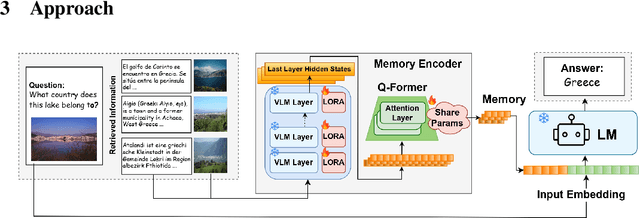
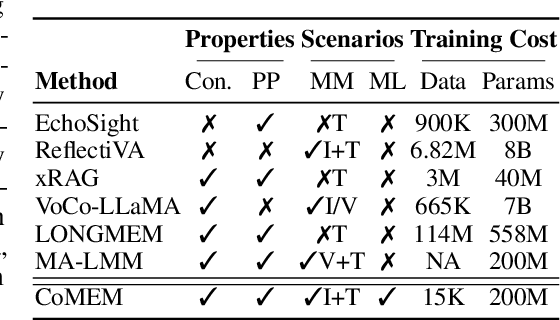
Language models (LMs) and their extension, vision-language models (VLMs), have achieved remarkable performance across various tasks. However, they still struggle with complex reasoning tasks that require multimodal or multilingual real-world knowledge. To support such capabilities, an external memory system that can efficiently provide relevant multimodal information is essential. Existing approaches generally concatenate image and text tokens into a long sequence as memory, which, however, may drastically increase context length and even degrade performance. In contrast, we propose using continuous memory, a compact set of dense embeddings to more effectively and efficiently represent multimodal and multilingual knowledge. Our key insight is that a VLM can serve as its own continuous memory encoder. We empirically show that this design improves performance on complex multimodal reasoning tasks. Building on this, we introduce a data-efficient and parameter-efficient method to fine-tune the VLM into a memory encoder, requiring only 1.2% of the model's parameters and a small corpus of 15.6K self-synthesized samples. Our approach CoMEM utilizes VLM's original capabilities to encode arbitrary multimodal and multilingual knowledge into just 8 continuous embeddings. Since the inference-time VLM remains frozen, our memory module is plug-and-play and can be flexibly integrated as needed. Extensive experiments across eight multimodal reasoning benchmarks demonstrate the effectiveness of our approach.
Activation Control for Efficiently Eliciting Long Chain-of-thought Ability of Language Models
May 23, 2025Despite the remarkable reasoning performance, eliciting the long chain-of-thought (CoT) ability in large language models (LLMs) typically requires costly reinforcement learning or supervised fine-tuning on high-quality distilled data. We investigate the internal mechanisms behind this capability and show that a small set of high-impact activations in the last few layers largely governs long-form reasoning attributes, such as output length and self-reflection. By simply amplifying these activations and inserting "wait" tokens, we can invoke the long CoT ability without any training, resulting in significantly increased self-reflection rates and accuracy. Moreover, we find that the activation dynamics follow predictable trajectories, with a sharp rise after special tokens and a subsequent exponential decay. Building on these insights, we introduce a general training-free activation control technique. It leverages a few contrastive examples to identify key activations, and employs simple analytic functions to modulate their values at inference time to elicit long CoTs. Extensive experiments confirm the effectiveness of our method in efficiently eliciting long CoT reasoning in LLMs and improving their performance. Additionally, we propose a parameter-efficient fine-tuning method that trains only a last-layer activation amplification module and a few LoRA layers, outperforming full LoRA fine-tuning on reasoning benchmarks with significantly fewer parameters. Our code and data are publicly released.
Decentralized Arena: Towards Democratic and Scalable Automatic Evaluation of Language Models
May 19, 2025


The recent explosion of large language models (LLMs), each with its own general or specialized strengths, makes scalable, reliable benchmarking more urgent than ever. Standard practices nowadays face fundamental trade-offs: closed-ended question-based benchmarks (eg MMLU) struggle with saturation as newer models emerge, while crowd-sourced leaderboards (eg Chatbot Arena) rely on costly and slow human judges. Recently, automated methods (eg LLM-as-a-judge) shed light on the scalability, but risk bias by relying on one or a few "authority" models. To tackle these issues, we propose Decentralized Arena (dearena), a fully automated framework leveraging collective intelligence from all LLMs to evaluate each other. It mitigates single-model judge bias by democratic, pairwise evaluation, and remains efficient at scale through two key components: (1) a coarse-to-fine ranking algorithm for fast incremental insertion of new models with sub-quadratic complexity, and (2) an automatic question selection strategy for the construction of new evaluation dimensions. Across extensive experiments across 66 LLMs, dearena attains up to 97% correlation with human judgements, while significantly reducing the cost. Our code and data will be publicly released on https://github.com/maitrix-org/de-arena.
REFINE: Reachability-based Trajectory Design using Robust Feedback Linearization and Zonotopes
Nov 22, 2022Performing real-time receding horizon motion planning for autonomous vehicles while providing safety guarantees remains difficult. This is because existing methods to accurately predict ego vehicle behavior under a chosen controller use online numerical integration that requires a fine time discretization and thereby adversely affects real-time performance. To address this limitation, several recent papers have proposed to apply offline reachability analysis to conservatively predict the behavior of the ego vehicle. This reachable set can be constructed by utilizing a simplified model whose behavior is assumed a priori to conservatively bound the dynamics of a full-order model. However, guaranteeing that one satisfies this assumption is challenging. This paper proposes a framework named REFINE to overcome the limitations of these existing approaches. REFINE utilizes a parameterized robust controller that partially linearizes the vehicle dynamics even in the presence of modeling error. Zonotope-based reachability analysis is then performed on the closed-loop, full-order vehicle dynamics to compute the corresponding control-parameterized, over-approximate Forward Reachable Sets (FRS). Because reachability analysis is applied to the full-order model, the potential conservativeness introduced by using a simplified model is avoided. The pre-computed, control-parameterized FRS is then used online in an optimization framework to ensure safety. The proposed method is compared to several state of the art methods during a simulation-based evaluation on a full-size vehicle model and is evaluated on a 1/10th race car robot in real hardware testing. In contrast to existing methods, REFINE is shown to enable the vehicle to safely navigate itself through complex environments.