 Add to Chrome
 Add to Firefox
 Add to Edge
Spider-Sense: Intrinsic Risk Sensing for Efficient Agent Defense with Hierarchical Adaptive Screening
Feb 05, 2026
As large language models (LLMs) evolve into autonomous agents, their real-world applicability has expanded significantly, accompanied by new security challenges. Most existing agent defense mechanisms adopt a mandatory checking paradigm, in which security validation is forcibly triggered at predefined stages of the agent lifecycle. In this work, we argue that effective agent security should be intrinsic and selective rather than architecturally decoupled and mandatory. We propose Spider-Sense framework, an event-driven defense framework based on Intrinsic Risk Sensing (IRS), which allows agents to maintain latent vigilance and trigger defenses only upon risk perception. Once triggered, the Spider-Sense invokes a hierarchical defence mechanism that trades off efficiency and precision: it resolves known patterns via lightweight similarity matching while escalating ambiguous cases to deep internal reasoning, thereby eliminating reliance on external models. To facilitate rigorous evaluation, we introduce S$^2$Bench, a lifecycle-aware benchmark featuring realistic tool execution and multi-stage attacks. Extensive experiments demonstrate that Spider-Sense achieves competitive or superior defense performance, attaining the lowest Attack Success Rate (ASR) and False Positive Rate (FPR), with only a marginal latency overhead of 8.3\%.

Controlled Self-Evolution for Algorithmic Code Optimization
Jan 13, 2026Self-evolution methods enhance code generation through iterative "generate-verify-refine" cycles, yet existing approaches suffer from low exploration efficiency, failing to discover solutions with superior complexity within limited budgets. This inefficiency stems from initialization bias trapping evolution in poor solution regions, uncontrolled stochastic operations lacking feedback guidance, and insufficient experience utilization across tasks. To address these bottlenecks, we propose Controlled Self-Evolution (CSE), which consists of three key components. Diversified Planning Initialization generates structurally distinct algorithmic strategies for broad solution space coverage. Genetic Evolution replaces stochastic operations with feedback-guided mechanisms, enabling targeted mutation and compositional crossover. Hierarchical Evolution Memory captures both successful and failed experiences at inter-task and intra-task levels. Experiments on EffiBench-X demonstrate that CSE consistently outperforms all baselines across various LLM backbones. Furthermore, CSE achieves higher efficiency from early generations and maintains continuous improvement throughout evolution. Our code is publicly available at https://github.com/QuantaAlpha/EvoControl.
Cause-Aware Empathetic Response Generation via Chain-of-Thought Fine-Tuning
Aug 21, 2024
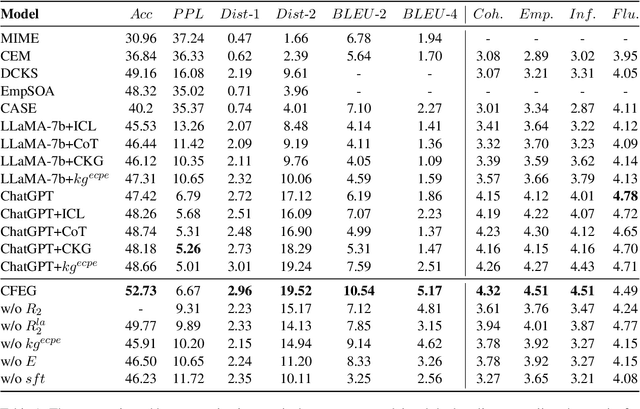
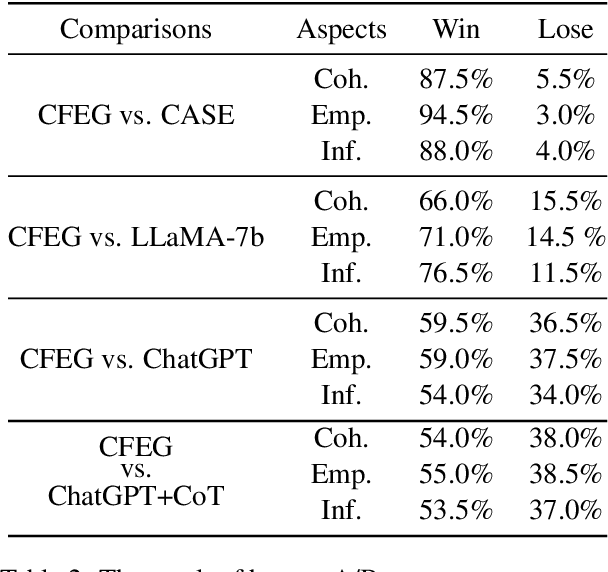
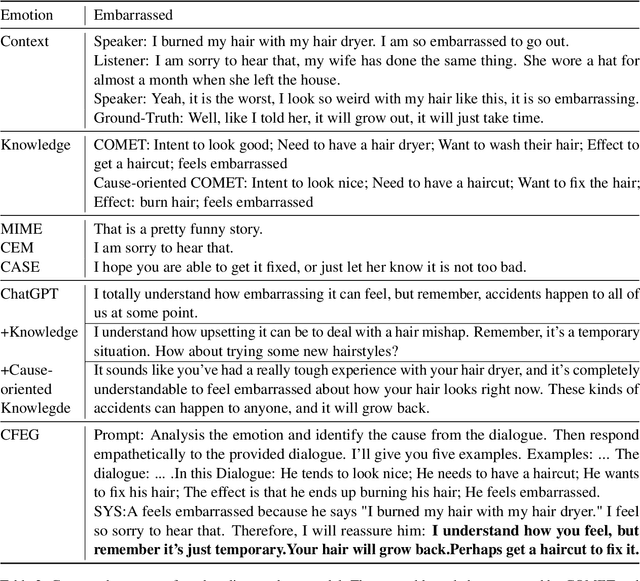
Empathetic response generation endows agents with the capability to comprehend dialogue contexts and react to expressed emotions. Previous works predominantly focus on leveraging the speaker's emotional labels, but ignore the importance of emotion cause reasoning in empathetic response generation, which hinders the model's capacity for further affective understanding and cognitive inference. In this paper, we propose a cause-aware empathetic generation approach by integrating emotions and causes through a well-designed Chain-of-Thought (CoT) prompt on Large Language Models (LLMs). Our approach can greatly promote LLMs' performance of empathy by instruction tuning and enhancing the role awareness of an empathetic listener in the prompt. Additionally, we propose to incorporate cause-oriented external knowledge from COMET into the prompt, which improves the diversity of generation and alleviates conflicts between internal and external knowledge at the same time. Experimental results on the benchmark dataset demonstrate that our approach on LLaMA-7b achieves state-of-the-art performance in both automatic and human evaluations.