 Add to Chrome
 Add to Firefox
 Add to Edge
Spider-Sense: Intrinsic Risk Sensing for Efficient Agent Defense with Hierarchical Adaptive Screening
Feb 05, 2026
As large language models (LLMs) evolve into autonomous agents, their real-world applicability has expanded significantly, accompanied by new security challenges. Most existing agent defense mechanisms adopt a mandatory checking paradigm, in which security validation is forcibly triggered at predefined stages of the agent lifecycle. In this work, we argue that effective agent security should be intrinsic and selective rather than architecturally decoupled and mandatory. We propose Spider-Sense framework, an event-driven defense framework based on Intrinsic Risk Sensing (IRS), which allows agents to maintain latent vigilance and trigger defenses only upon risk perception. Once triggered, the Spider-Sense invokes a hierarchical defence mechanism that trades off efficiency and precision: it resolves known patterns via lightweight similarity matching while escalating ambiguous cases to deep internal reasoning, thereby eliminating reliance on external models. To facilitate rigorous evaluation, we introduce S$^2$Bench, a lifecycle-aware benchmark featuring realistic tool execution and multi-stage attacks. Extensive experiments demonstrate that Spider-Sense achieves competitive or superior defense performance, attaining the lowest Attack Success Rate (ASR) and False Positive Rate (FPR), with only a marginal latency overhead of 8.3\%.

FinGAIA: An End-to-End Benchmark for Evaluating AI Agents in Finance
Jul 23, 2025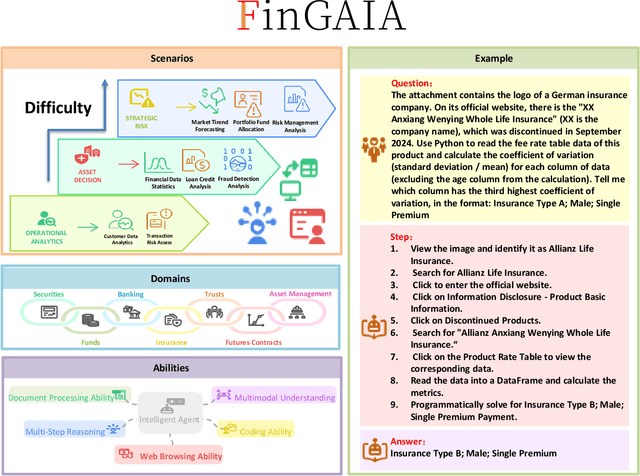
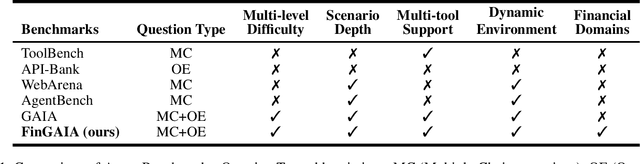
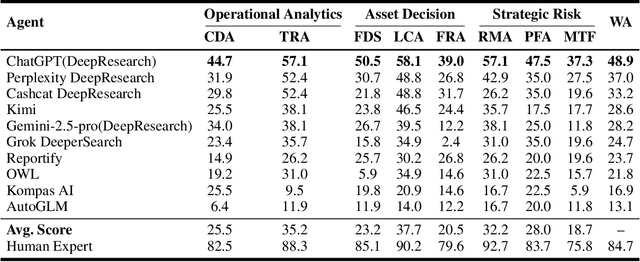
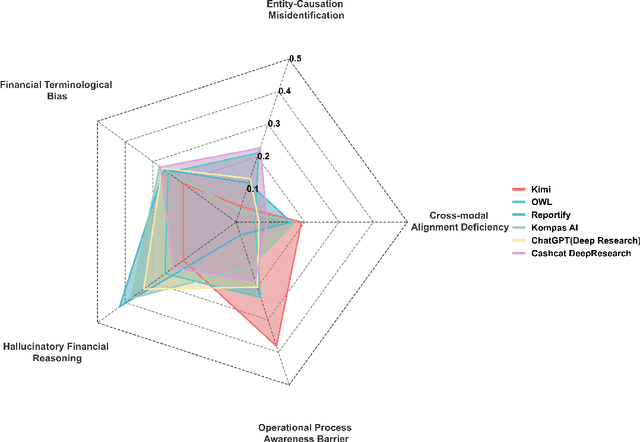
The booming development of AI agents presents unprecedented opportunities for automating complex tasks across various domains. However, their multi-step, multi-tool collaboration capabilities in the financial sector remain underexplored. This paper introduces FinGAIA, an end-to-end benchmark designed to evaluate the practical abilities of AI agents in the financial domain. FinGAIA comprises 407 meticulously crafted tasks, spanning seven major financial sub-domains: securities, funds, banking, insurance, futures, trusts, and asset management. These tasks are organized into three hierarchical levels of scenario depth: basic business analysis, asset decision support, and strategic risk management. We evaluated 10 mainstream AI agents in a zero-shot setting. The best-performing agent, ChatGPT, achieved an overall accuracy of 48.9\%, which, while superior to non-professionals, still lags financial experts by over 35 percentage points. Error analysis has revealed five recurring failure patterns: Cross-modal Alignment Deficiency, Financial Terminological Bias, Operational Process Awareness Barrier, among others. These patterns point to crucial directions for future research. Our work provides the first agent benchmark closely related to the financial domain, aiming to objectively assess and promote the development of agents in this crucial field. Partial data is available at https://github.com/SUFE-AIFLM-Lab/FinGAIA.
Fin-R1: A Large Language Model for Financial Reasoning through Reinforcement Learning
Mar 21, 2025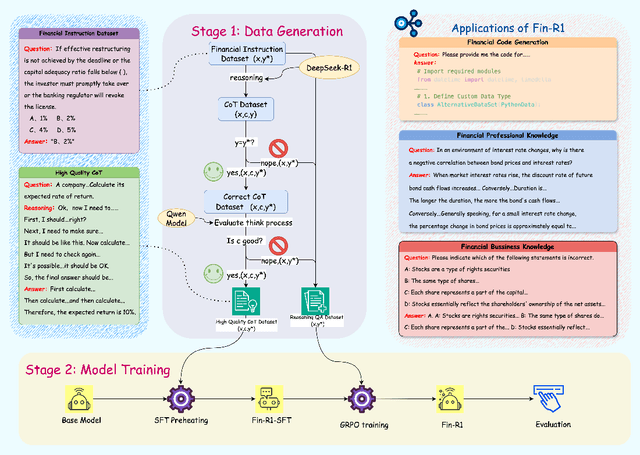

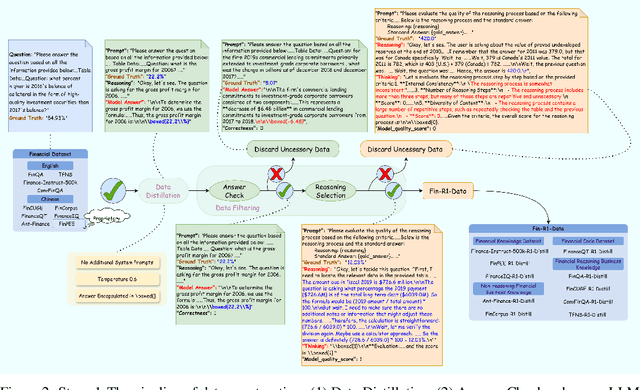
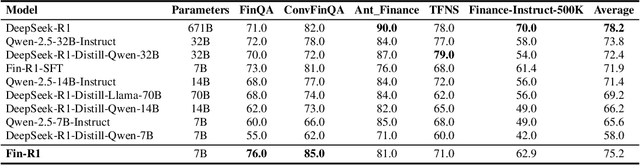
Reasoning large language models are rapidly evolving across various domains. However, their capabilities in handling complex financial tasks still require in-depth exploration. In this paper, we introduce Fin-R1, a reasoning large language model specifically designed for the financial sector. Fin-R1 is built using a two-stage architecture, leveraging a financial reasoning dataset distilled and processed based on DeepSeek-R1. Through supervised fine-tuning (SFT) and reinforcement learning (RL) training, it demonstrates performance close to DeepSeek-R1 with a parameter size of 7 billion across a range of financial reasoning tasks. It achieves the state-of-the-art (SOTA) in the FinQA and ConvFinQA tasks between those LLMs in our evaluation, surpassing larger models in other tasks as well. Fin-R1 showcases strong reasoning and decision-making capabilities, providing solutions to various problems encountered in the financial domain. Our code is available at https://github.com/SUFE-AIFLM-Lab/Fin-R1.