 Add to Chrome
 Add to Firefox
 Add to Edge
Dynamic Multimodal Activation Steering for Hallucination Mitigation in Large Vision-Language Models
Feb 25, 2026
Large Vision-Language Models (LVLMs) exhibit outstanding performance on vision-language tasks but struggle with hallucination problems. Through in-depth analysis of LVLM activation patterns, we reveal two key findings: 1) truthfulness and visual perception capabilities predominantly engage different subsets of attention heads within the model architecture; and 2) truthfulness steering vectors vary significantly across different semantic contexts. Based on these observations, we propose Dynamic Multimodal Activation Steering, a training-free approach for hallucination mitigation. Our method constructs a semantic-based truthfulness steering vector database and computes visual perception steering vectors, enabling context-aware interventions during inference by dynamically selecting the most relevant steering vectors based on input semantic similarity and applying them to the most influential attention heads. We conduct comprehensive experiments across multiple models and datasets, demonstrating that our approach significantly enhances model performance, outperforming existing state-of-the-art methods.

Controlled Self-Evolution for Algorithmic Code Optimization
Jan 13, 2026Self-evolution methods enhance code generation through iterative "generate-verify-refine" cycles, yet existing approaches suffer from low exploration efficiency, failing to discover solutions with superior complexity within limited budgets. This inefficiency stems from initialization bias trapping evolution in poor solution regions, uncontrolled stochastic operations lacking feedback guidance, and insufficient experience utilization across tasks. To address these bottlenecks, we propose Controlled Self-Evolution (CSE), which consists of three key components. Diversified Planning Initialization generates structurally distinct algorithmic strategies for broad solution space coverage. Genetic Evolution replaces stochastic operations with feedback-guided mechanisms, enabling targeted mutation and compositional crossover. Hierarchical Evolution Memory captures both successful and failed experiences at inter-task and intra-task levels. Experiments on EffiBench-X demonstrate that CSE consistently outperforms all baselines across various LLM backbones. Furthermore, CSE achieves higher efficiency from early generations and maintains continuous improvement throughout evolution. Our code is publicly available at https://github.com/QuantaAlpha/EvoControl.
MemGovern: Enhancing Code Agents through Learning from Governed Human Experiences
Jan 13, 2026While autonomous software engineering (SWE) agents are reshaping programming paradigms, they currently suffer from a "closed-world" limitation: they attempt to fix bugs from scratch or solely using local context, ignoring the immense historical human experience available on platforms like GitHub. Accessing this open-world experience is hindered by the unstructured and fragmented nature of real-world issue-tracking data. In this paper, we introduce MemGovern, a framework designed to govern and transform raw GitHub data into actionable experiential memory for agents. MemGovern employs experience governance to convert human experience into agent-friendly experience cards and introduces an agentic experience search strategy that enables logic-driven retrieval of human expertise. By producing 135K governed experience cards, MemGovern achieves a significant performance boost, improving resolution rates on the SWE-bench Verified by 4.65%. As a plug-in approach, MemGovern provides a solution for agent-friendly memory infrastructure.
Mimic Human Cognition, Master Multi-Image Reasoning: A Meta-Action Framework for Enhanced Visual Understanding
Jan 12, 2026While Multimodal Large Language Models (MLLMs) excel at single-image understanding, they exhibit significantly degraded performance in multi-image reasoning scenarios. Multi-image reasoning presents fundamental challenges including complex inter-relationships between images and scattered critical information across image sets. Inspired by human cognitive processes, we propose the Cognition-Inspired Meta-Action Framework (CINEMA), a novel approach that decomposes multi-image reasoning into five structured meta-actions: Global, Focus, Hint, Think, and Answer which explicitly modeling the sequential cognitive steps humans naturally employ. For cold-start training, we introduce a Retrieval-Based Tree Sampling strategy that generates high-quality meta-action trajectories to bootstrap the model with reasoning patterns. During reinforcement learning, we adopt a two-stage paradigm: an exploration phase with Diversity-Preserving Strategy to avoid entropy collapse, followed by an annealed exploitation phase with DAPO to gradually strengthen exploitation. To train our model, we construct a dataset of 57k cold-start and 58k reinforcement learning instances spanning multi-image, multi-frame, and single-image tasks. We conduct extensive evaluations on multi-image reasoning benchmarks, video understanding benchmarks, and single-image benchmarks, achieving competitive state-of-the-art performance on several key benchmarks. Our model surpasses GPT-4o on the MUIR and MVMath benchmarks and notably outperforms specialized video reasoning models on video understanding benchmarks, demonstrating the effectiveness and generalizability of our human cognition-inspired reasoning framework.
Boosting Conversational Question Answering with Fine-Grained Retrieval-Augmentation and Self-Check
Mar 27, 2024Retrieval-Augmented Generation (RAG) aims to generate more reliable and accurate responses, by augmenting large language models (LLMs) with the external vast and dynamic knowledge. Most previous work focuses on using RAG for single-round question answering, while how to adapt RAG to the complex conversational setting wherein the question is interdependent on the preceding context is not well studied. In this paper, we propose a conversation-level RAG approach, which incorporates fine-grained retrieval augmentation and self-check for conversational question answering (CQA). In particular, our approach consists of three components, namely conversational question refiner, fine-grained retriever and self-check based response generator, which work collaboratively for question understanding and relevant information acquisition in conversational settings. Extensive experiments demonstrate the great advantages of our approach over the state-of-the-art baselines. Moreover, we also release a Chinese CQA dataset with new features including reformulated question, extracted keyword, retrieved paragraphs and their helpfulness, which facilitates further researches in RAG enhanced CQA.
EduChat: A Large-Scale Language Model-based Chatbot System for Intelligent Education
Aug 05, 2023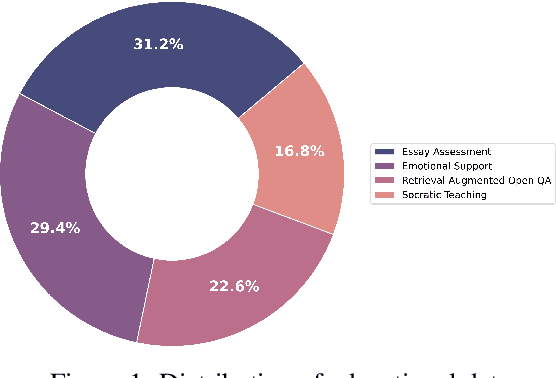
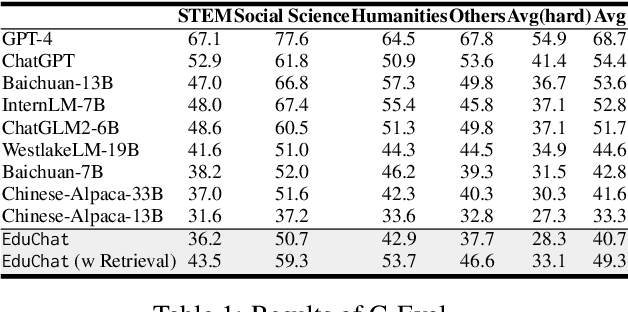


EduChat (https://www.educhat.top/) is a large-scale language model (LLM)-based chatbot system in the education domain. Its goal is to support personalized, fair, and compassionate intelligent education, serving teachers, students, and parents. Guided by theories from psychology and education, it further strengthens educational functions such as open question answering, essay assessment, Socratic teaching, and emotional support based on the existing basic LLMs. Particularly, we learn domain-specific knowledge by pre-training on the educational corpus and stimulate various skills with tool use by fine-tuning on designed system prompts and instructions. Currently, EduChat is available online as an open-source project, with its code, data, and model parameters available on platforms (e.g., GitHub https://github.com/icalk-nlp/EduChat, Hugging Face https://huggingface.co/ecnu-icalk ). We also prepare a demonstration of its capabilities online (https://vimeo.com/851004454). This initiative aims to promote research and applications of LLMs for intelligent education.