 Add to Chrome
 Add to Firefox
 Add to Edge
MedViz: An Agent-based, Visual-guided Research Assistant for Navigating Biomedical Literature
Jan 28, 2026
Biomedical researchers face increasing challenges in navigating millions of publications in diverse domains. Traditional search engines typically return articles as ranked text lists, offering little support for global exploration or in-depth analysis. Although recent advances in generative AI and large language models have shown promise in tasks such as summarization, extraction, and question answering, their dialog-based implementations are poorly integrated with literature search workflows. To address this gap, we introduce MedViz, a visual analytics system that integrates multiple AI agents with interactive visualization to support the exploration of the large-scale biomedical literature. MedViz combines a semantic map of millions of articles with agent-driven functions for querying, summarizing, and hypothesis generation, allowing researchers to iteratively refine questions, identify trends, and uncover hidden connections. By bridging intelligent agents with interactive visualization, MedViz transforms biomedical literature search into a dynamic, exploratory process that accelerates knowledge discovery.

Be.FM: Open Foundation Models for Human Behavior
May 29, 2025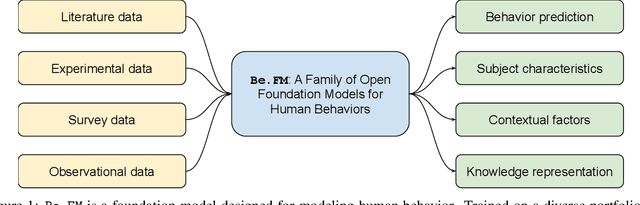
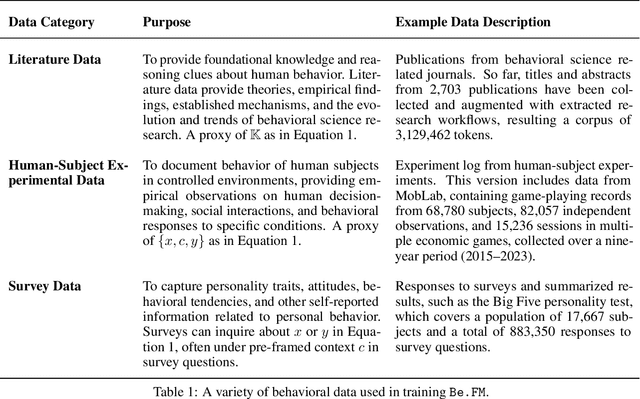
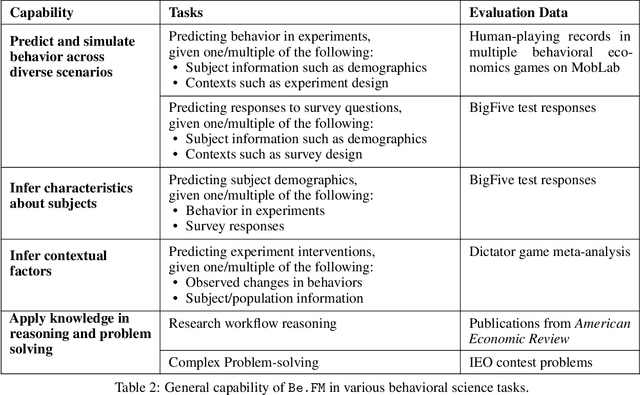
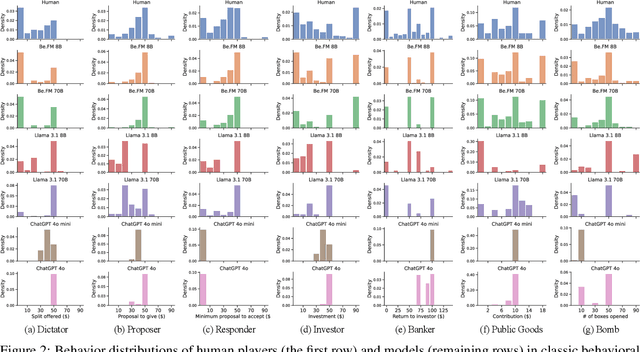
Despite their success in numerous fields, the potential of foundation models for modeling and understanding human behavior remains largely unexplored. We introduce Be.FM, one of the first open foundation models designed for human behavior modeling. Built upon open-source large language models and fine-tuned on a diverse range of behavioral data, Be.FM can be used to understand and predict human decision-making. We construct a comprehensive set of benchmark tasks for testing the capabilities of behavioral foundation models. Our results demonstrate that Be.FM can predict behaviors, infer characteristics of individuals and populations, generate insights about contexts, and apply behavioral science knowledge.
MASSW: A New Dataset and Benchmark Tasks for AI-Assisted Scientific Workflows
Jun 10, 2024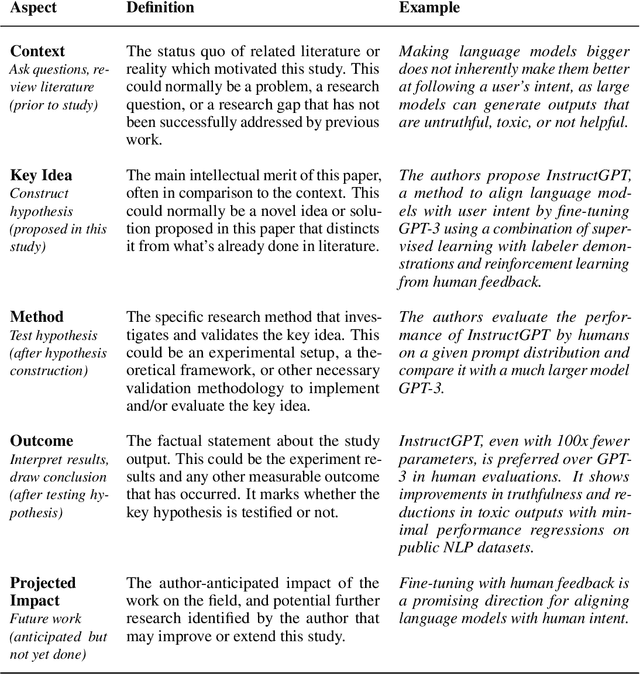
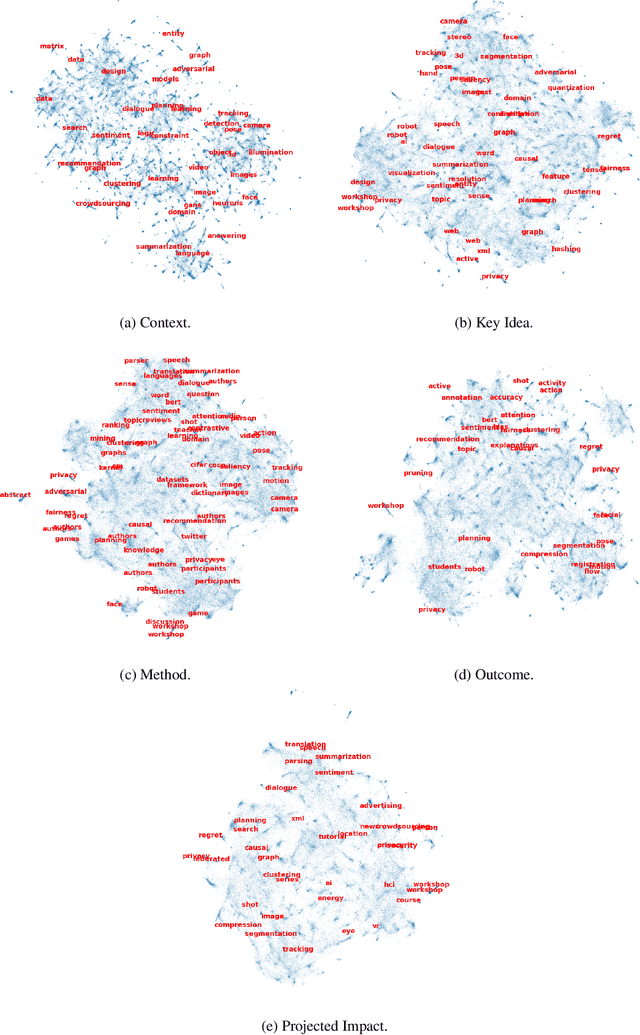
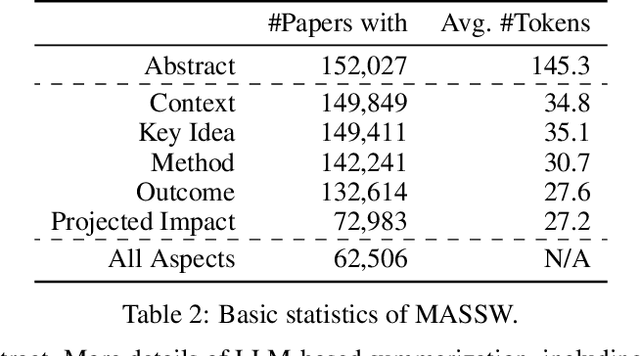
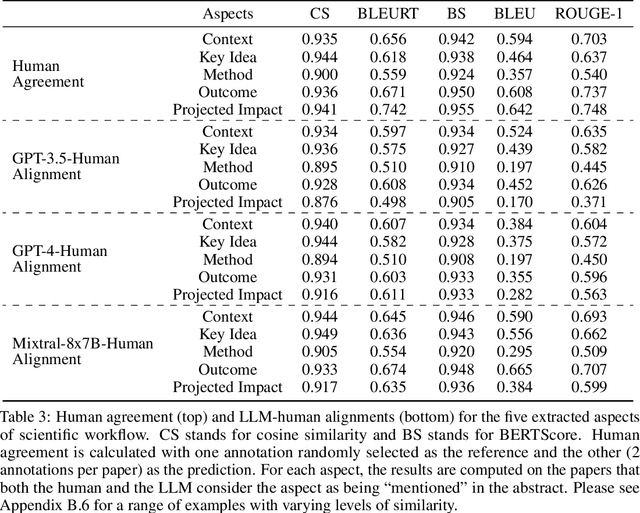
Scientific innovation relies on detailed workflows, which include critical steps such as analyzing literature, generating ideas, validating these ideas, interpreting results, and inspiring follow-up research. However, scientific publications that document these workflows are extensive and unstructured. This makes it difficult for both human researchers and AI systems to effectively navigate and explore the space of scientific innovation. To address this issue, we introduce MASSW, a comprehensive text dataset on Multi-Aspect Summarization of Scientific Workflows. MASSW includes more than 152,000 peer-reviewed publications from 17 leading computer science conferences spanning the past 50 years. Using Large Language Models (LLMs), we automatically extract five core aspects from these publications -- context, key idea, method, outcome, and projected impact -- which correspond to five key steps in the research workflow. These structured summaries facilitate a variety of downstream tasks and analyses. The quality of the LLM-extracted summaries is validated by comparing them with human annotations. We demonstrate the utility of MASSW through multiple novel machine-learning tasks that can be benchmarked using this new dataset, which make various types of predictions and recommendations along the scientific workflow. MASSW holds significant potential for researchers to create and benchmark new AI methods for optimizing scientific workflows and fostering scientific innovation in the field. Our dataset is openly available at \url{https://github.com/xingjian-zhang/massw}.