 Add to Chrome
 Add to Firefox
 Add to Edge
Connect the Dots: Knowledge Graph-Guided Crawler Attack on Retrieval-Augmented Generation Systems
Jan 22, 2026
Retrieval-augmented generation (RAG) systems integrate document retrieval with large language models and have been widely adopted. However, in privacy-related scenarios, RAG introduces a new privacy risk: adversaries can issue carefully crafted queries to exfiltrate sensitive content from the underlying corpus gradually. Although recent studies have demonstrated multi-turn extraction attacks, they rely on heuristics and fail to perform long-term extraction planning. To address these limitations, we formulate the RAG extraction attack as an adaptive stochastic coverage problem (ASCP). In ASCP, each query is treated as a probabilistic action that aims to maximize conditional marginal gain (CMG), enabling principled long-term planning under uncertainty. However, integrating ASCP with practical RAG attack faces three key challenges: unobservable CMG, intractability in the action space, and feasibility constraints. To overcome these challenges, we maintain a global attacker-side state to guide the attack. Building on this idea, we introduce RAGCRAWLER, which builds a knowledge graph to represent revealed information, uses this global state to estimate CMG, and plans queries in semantic space that target unretrieved regions. In comprehensive experiments across diverse RAG architectures and datasets, our proposed method, RAGCRAWLER, consistently outperforms all baselines. It achieves up to 84.4% corpus coverage within a fixed query budget and deliver an average improvement of 20.7% over the top-performing baseline. It also maintains high semantic fidelity and strong content reconstruction accuracy with low attack cost. Crucially, RAGCRAWLER proves its robustness by maintaining effectiveness against advanced RAG systems employing query rewriting and multi-query retrieval strategies. Our work reveals significant security gaps and highlights the pressing need for stronger safeguards for RAG.

Can Deep Research Agents Find and Organize? Evaluating the Synthesis Gap with Expert Taxonomies
Jan 18, 2026Deep Research Agents are increasingly used for automated survey generation. However, whether they can write surveys like human experts remains unclear. Existing benchmarks focus on fluency or citation accuracy, but none evaluates the core capabilities: retrieving essential papers and organizing them into coherent knowledge structures. We introduce TaxoBench, a diagnostic benchmark derived from 72 highly-cited computer science surveys. We manually extract expert-authored taxonomy trees containing 3,815 precisely categorized citations as ground truth. Our benchmark supports two evaluation modes: Deep Research mode tests end-to-end retrieval and organization given only a topic, while Bottom-Up mode isolates structuring capability by providing the exact papers human experts used. We evaluate 7 leading Deep Research agents and 12 frontier LLMs. Results reveal a dual bottleneck: the best agent recalls only 20.9% of expert-selected papers, and even with perfect input, the best model achieves only 0.31 ARI in organization. Current deep research agents remain far from expert-level survey writing. Our benchmark is publicly available at https://github.com/KongLongGeFDU/TaxoBench.
Predicting Individual Treatment Effects of Large-scale Team Competitions in a Ride-sharing Economy
Aug 07, 2020


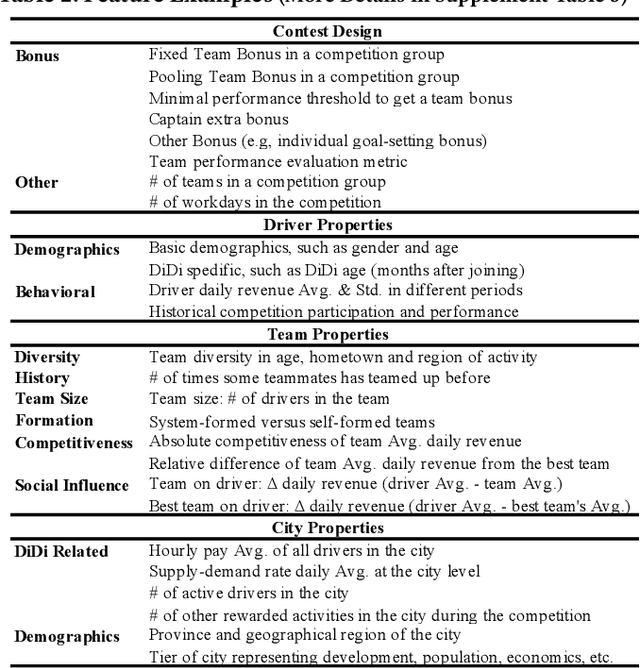
Millions of drivers worldwide have enjoyed financial benefits and work schedule flexibility through a ride-sharing economy, but meanwhile they have suffered from the lack of a sense of identity and career achievement. Equipped with social identity and contest theories, financially incentivized team competitions have been an effective instrument to increase drivers' productivity, job satisfaction, and retention, and to improve revenue over cost for ride-sharing platforms. While these competitions are overall effective, the decisive factors behind the treatment effects and how they affect the outcomes of individual drivers have been largely mysterious. In this study, we analyze data collected from more than 500 large-scale team competitions organized by a leading ride-sharing platform, building machine learning models to predict individual treatment effects. Through a careful investigation of features and predictors, we are able to reduce out-sample prediction error by more than 24%. Through interpreting the best-performing models, we discover many novel and actionable insights regarding how to optimize the design and the execution of team competitions on ride-sharing platforms. A simulated analysis demonstrates that by simply changing a few contest design options, the average treatment effect of a real competition is expected to increase by as much as 26%. Our procedure and findings shed light on how to analyze and optimize large-scale online field experiments in general.