 Add to Chrome
 Add to Firefox
 Add to Edge
SuperMemory-VQA: An Egocentric Visual Question-Answering Benchmark for Long-Horizon Memory
May 30, 2026
AI glasses present a compelling platform for AI agents to serve as personalized memory assistants. To be genuinely useful, such systems must move beyond short-term video comprehension and address memory gaps that humans experience for practical, personal, or social purposes over longitudinal egocentric video streams. However, existing egocentric datasets predominantly focus on action recognition or generic QAs from short clips, measuring perceptual capabilities rather than realistic human memory needs. We introduce SuperMemory-VQA, an egocentric visual question answering (VQA) dataset for evaluating AI assistants on practical, long-horizon memory tasks. It contains 52.9 hours of everyday activities recorded with AI glasses, including synchronized RGB video, audio transcription, eye gaze, IMU, and SLAM trajectories. Through a human-verified annotation pipeline, we construct grounded 4,853 question-answer pairs that span object and location memory, intent recall, visual scene recall, timeline reconstruction, conversational memory, and in-context retrieval. Each question is posed as multiple-choice with an explicit "unanswerable" option to test hallucination robustness. Benchmarking leading agentic frameworks and LLM backbones reveals that existing systems remain far from reliable on real-world memory tasks, highlighting the need for new architectures for grounded AI memory that can answer only when evidence is sufficient. A participant survey further supports that our questions are realistic, useful, and aligned with everyday memory needs.

Morph: ChirpTransformer-based Encoder-decoder Co-design for Reliable LoRa Communication
Jul 30, 2025In this paper, we propose Morph, a LoRa encoder-decoder co-design to enhance communication reliability while improving its computation efficiency in extremely-low signal-to-noise ratio (SNR) situations. The standard LoRa encoder controls 6 Spreading Factors (SFs) to tradeoff SNR tolerance with data rate. SF-12 is the maximum SF providing the lowest SNR tolerance on commercial off-the-shelf (COTS) LoRa nodes. In Morph, we develop an SF-configuration based encoder to mimic the larger SFs beyond SF-12 while it is compatible with COTS LoRa nodes. Specifically, we manipulate four SF configurations of a Morph symbol to encode 2-bit data. Accordingly, we recognize the used SF configuration of the symbol for data decoding. We leverage a Deep Neural Network (DNN) decoder to fully capture multi-dimensional features among diverse SF configurations to maximize the SNR gain. Moreover, we customize the input size, neural network structure, and training method of the DNN decoder to improve its efficiency, reliability, and generalizability. We implement Morph with COTS LoRa nodes and a USRP N210, then evaluate its performance on indoor and campus-scale testbeds. Results show that we can reliably decode data at -28.8~dB SNR, which is 6.4~dB lower than the standard LoRa with SF-12 chirps. In addition, the computation efficiency of our DNN decoder is about 3x higher than state-of-the-art.
Reading Recognition in the Wild
May 30, 2025To enable egocentric contextual AI in always-on smart glasses, it is crucial to be able to keep a record of the user's interactions with the world, including during reading. In this paper, we introduce a new task of reading recognition to determine when the user is reading. We first introduce the first-of-its-kind large-scale multimodal Reading in the Wild dataset, containing 100 hours of reading and non-reading videos in diverse and realistic scenarios. We then identify three modalities (egocentric RGB, eye gaze, head pose) that can be used to solve the task, and present a flexible transformer model that performs the task using these modalities, either individually or combined. We show that these modalities are relevant and complementary to the task, and investigate how to efficiently and effectively encode each modality. Additionally, we show the usefulness of this dataset towards classifying types of reading, extending current reading understanding studies conducted in constrained settings to larger scale, diversity and realism. Code, model, and data will be public.
Artificial Intelligence of Things: A Survey
Oct 25, 2024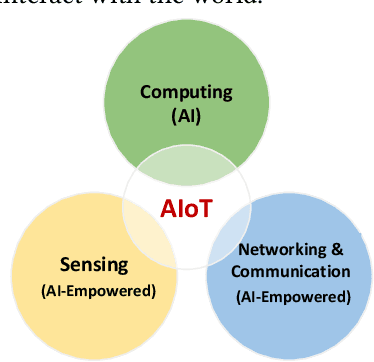
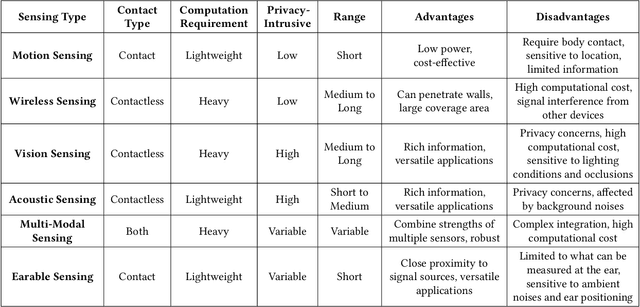
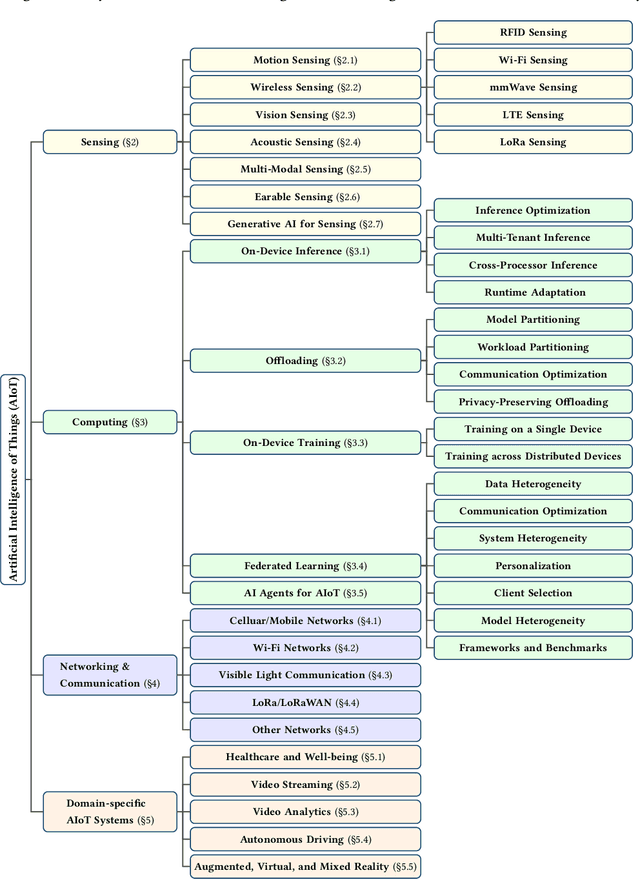
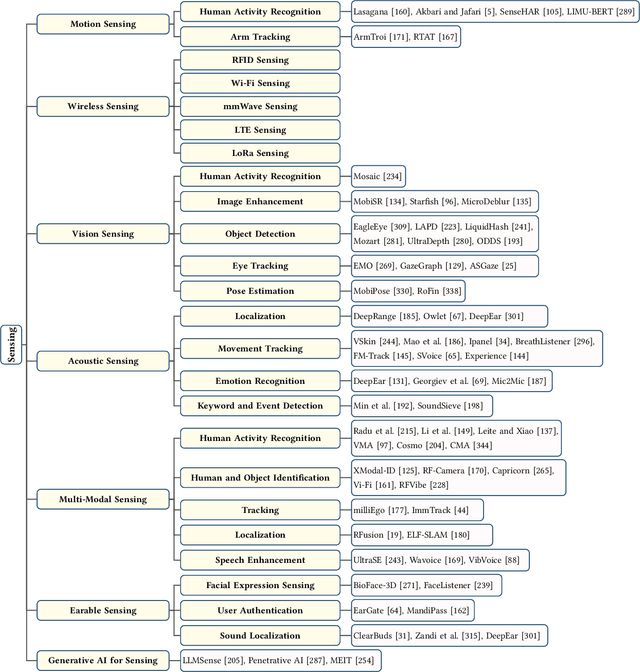
The integration of the Internet of Things (IoT) and modern Artificial Intelligence (AI) has given rise to a new paradigm known as the Artificial Intelligence of Things (AIoT). In this survey, we provide a systematic and comprehensive review of AIoT research. We examine AIoT literature related to sensing, computing, and networking & communication, which form the three key components of AIoT. In addition to advancements in these areas, we review domain-specific AIoT systems that are designed for various important application domains. We have also created an accompanying GitHub repository, where we compile the papers included in this survey: https://github.com/AIoT-MLSys-Lab/AIoT-Survey. This repository will be actively maintained and updated with new research as it becomes available. As both IoT and AI become increasingly critical to our society, we believe AIoT is emerging as an essential research field at the intersection of IoT and modern AI. We hope this survey will serve as a valuable resource for those engaged in AIoT research and act as a catalyst for future explorations to bridge gaps and drive advancements in this exciting field.
* Accepted in ACM Transactions on Sensor Networks (TOSN)