 Add to Chrome
 Add to Firefox
 Add to Edge
BrainFuse: a unified infrastructure integrating realistic biological modeling and core AI methodology
Jan 29, 2026
Neuroscience and artificial intelligence represent distinct yet complementary pathways to general intelligence. However, amid the ongoing boom in AI research and applications, the translational synergy between these two fields has grown increasingly elusive-hampered by a widening infrastructural incompatibility: modern AI frameworks lack native support for biophysical realism, while neural simulation tools are poorly suited for gradient-based optimization and neuromorphic hardware deployment. To bridge this gap, we introduce BrainFuse, a unified infrastructure that provides comprehensive support for biophysical neural simulation and gradient-based learning. By addressing algorithmic, computational, and deployment challenges, BrainFuse exhibits three core capabilities: (1) algorithmic integration of detailed neuronal dynamics into a differentiable learning framework; (2) system-level optimization that accelerates customizable ion-channel dynamics by up to 3,000x on GPUs; and (3) scalable computation with highly compatible pipelines for neuromorphic hardware deployment. We demonstrate this full-stack design through both AI and neuroscience tasks, from foundational neuron simulation and functional cylinder modeling to real-world deployment and application scenarios. For neuroscience, BrainFuse supports multiscale biological modeling, enabling the deployment of approximately 38,000 Hodgkin-Huxley neurons with 100 million synapses on a single neuromorphic chip while consuming as low as 1.98 W. For AI, BrainFuse facilitates the synergistic application of realistic biological neuron models, demonstrating enhanced robustness to input noise and improved temporal processing endowed by complex HH dynamics. BrainFuse therefore serves as a foundational engine to facilitate cross-disciplinary research and accelerate the development of next-generation bio-inspired intelligent systems.

Singular Value Decomposition on Kronecker Adaptation for Large Language Model
Jun 18, 2025Large pre-trained Transformer models achieve state-of-the-art results across diverse language and reasoning tasks, but full fine-tuning incurs substantial storage, memory, and computational overhead. Parameter-efficient fine-tuning (PEFT) methods mitigate these costs by learning only a small subset of task-specific parameters, yet existing approaches either introduce inference-time latency (adapter modules), suffer from suboptimal convergence (randomly initialized low-rank updates), or rely on fixed rank choices that may not match task complexity (Kronecker-based decompositions). We propose SoKA (SVD on Kronecker Adaptation), a novel PEFT strategy that combines Kronecker-product tensor factorization with SVD-driven initialization and spectrum-aware dynamic rank selection. Our Kronecker-Product SVD (KPSVD) procedure extracts principal components of the full weight update into compact Kronecker factors, while an adaptive rank selection algorithm uses energy-threshold and elbow-point criteria to prune negligible components. Empirical evaluation on LLaMA2-7B across arithmetic reasoning (GSM8K), formal mathematics (MATH), and code generation (MBPP) demonstrates that SoKA requires only 0.99M trainable parameters, 25% fewer than LoRA/PiSSA, while matching or exceeding baseline performance. Moreover, SoKA exhibits faster convergence and more stable gradients, highlighting its robustness and efficiency for large-scale model adaptation.
Pipelining Kruskal's: A Neuromorphic Approach for Minimum Spanning Tree
May 19, 2025Neuromorphic computing, characterized by its event-driven computation and massive parallelism, is particularly effective for handling data-intensive tasks in low-power environments, such as computing the minimum spanning tree (MST) for large-scale graphs. The introduction of dynamic synaptic modifications provides new design opportunities for neuromorphic algorithms. Building on this foundation, we propose an SNN-based union-sort routine and a pipelined version of Kruskal's algorithm for MST computation. The event-driven nature of our method allows for the concurrent execution of two completely decoupled stages: neuromorphic sorting and union-find. Our approach demonstrates superior performance compared to state-of-the-art Prim 's-based methods on large-scale graphs from the DIMACS10 dataset, achieving speedups by 269.67x to 1283.80x, with a median speedup of 540.76x. We further evaluate the pipelined implementation against two serial variants of Kruskal's algorithm, which rely on neuromorphic sorting and neuromorphic radix sort, showing significant performance advantages in most scenarios.
Hierarchical Macro Strategy Model for MOBA Game AI
Dec 19, 2018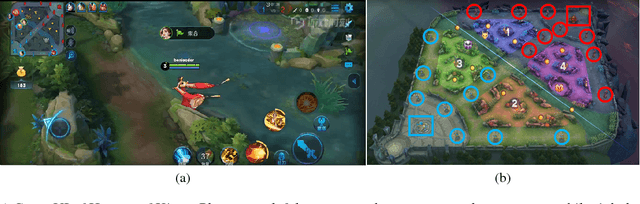
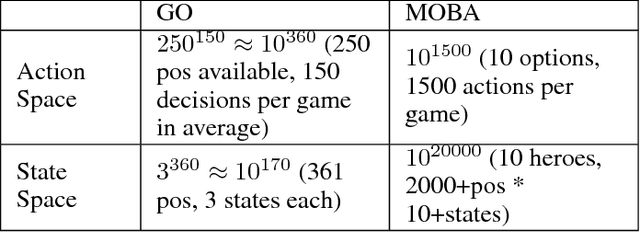
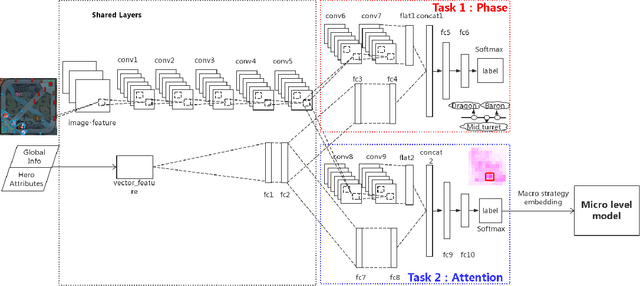
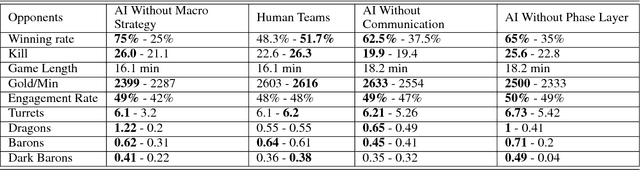
The next challenge of game AI lies in Real Time Strategy (RTS) games. RTS games provide partially observable gaming environments, where agents interact with one another in an action space much larger than that of GO. Mastering RTS games requires both strong macro strategies and delicate micro level execution. Recently, great progress has been made in micro level execution, while complete solutions for macro strategies are still lacking. In this paper, we propose a novel learning-based Hierarchical Macro Strategy model for mastering MOBA games, a sub-genre of RTS games. Trained by the Hierarchical Macro Strategy model, agents explicitly make macro strategy decisions and further guide their micro level execution. Moreover, each of the agents makes independent strategy decisions, while simultaneously communicating with the allies through leveraging a novel imitated cross-agent communication mechanism. We perform comprehensive evaluations on a popular 5v5 Multiplayer Online Battle Arena (MOBA) game. Our 5-AI team achieves a 48% winning rate against human player teams which are ranked top 1% in the player ranking system.