 Add to Chrome
 Add to Firefox
 Add to Edge
ConLA: Contrastive Latent Action Learning from Human Videos for Robotic Manipulation
Jan 31, 2026
Vision-Language-Action (VLA) models achieve preliminary generalization through pretraining on large scale robot teleoperation datasets. However, acquiring datasets that comprehensively cover diverse tasks and environments is extremely costly and difficult to scale. In contrast, human demonstration videos offer a rich and scalable source of diverse scenes and manipulation behaviors, yet their lack of explicit action supervision hinders direct utilization. Prior work leverages VQ-VAE based frameworks to learn latent actions from human videos in an unsupervised manner. Nevertheless, since the training objective primarily focuses on reconstructing visual appearances rather than capturing inter-frame dynamics, the learned representations tend to rely on spurious visual cues, leading to shortcut learning and entangled latent representations that hinder transferability. To address this, we propose ConLA, an unsupervised pretraining framework for learning robotic policies from human videos. ConLA introduces a contrastive disentanglement mechanism that leverages action category priors and temporal cues to isolate motion dynamics from visual content, effectively mitigating shortcut learning. Extensive experiments show that ConLA achieves strong performance across diverse benchmarks. Notably, by pretraining solely on human videos, our method for the first time surpasses the performance obtained with real robot trajectory pretraining, highlighting its ability to extract pure and semantically consistent latent action representations for scalable robot learning.

FinLMM-R1: Enhancing Financial Reasoning in LMM through Scalable Data and Reward Design
Jun 16, 2025Large Multimodal Models (LMMs) demonstrate significant cross-modal reasoning capabilities. However, financial applications face challenges due to the lack of high-quality multimodal reasoning datasets and the inefficiency of existing training paradigms for reasoning enhancement. To address these issues, we propose an integrated framework, FinLMM-R1, combining an automated and scalable pipeline for data construction with enhanced training strategies to improve the multimodal reasoning of LMM. The Automated and Scalable Pipeline (ASP) resolves textual-visual misalignment in financial reports through a separate paradigm of question-answer generation and image-question alignment, ensuring data integrity and extraction efficiency. Through ASP, we collect 89,378 aligned image-question pairs from 23,397 financial reports, covering tasks such as arithmetic reasoning, statistics reasoning, financial explanation, and financial knowledge. Moreover, we introduce the Thinking with Adversarial Reward in LMM (TAR-LMM), extending the prior two-stage training framework [1] with additional reward mechanisms. In the first stage, we focus on text-only tasks with format and accuracy rewards to guide the model in generating well-structured thinking contents. In the second stage, we construct multi-image contrastive samples with additional reward components including image selection, thinking content length, and adversarial reward to jointly optimize the LMM across visual perception, reasoning efficiency, and logical coherence. Extensive experiments on 7 benchmarks show ASP-derived dataset and training framework significantly improve answer accuracy and reasoning depth over existing reasoning LMMs in both general and financial multimodal contexts.
Creation-MMBench: Assessing Context-Aware Creative Intelligence in MLLM
Mar 19, 2025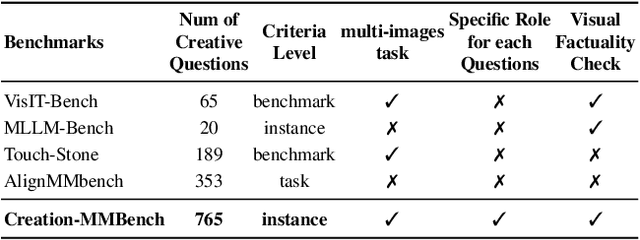
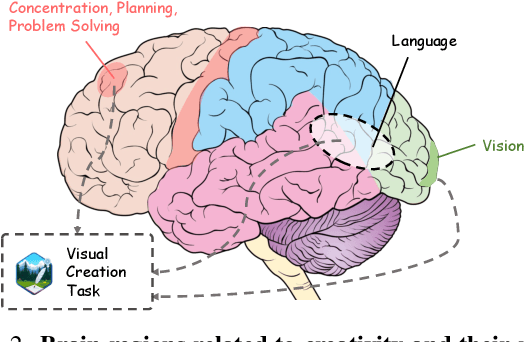
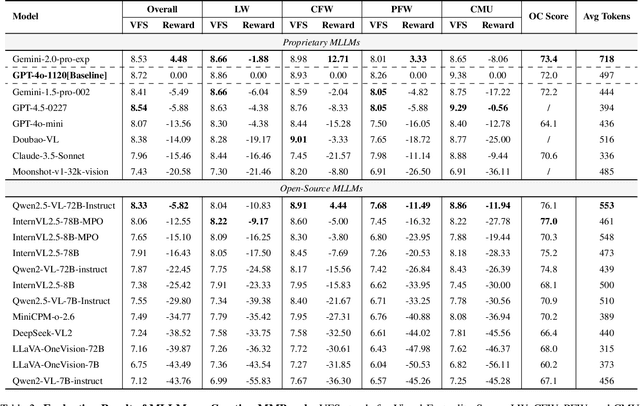

Creativity is a fundamental aspect of intelligence, involving the ability to generate novel and appropriate solutions across diverse contexts. While Large Language Models (LLMs) have been extensively evaluated for their creative capabilities, the assessment of Multimodal Large Language Models (MLLMs) in this domain remains largely unexplored. To address this gap, we introduce Creation-MMBench, a multimodal benchmark specifically designed to evaluate the creative capabilities of MLLMs in real-world, image-based tasks. The benchmark comprises 765 test cases spanning 51 fine-grained tasks. To ensure rigorous evaluation, we define instance-specific evaluation criteria for each test case, guiding the assessment of both general response quality and factual consistency with visual inputs. Experimental results reveal that current open-source MLLMs significantly underperform compared to proprietary models in creative tasks. Furthermore, our analysis demonstrates that visual fine-tuning can negatively impact the base LLM's creative abilities. Creation-MMBench provides valuable insights for advancing MLLM creativity and establishes a foundation for future improvements in multimodal generative intelligence. Full data and evaluation code is released on https://github.com/open-compass/Creation-MMBench.